Strong Local Economy : Development News
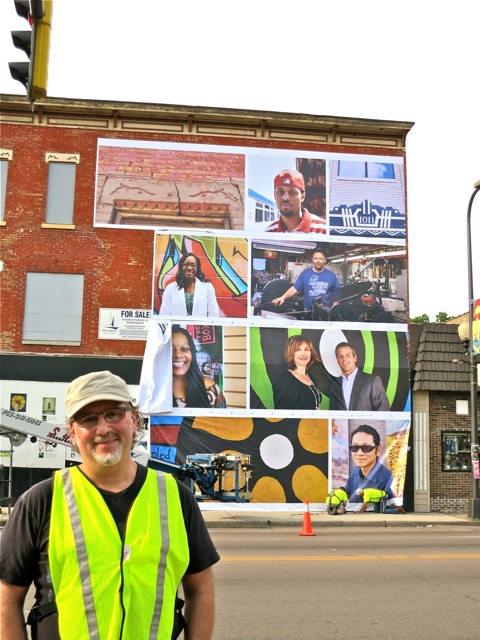
Last weekend, a vacant building at 1001 West Broadway Avenue in North Minneapolis was turned into a large-scale work of art.
A bold vinyl wrap featuring photographic images from the neighborhood wraps around two sides of the three-story building.
The project kicks off the FLOW Art Crawl, an annual event since 2006 that’s running this weekend with more offerings than in previous years.
Many different galleries, studios, theaters, and other spaces are a part of the art crawl, which stretches down West Broadway, from the Mississippi River to Penn Avenue North, according to art crawl materials. This includes a Caribbean cultural "masquerade parade" and a mini-Open Streets event in partnership with the Minneapolis Bike Coalition. Open Streets allows for bicyclists and pedestrians to freely wander North 2nd Street.
Dudley Voigt, FLOW’s artistic director, says that each year during the event, “We have made a piece of public art that lasted beyond the event.”
The three-story building can’t be occupied at this time, “but that doesn’t mean it can’t be showcased,” she says.
FLOW, along with the West Broadway Business and Area Coalition, collaborated with the city, which owns the building, to “figure out a way to wrap it, to use art on a larger scale and amplify what we’ve been doing for a long time,” she says.
The project expands on the city’s façade improvement efforts and the coalition’s work around business recruitment, corridor marketing and creative placemaking, a prepared statement from the city reads.
The guerilla-style photos that characterize the vinyl wrap, which Armour Photography, owned by Jake Armour, shot in June, feature area business owners, organization leaders, artists, architectural elements of the corridor and more.
“What’s great about this is that you can drive by it and see it anytime. It’s a celebration of the great things happening on the North Side everyday,” she says.
A number of other North Side buildings have also gotten an artistic makeover. “Public art makes any space look good,” on both the inside and outside, Voigt says. At times, this type of public artwork has even led to a building or another space being rented or purchased. “We see that story playing out over and over again, the intersection of art and commerce,” she says.
Meanwhile, the vinyl wrap is expected to last several years. “The city and the community want to see the building occupied before the banner fades,” says Voigt.
Source: Dudley Voigt, artistic director, FLOW
Writer: Anna Pratt

The Minnesota Beer Activists group is planning a community garden centered exclusively on hops, which are used to flavor beer.
Andrew Schmitt, the group’s executive director, saw a need for fresh, locally sourced hops. “I thought, ‘why not have a garden dedicated to just hops, which the community can use?’” he says. “We have a great community of home brewers in Minnesota and this is one way we can help with that.”
He knows of no other community hops gardens in the country. The Minnesota Beer Activists worked with Hennepin County to find a spot for the garden. They setled on a lot at the corner of East 38th Street and Dight Avenue in Minneapolis’s Longfellow neighborhood.
Besides turning a vacant space into a productive one, the garden dovetails with several local breweries. “It brings neighbors together and they can share something they have in common,” he says.
The Minnesota Beer Activists plans to run the hops garden cooperatively. People can sign up to take part in much the same way that they would in any other community garden, collectively maintaining it, he says.
To help get it up and running, Hippity Hop Farms in Forest Lake is donating hop plants and trellises, which cuts down on the group’s overhead costs, he says. Schmitt hopes to track down some rain barrels as well.
The garden will start out by planting Cascade hops, which are “great all around for making beer, in terms of taste and aroma,” he says, adding, “As things progress, we may look at some other styles.”
Schmitt plans to edge the garden with wheat and barley. He also wants to set up a bench to create a park-like feel, he says.
By October, the garden should have its first harvest. The hops will be good for home brewers and cooking enthusiasts alike.
He hopes to make the garden the “leading edge of what could be a movement,” inspiring other community hops gardens in the area, and beyond.
Source: Andrew Schmitt, executive director, Minnesota Beer Activists
Writer: Anna Pratt
To flesh out its in-progress street design manual that’s part of a broader plan, St. Paul is holding a photo contest of “street elements" that can be found throughout the city.
The manual will provide "a clear framework for street design processes,” according to city information. Community members can help add to the manual with snapshots of “street elements,” which include sidewalks, benches, crosswalks, bike racks and lanes, boulevard trees, outdoor cafes, and more.
The contest, which has an Aug. 1 deadline, is open to anyone, from the amateur to the professional photographer, according to Anton Jerve, a city official who is leading the charge. Contest rules, along with a lengthy list of “street elements,” sample photos and image requirements can be found on the city’s website. Some people may even be able to use their smartphones, depending on how good their cameras are, he says.
The contest is a creative way to get the public involved in the digital manual, which will see plenty of use from city planners, he says. “This is an opportunity for people to go out and take photos and help us customize the manual,” he says, adding, “It showcases the good things we’re already doing.”
This will contribute to the city's Complete Streets Plan, which is all about street design that takes into consideration “the needs of all street users, of all ages and abilities,” city materials state. The manual will “talk about how we can bring the street elements all together to design a complete or balanced street,” Jerve says.
Part of what makes it helpful is that “People will take photos of places they like. It gets people out and about and thinking about the streets, and the relationship between what we’re calling something in the manual and how it’s functioning,” he says.
Source: Anton Jerve, city of St. Paul
Writer: Anna Pratt
Heyday, a new restaurant coming to Minneapolis's Uptown neighborhood, has big plans to transform the space once occupied by the former Sunny Side Up Café and an adjacent Laundromat.
Lorin Zinter, a principal of Heyday whose partner is chef Jim Christiansen, says the pair scouted out lots of restaurant spaces all over the city for several years before settling on this location. They’re fans of Uptown, which is ideally situated “so close to single-family homes, condos, apartments and other great businesses. It was a great fit for us.”
To make way for Heyday, the concept for which they’re still developing, the pair is planning a dramatic renovation of the space. The building will take on a whole new look and feel, he says.
For starters, they’ll be removing the exterior siding and installing new windows and doors, while the interior will be brought down to the floorboards and studs. “We’ll start from scratch and it’ll be open, extending up to the ceiling,” he says, adding, “I love the original exposed hardwood ceilings.”
Natural materials will characterize the place, while local artist Terrence Payne, founder of the Rosalux Gallery, will create an original piece that will lend plenty of personality to one interior wall. “We’re excited to work with him. He’s immensely talented. We want to use local artists, so visitors can see and feel the impact of people in Minneapolis within the restaurant,” Zinter says.
A bar and lounge will take up close to half of the space, while the restaurant portion will fill out the remainder of the nearly 4,600-square-foot area, he says.
Even though Zinter and Christiansen have a background in fine dining, “We don’t want it to be only a special-occasion place. We want it to be a place in the neighborhood where people feel free to walk down anytime.”
Construction will start in mid-July, while the restaurant aims to open in December.
“I think there’s such a great food scene already on Lyndale, and it’s building nicely. We want to contribute to that and make this part of the city that much more fun and enjoyable,” he says.
Source: Lorin Zinter, co-owner, Heyday
Writer: Anna Pratt
Urban Growler Brewing, a small packaging microbrewery with a taproom, is in the works for a vintage brick building in St. Paul's St. Anthony Park neighborhood. The place is hosting an open house this Friday and Saturday.
Although the 6,200-square-foot warehouse space still has a ways to go before the brewing can happen, the event is a chance to learn more about Urban Growler or to become a member, according to brewer and co-founder Deb Loch.
Loch, whose business partner is Jill Pavlak, says the women-run brewery’s mission is to "bring people together through beer." Also, they want to make craft beer more accessible to women. Although beer brewing is male-dominated, long ago in the brewing tradition, “It was a woman’s job,” Loch says.
Right now, the brewery is fundraising to build out the space. That includes installing the right equipment for the brewing process. Besides that, “We have to make sure the structural integrity is there to hold the weight of the tanks,” she says.
The brewery plans to make traditional and specialty beers, while its “Plow to Pint” series will include local ingredients. “We’ll be partnering with local farmers and bringing out their story,” and some customers might act as “specialty suppliers,” too, she says. The brewery will have a “kitchen where a small but delicious menu of food that goes with beer will be made. We hope to have a local twist for that as well."
Its ambiance will be “warm industrial,” according to Loch. “We hope it becomes a community gathering spot,” she says, adding, “We envision this area becoming the next Northeast Minneapolis,” brewery-wise.
The place joins a growing list of local breweries springing up in the area, including Bang Brewing Co., Burning Brothers Brewing and Surly Brewing Co. “Craft beer is growing like crazy in the Twin Cities,” she says.
She hopes that the neighborhood “becomes a destination for people outside the area. “There’s a lot of interest in beer out there and there’s plenty of room for everyone.”
Source: Deb Loch, co-founder and brewer, Urban Growler Brewing
Writer: Anna Pratt
Before the Kosama Body Transformation fitness studio moved into Laurel Village, a downtown Minneapolis apartment complex, the 4,000-square-foot space had been vacant for over a decade.
Jake Madrinich, who owns the local Kosama, says, “I was able to come in and work with the landlord, who wanted there to be an amenity for people in the building.”
From the outset, Madrinich had been looking to bring the fitness studio to the neighborhood because “This area is starting to change and grow,” he says. Plus, the central location offers “great visibility,” and it’s easy for downtown commuters to stop in before or after work.
Even though gym memberships tend to wane in the warmer months, Kosama, which opened six months ago, continues to grow its clientele, says Madrinich. The fitness studio stands out for its group dynamic, he says.
While people work out in a group, their heart rate is being monitored, with a display on a TV. This fosters a healthy level of competition. “Nobody wants to be last on the heart rate monitor,” according to Madrinich.
It may sound counterintuitive, but in a group setting, where everyone is trying to meet various fitness goals, “Self-consciousness goes away and we get down to getting results,” Madrinich says. “We’re helping people with lifestyle changes and making fitness a part of their life.”
“Even though it’s in a group setting, we provide individual feedback,” he says, adding that people receive an email afterward telling them how many calories they burned along with other infoirmation.
Beyond fitness, “I really hope we can become a focal point within the community, where people can get to know their neighbors,” Madrinich says.
Source: Jake Madrinich, owner, Kosama
Writer: Anna Pratt
The recently formed Women on Bikes Saint Paul, an advocacy group that aims to get more women biking around the city, is looking for a full-time community organizer to lead the way. (See the job posting here.)
The group hopes to fill the position by early July, according to Jessica Treat, the executive director at St. Paul Smart Trips, its umbrella organization.
The idea behind the initiative is to “advance the political will in St. Paul” as it pertains to bicycling. “We want to turn out a coalition of women, including women with kids, for bicycling issues,” she says. “It’s about livability.”
Treat is a co-founder of the group along with Amber Dallman and Samantha Henningson. All of them are avid bicyclists.
The idea for the group came out of a grassroots process to get a bike boulevard on Charles Avenue, from North Aldine Street to Park Street. It was a success, but it took quite a bit of effort to turn out women and families. “That was eye-opening to the three of us involved,” Treat says. “We said, ‘what would it take to turn out that voice repeatedly?’”
The “percentage of women on bikes is a lot lower,” than it is for men, she says, adding, “There are real reasons for that.”
A recent survey from St. Paul Smart Trips of over 200 women in the city showed that safety is a major concern when it comes to biking, especially for those with children, she says. “It’s not that there aren’t sympathetic men, but women with families are a powerful constituency that needs to be heard."
The group’s next step is to pull together a group of spokeswomen from each city ward, who would be responsible for connecting with local politicians. Soon, the group will also organize an advisory body of some sort, to “help us decide what to focus on,” she says.
Some areas of the city have little to no bicycle infrastructure. “We need to have some conversations about trade-offs, what are the priorities,” she says. “We need to start talking about why biking and having a bike-supportive city is important to business in St. Paul, and attracting talent and young people.”
Source: Jessica Treat, executive director, St. Paul Smart Trips
Writer: Anna Pratt
The Buttered Tin, a new bakery/restaurant, is slated to open in St. Paul’s Lowertown neighborhood later this month.
The place has a $10,000 Kickstarter fundraising campaign underway, for which it needs $2,000 to reach its goal by next week.
Jennifer Lueck, who co-owns the place with her business partner, Alicia Hinze, says the money will help get the bakery up and running. She hopes the campaign gets community members to take ownership of the bakery/restaurant right away, too.
The pair focused on this neighborhood because “We knew it was a need. There’s nothing like it in that area,” Lueck says. Lowertown “seems like it’s right on the verge of exploding with light rail and the new stadium coming. It feels like a good time to get in and establish ourselves,” early, she says.
The space previously housed a sub shop but had been vacant for a number of years. It had a good floor plan already, with space for 45 seats inside plus outdoor dining for 20 patrons. “We didn’t have to do a major renovation or construction,” Lueck says.
Instead, they mainly reimagined the look of the space, and created an open kitchen, so people can see the food as it's prepared. "We think it’s important that people feel connected to their food,” she says.
The partners want the café to be a comfortable neighborhood gathering place. “We feel we’re contributing to the neighborhood,” Lueck says. To create that feel, the space has ceiling tiles, dark wood, “a cool floor that’s really durable,” and reclaimed marble from the historic Foshay Tower in downtown Minneapolis, which makes for a unique countertop. “Aesthetically, it’s traditional or classic. That’s what our aim is for the interior."
It’s been fun to see the elements she and Hinze picked out a year ago falling into place, says Lueck. “We’re so excited. It turned out beautifully,” she says.
Source: Jennifer Lueck, co-owner, The Buttered Tin
Writer: Anna Pratt
The Midtown Greenway, a 5.5-mile biking and walking trail in South Minneapolis, is too dark in some places.
This was a key concern raised by the Midtown Greenway Coalition’s crime-prevention task force, which recently studied the Greenway’s safety, according to Soren Jensen, who leads the organization. Jensen says the coalition’s Trail Watch, a volunteer group of bicyclists who patrol the Greenway nightly, tries to keep an eye on things.
But the group has been working to go beyond that to ensure safety along the path. “We wanted to see if we could come up with more ways to keep crime low in the Greenway,” he says. That’s what led the organization to form the crime-prevention task force a number of months ago.
To evaluate conditions along the Greenway, the task force members, armed with light meters, went out one night “measuring the amount of light in the corridor,” he says.
In the end, they found too many shady spots, going by national trail standards, he says. Of particular concern are “very dark stairs and ramps,” at some points along the trail.
Although the Greenway has a low crime rate, "When there have been late-night muggings, they have tended to be near the dark stairways.”
To get a better handle on the situation, the task force produced a Google map; it’s an internal document that pinpoints the worst places along the Greenway, in order of priority, he says. Soon, the coalition hopes to see more lighting installed and signage that lets people know they’re under surveillance on the Greenway.
“We have prioritized about 15 sites so far, mostly between Interstate 35W and Hiawatha Avenue, and will continue to roll out our rankings of dark spots as the city moves to fix them,” he says.
Source: Soren Jensen, executive director, Midtown Greenway Coalition
Writer: Anna Pratt
ReUse Minnesota, a new nonprofit trade association, promotes reuse as a more efficient alternative to recycling. The group hopes to keep items that are still useful in circulation, and not in landfills, according to ReUse information.
Anna Arkin, the organization’s coordinator, says the membership-based group is for “any sort of business that expands the life of a product through reuse or repair,” or an individual or nonprofit agency working in this capacity.
While most people recycle, reuse is “preferred environmentally,” she says. Reuse can shrink one’s ecological footprint by cutting down on “new purchases which require virgin raw materials and energy,” a prepared statement reads.
Thrift stores, secondhand bookstores, electronics repair and consignment, and architectural salvage shops are just a few examples of businesses working in this area, Arkin says.
However, there’s a lack of consumer awareness on this front, she adds.
Although the association has already begun recruiting members, the group is hosting an official launch event on June 26 at the Summit Brewery in St. Paul.
The group is an outgrowth of the local chapter of the national Reuse Alliance. In 2012, members decided to create a separate organization “to focus on promoting and facilitating reuse at the state level, rather than the national, level,” a prepared statement reads.
Already, the organization has pulled together a variety of local businesses, government organizations, and individuals dealing in the reuse, rental, or repair sector. ReUse Minnesota is also working with the Minnesota Pollution Control Agency to document the impact of reuse. “The goal is to make reuse happen, so we create a stronger reuse community,” Arkin says.
Source: Anna Arkin, coordinator, ReUse Minnesota
Writer: Anna Pratt
In April, the St. Paul City Council gave the go-ahead to the parks department to enter into a development agreement with Frogtown Gardens.
The agreement lays out the next steps to make the five-acre urban agriculture demonstration site a reality. Frogtown Gardens “will encourage residents to start their own backyard gardens and will promote healthier eating habits,” a prepared statement reads.
The land for the garden once belonged to the Wilder Foundation, which has since moved its offices. St. Paul is working with the Trust for Public Land to acquire the property this year, according to St. Paul information. In the meantime, the trust is trying to raise the $3.45 million needed to buy the land and to jumpstart development and programming.
Mike Hahm, who leads the parks department, says the development agreement with Frogtown Gardens helps flesh out those details. “It’s the next important step to bring this thing to life,” he says. Frogtown Gardens speaks directly to a need for parkland in the neighborhood, a need that the parks department identified a while ago.
As a part of the project, more than half of the property will become public parkland. “We’re super excited about the project. It hits on so many priority issues for Frogtown and St. Paul as a community,” Hahm says. It goes without saying, he adds, that parkland “is important for the community for so many reasons.” Parkland contributes to sustainability and livability, both of which are big goals for the city, he says.
Another part of the acreage will be used for growing fruits and vegetables. “The city is facilitating the partnership between the Frogtown Gardens group and the public, which will own the land,” he says.
Frogtown Gardens is an example of a community-driven effort. “It was the community that raised its hand repeatedly and said it had a vision for this property as a park and an urban agricultural center,” Hahm says, adding, “It caught the attention of various officials and captured the imagination of others in the community.”
Source: Mike Hahm, director, St. Paul Parks
Writer: Anna Pratt
Last week, Megabus, which offers low-cost intercity travel by bus, rolled out a St. Paul bus stop.
The stop, which can be found in the Midway Shopping Center’s parking lot, is only blocks away from the coming Central Corridor light rail transit station on Snelling Avenue.
Mike Alvich, the vice president of marketing and public relations for Megabus and Coach USA, says St. Paul is a natural connection for the bus service. “We always felt that St. Paul was a place where we should have service,” though the company began conservatively, he says.
Megabus, which began in Britain and expanded into the U.S. in 2006, also has a downtown Minneapolis bus stop, near the Metrodome and a Hiawatha light rail transit station.
Megabus operates in 100 U.S. cities out of a dozen hubs nationwide, with Chicago being its first. “It’s been very exciting,” Alvich says, adding that the company just reached a milestone of 25 million customers.
In general, Megabus attracts an interesting mix of people, including small groups taking day trips, businesspeople and seniors, with students and young professionals accounting for the largest group of riders. “St. Paul fits the mold for us,” he says, adding, “The community fits the demographic.” Additionally, Greyhound buses have discontinued service in St. Paul, he says.
While the Megabus service helps connect the city to other areas across the Midwest, “For those traveling into the city, it adds to the city’s economy,” he says. Part of the draw of Megabus is that fares can be as low as $1, while the buses are “state-of-the-art double-decker buses with wifi outlets and electrical outlets.".
Something he’s found from the company’s social networking activity is that “we provide more than just transportation. We provide the ability for people to do the things they love."
Source: Mike Alvich, vice president of marketing and public relations for Megabus and Coach USA
Writer: Anna Pratt
Last year, the Soo Visual Arts Center opened a temporary pop-up shop in a vacant storefront space in Minneapolis’s Lyndale neighborhood, as a sort of experiment.
The place, which it calls Soo Local, has turned out to be so successful that the gallery has decided to stick with it in the long term, according to Carolyn Payne, who heads the gallery.
Kim Bartmann, who owns the nearby Pat's Tap and other local restaurants, rents the space to the gallery, Payne says.
When it became available, Soo Visual Arts jumped at it. Despite a strong arts community in the area, “There aren’t a lot of visual art spaces that highlight locals,” she says.
Already, Soo Local has helped the gallery to broaden its reach, and work with a larger, more diverse pool of artists. The place has featured 200 artists since November of 2012. “It’s amazing, that’s sometimes what we show in one year at Soo Visual Arts,” says Payne.
She characterizes the place as a “more spontaneous, experimental space. We can do things quicker that don’t fit into the exhibition schedule.”
The second location gives the gallery the chance to partner with other local groups, something it often didn’t have the space or time to do in the past. SooLocal is “a way for us to do even more programming within the community.”
It’s also a venue for exploring new ideas from artists, often those who don’t have gallery experience, she says. In those cases, SooLocal is able to help people with everything from installing a professional-level show to writing press releases.
She’s been pleasantly surprised by the enthusiasm for SooLocal. In April, the place was so full for a performance by artist Jaime Carrera that she had to turn people away from the doors, she says.
“Tons of people walk in. It has a neighborhood vibe, with lots of families, artists, and non-artists coming in,” she says. “It’s been really fun and we’ve met a lot of people.”
Now, she’s hoping that SooLocal can secure more funding for regular hours, upgrades to the space, and an internship program.
Source: Carolyn Payne, SooLocal
Writer: Anna Pratt
The Hub bike cooperative opened its fourth location on April 26, alongside Spokes, an organization that offers an open bike shop and community classes.
Spokes opened in Minneapolis's Seward neighborhood last fall. The two bike businesses are in a building that previously housed an Islamic cultural center and a machine shop, according to Sheldon Mains, who works with Spokes.
“Having both facilities together helps bring together everything someone needs to start biking,” he says.
This collaboration came together thanks to the work of a handful of partners, including Cycles for Change, The Hub, Seward Neighborhood Group and Seward ReDesign, which all worked together to make the place a reality.
At this location, The Hub is selling used bikes, bike parts and accessories, he says.
However, The Hub won’t be repairing bikes. That’s because Spokes helps people to do that themselves, Mains explains. “What we do is shoulder-to-shoulder training,” he says. “Mechanics help and walk people through the process, even if they’ve never done it before.”
Between the open workshop and the retail side, “It’s a great symbiotic relationship,” he says.
This summer, the place hopes to offer a kind of lending library, where people can “check out” a bike for a defined period. That might appeal to people who aren’t ready to buy a bike yet, he says.
The idea is to get more people biking and walking, especially the local immigrant community. Spokes has already hosted a number of successful biking classes, including one that focused on navigating busy streets. “We’re using any ideas that we can come up with to get people more active,” and to use biking as a mode of transportation and for exercise and recreational purposes, he says.
Source: Sheldon Mains, Spokes
Writer: Anna Pratt
Art Materials, which has had a longstanding presence in Minneapolis’s Uptown neighborhood, recently underwent a remodel and added a Northeast location.
Both projects unfolded simultaneously, according to Larry Brown, who co-owns the business with his wife, Joanne. In fact, many of the finishing touches on the remodel of its Lyndale store were still being made this week.
At one point, the store had considered relocating from Lyndale, but after putting the project on hold for a year, “We discovered in that year that Uptown had turned into a veritable beehive of building activity,” with lots of new apartments, restaurants and more. “It was a highly desirable place to be.”
So, after deciding to stay put, “We felt the building needed to be rehabbed,” he says.
The renovation process opened up the space in the vintage building, which had once served as a creamery with an attached garage. Higher ceilings and concrete floors came to light, while lighting fixtures were upgraded, which is important in a store that sells paint colors, he says, adding, “It has a softer and more pleasing look.”
A colorful mural reflecting various aspects of the city, something the store didn’t have room for before, brings a nice contrast to the gray walls, he says.
Later on, the store hopes to give the exterior a facelift, too, he says.
The art-supply store had long wanted to open a Northeast location, to serve the city’s Arts District. “There’s been a void in the area for the things we do and we see it as something to capitalize on,” he says.
Art Materials was able to settle into an industrial space in Northeast, which has a funkier look.
Both stores are destination places, as is a third location in Fargo, North Dakota.
“We have succeeded in changing the face of our business in Minneapolis to be something different and better than what it was,” Brown says.
Source: Larry Brown, co-owner, Art Materials
Writer: Anna Pratt