creative leadership : Development News
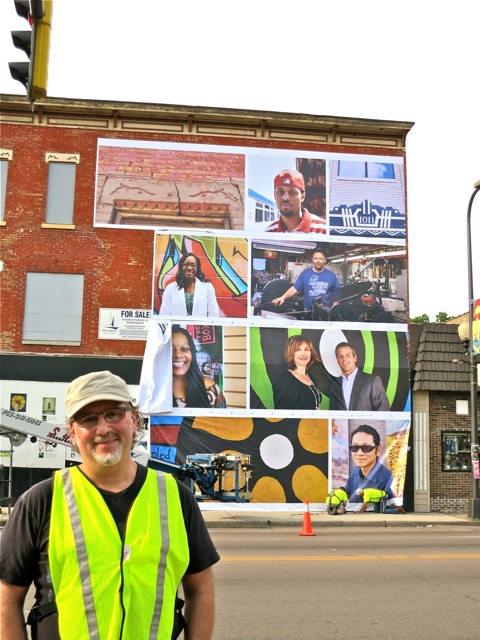
Last weekend, a vacant building at 1001 West Broadway Avenue in North Minneapolis was turned into a large-scale work of art.
A bold vinyl wrap featuring photographic images from the neighborhood wraps around two sides of the three-story building.
The project kicks off the FLOW Art Crawl, an annual event since 2006 that’s running this weekend with more offerings than in previous years.
Many different galleries, studios, theaters, and other spaces are a part of the art crawl, which stretches down West Broadway, from the Mississippi River to Penn Avenue North, according to art crawl materials. This includes a Caribbean cultural "masquerade parade" and a mini-Open Streets event in partnership with the Minneapolis Bike Coalition. Open Streets allows for bicyclists and pedestrians to freely wander North 2nd Street.
Dudley Voigt, FLOW’s artistic director, says that each year during the event, “We have made a piece of public art that lasted beyond the event.”
The three-story building can’t be occupied at this time, “but that doesn’t mean it can’t be showcased,” she says.
FLOW, along with the West Broadway Business and Area Coalition, collaborated with the city, which owns the building, to “figure out a way to wrap it, to use art on a larger scale and amplify what we’ve been doing for a long time,” she says.
The project expands on the city’s façade improvement efforts and the coalition’s work around business recruitment, corridor marketing and creative placemaking, a prepared statement from the city reads.
The guerilla-style photos that characterize the vinyl wrap, which Armour Photography, owned by Jake Armour, shot in June, feature area business owners, organization leaders, artists, architectural elements of the corridor and more.
“What’s great about this is that you can drive by it and see it anytime. It’s a celebration of the great things happening on the North Side everyday,” she says.
A number of other North Side buildings have also gotten an artistic makeover. “Public art makes any space look good,” on both the inside and outside, Voigt says. At times, this type of public artwork has even led to a building or another space being rented or purchased. “We see that story playing out over and over again, the intersection of art and commerce,” she says.
Meanwhile, the vinyl wrap is expected to last several years. “The city and the community want to see the building occupied before the banner fades,” says Voigt.
Source: Dudley Voigt, artistic director, FLOW
Writer: Anna Pratt

The Minnesota Beer Activists group is planning a community garden centered exclusively on hops, which are used to flavor beer.
Andrew Schmitt, the group’s executive director, saw a need for fresh, locally sourced hops. “I thought, ‘why not have a garden dedicated to just hops, which the community can use?’” he says. “We have a great community of home brewers in Minnesota and this is one way we can help with that.”
He knows of no other community hops gardens in the country. The Minnesota Beer Activists worked with Hennepin County to find a spot for the garden. They setled on a lot at the corner of East 38th Street and Dight Avenue in Minneapolis’s Longfellow neighborhood.
Besides turning a vacant space into a productive one, the garden dovetails with several local breweries. “It brings neighbors together and they can share something they have in common,” he says.
The Minnesota Beer Activists plans to run the hops garden cooperatively. People can sign up to take part in much the same way that they would in any other community garden, collectively maintaining it, he says.
To help get it up and running, Hippity Hop Farms in Forest Lake is donating hop plants and trellises, which cuts down on the group’s overhead costs, he says. Schmitt hopes to track down some rain barrels as well.
The garden will start out by planting Cascade hops, which are “great all around for making beer, in terms of taste and aroma,” he says, adding, “As things progress, we may look at some other styles.”
Schmitt plans to edge the garden with wheat and barley. He also wants to set up a bench to create a park-like feel, he says.
By October, the garden should have its first harvest. The hops will be good for home brewers and cooking enthusiasts alike.
He hopes to make the garden the “leading edge of what could be a movement,” inspiring other community hops gardens in the area, and beyond.
Source: Andrew Schmitt, executive director, Minnesota Beer Activists
Writer: Anna Pratt
A mural in a skyway at downtown St. Paul’s Alliance Bank Center is encouraging all kinds of personal and profound reactions.
The mural, which spans a 36-foot-long construction barricade, has been designed to appear like an oversized chalkboard. Over and over, it contains the line, “Before I die I want to…” with space for 168 people to fill in the blanks.
Shawn Wiski, the property manager for the building, had seen a headline about New Orleans-based artist Candy Chang’s original project. It had to do with how the words, “Before I die I want to….” changed her life, she says.
Chang came up with the project after losing a close friend who’d been a mother figure to her. “She started reflecting on the rest of her life and what she wanted to do,” she says.
The artist took that line of thought and she wound up stenciling it on the exterior of a vacant, boarded-up house in New Orleans. “The response was phenomenal, so it’s been duplicated,” in cities all over the globe, she says.
Wiski thought about the skyway, where the “huge white construction wall calls out for something to be decorating it. It was an opportunity for something to go there that benefits others.”
St. Paul's "Before I die" mural is in an ideal spot, with plenty of pedestrian traffic. “It’s gone over far better than I could have expected. It’s had an overwhelming response,” Wiski says.
Within several hours of the mural’s unveiling in the skyway on July 8, the slots had been completely filled out. Since then, the answers have been erased and already it’s chock-full of answers once again. “It’s been cool to watch the people gather by it, read it, take pictures and write on it,” she says.
The mural will be up for a total of six weeks, as was another art project that came before it. “I just hope it’s an inspiration to all, that it helps everyone reflect on their life and the importance of what they can contribute,” she says.
The mural also offers a community-building exercise. “It teaches us about our fellow businessperson, resident, visitor, and more,” she says.
Many of the responses defy stereotypes, she says. People are “divulging a little bit of their inner self. So it’s personal.”
Source: Shawn Wiski, property manager, Alliance Bank Center
Writer: Anna Pratt
To flesh out its in-progress street design manual that’s part of a broader plan, St. Paul is holding a photo contest of “street elements" that can be found throughout the city.
The manual will provide "a clear framework for street design processes,” according to city information. Community members can help add to the manual with snapshots of “street elements,” which include sidewalks, benches, crosswalks, bike racks and lanes, boulevard trees, outdoor cafes, and more.
The contest, which has an Aug. 1 deadline, is open to anyone, from the amateur to the professional photographer, according to Anton Jerve, a city official who is leading the charge. Contest rules, along with a lengthy list of “street elements,” sample photos and image requirements can be found on the city’s website. Some people may even be able to use their smartphones, depending on how good their cameras are, he says.
The contest is a creative way to get the public involved in the digital manual, which will see plenty of use from city planners, he says. “This is an opportunity for people to go out and take photos and help us customize the manual,” he says, adding, “It showcases the good things we’re already doing.”
This will contribute to the city's Complete Streets Plan, which is all about street design that takes into consideration “the needs of all street users, of all ages and abilities,” city materials state. The manual will “talk about how we can bring the street elements all together to design a complete or balanced street,” Jerve says.
Part of what makes it helpful is that “People will take photos of places they like. It gets people out and about and thinking about the streets, and the relationship between what we’re calling something in the manual and how it’s functioning,” he says.
Source: Anton Jerve, city of St. Paul
Writer: Anna Pratt
Heyday, a new restaurant coming to Minneapolis's Uptown neighborhood, has big plans to transform the space once occupied by the former Sunny Side Up Café and an adjacent Laundromat.
Lorin Zinter, a principal of Heyday whose partner is chef Jim Christiansen, says the pair scouted out lots of restaurant spaces all over the city for several years before settling on this location. They’re fans of Uptown, which is ideally situated “so close to single-family homes, condos, apartments and other great businesses. It was a great fit for us.”
To make way for Heyday, the concept for which they’re still developing, the pair is planning a dramatic renovation of the space. The building will take on a whole new look and feel, he says.
For starters, they’ll be removing the exterior siding and installing new windows and doors, while the interior will be brought down to the floorboards and studs. “We’ll start from scratch and it’ll be open, extending up to the ceiling,” he says, adding, “I love the original exposed hardwood ceilings.”
Natural materials will characterize the place, while local artist Terrence Payne, founder of the Rosalux Gallery, will create an original piece that will lend plenty of personality to one interior wall. “We’re excited to work with him. He’s immensely talented. We want to use local artists, so visitors can see and feel the impact of people in Minneapolis within the restaurant,” Zinter says.
A bar and lounge will take up close to half of the space, while the restaurant portion will fill out the remainder of the nearly 4,600-square-foot area, he says.
Even though Zinter and Christiansen have a background in fine dining, “We don’t want it to be only a special-occasion place. We want it to be a place in the neighborhood where people feel free to walk down anytime.”
Construction will start in mid-July, while the restaurant aims to open in December.
“I think there’s such a great food scene already on Lyndale, and it’s building nicely. We want to contribute to that and make this part of the city that much more fun and enjoyable,” he says.
Source: Lorin Zinter, co-owner, Heyday
Writer: Anna Pratt
Thistle, an occasional shop that offers repurposed vintage furniture and other home accessories, opened in the historical Milton Square in St. Paul in May.
The space has had a variety of uses through the years, according to shop owner Heather O’Malley.
She describes the place as a “nice complement to the quirky building,” which dates back to 1909. It has a European feeling, with old-fashioned steps that lead down to the store. People can “overlook it from the street and down into my doorway. People love to peek over,” she says.
Although O’Malley made some cosmetic changes to the 800-square-foot space, “My type of furniture, quirky repurposed things, fits in well with this,” she says. To flesh that out a little more, she took away layers to expose old pipes and radiators.
O’Malley, who also has a set-design business, had always wanted to have a shop like this and she likes the neighborhood. As far as work goes, “I love to find things and change them up and make them into something else, give them a new life,” she says, adding, “I felt it was time for me to have a retail spot for it.”
So, when this space opened up, “It was the perfect opportunity,” and it makes sense for the neighborhood, too, which is characterized by older homes, she says.
Since the shop is only open for a limited time over the course of a month, “It’s not like a typical gift shop. It’s constantly changing,” with different merchandise all the time. “People feel like they’re on a scavenger hunt to find something no one else has discovered yet.”
The shop’s next sale dates go from July 11 to 14. (Check the website for further details.) “People get excited about seeing what comes next,” O'Malley says, adding, “There’s been some really interesting comments and good feedback so far.”
Source: Heather O’Malley, owner, Thistle
Writer: Anna Pratt
A new French-style bakery and bistro on Nicollet Mall in downtown Minneapolis is hosting its grand opening this Thursday.
The French Corner Bistro & Bakery, which had a soft opening earlier this month, offers a wide variety of baked goods, sandwiches, soups and salads, and wine.
Nadia Storchak, a co-owner of the place along with Vladimir Storchak and Chrystel Klein, says the bistro’s concept is comparable to that of the former Pardon My French restaurants. “It has a similar menu,” she says, adding, “We have a French chef from France. So, it’s not only in the name. We have real French foods.”
The bistro, which has 40 seats inside along with sidewal-café seating, brought about a dramatic makeover of the space, which once housed a bank. “We demolished everything that was here before and started again. It was a big project,” Storchak says.
Inside, the bistro has a French-inspired ambience, with an eye-catching chandelier and granite countertops. “It’s a transitional modern look,” she says.
The place fills a unique niche in the area. “It’s a big need for people living or working downtown. There are a lot of coffee shops, but no place to buy pastries,” she says. Already, the place has been busy. “It’s a great place just to spend time and hang out with friends,” Storchak says, adding, “We have the best macaroons in town. Everyone is saying they’re the best.”
French Corner Bistro & Bakery also helps bring business to the adjacent Dahl Pharmacy, which the Storchaks and Klein also own, she says.
In the future, the bistro hopes to add catering services along with boxed lunches. “We’re looking forward to seeing more customers,” says Storchak.
Source: Nadia Storchak, co-owner, French Corner Bistro & Bakery
Writer: Anna Pratt
As a survivor of the I-35W bridge collapse in Minneapolis in 2007, Lindsay Walz, a youth worker, turned to art for healing.
“I found myself through the artistic process and creativity. I could tell my story to myself in a different way,” she says.
That experience led her to open courageous heARTS, an arts-focused youth center at 4164 Cedar Ave. S. in Minneapolis. As a part of a soft launch this summer, the center has special drop-in hours for open studio use. The center is also helping plan community art projects in conjunction with the Standish Ericsson Neighborhood Association (SENA).
Walz, who has long wanted to open a youth center of her own, says courageous heARTS is a “space that’s safe, where youth can express themselves and get the gunk out,” adding, “It’s better if those feelings come out on paper or with words, whatever the case may be.”
The center is a place to explore those possibilities. “Maybe someone is an untapped writer or a dancer or a musician,” she says. “It’s not about being good at it, just doing it.”
Also, youth can learn from each other. “They don’t have to separate themselves,” and they can develop leadership skills through the youth advisory board and other opportunities, she says.
The space, formerly a convenience store that had sat vacant for some time, is an ideal location, according to Walz. She wanted to find a space in the neighborhood, where she lives, “so it would be community-based in the true sense of it,” she says. Plus, the neighborhood doesn’t have a lot of youth programming. “It was about making art and space accessible."
The center will probably occupy the 1,800-square-foot space for a couple of years and then move to another location, since the landlord has other plans for the building in the longer term. “I felt like it would be a good window to get the center off the ground,” Walz says.
At this time, she’s still looking for partners and volunteers to help make the place a success, while an Aug. 1 fundraiser includes a screening of the documentary “Inocente” at the Riverview Theatre.
“Anyone that’s interested we’d love to hear from,” whether that has to do with art or office work or another skill, she says. “We need a lot of helping hands to get off the ground. We want to be around for a long time. That’s the goal.”
Source: Lindsay Walz, courageous heARTS
Writer: Anna Pratt
Urban Growler Brewing, a small packaging microbrewery with a taproom, is in the works for a vintage brick building in St. Paul's St. Anthony Park neighborhood. The place is hosting an open house this Friday and Saturday.
Although the 6,200-square-foot warehouse space still has a ways to go before the brewing can happen, the event is a chance to learn more about Urban Growler or to become a member, according to brewer and co-founder Deb Loch.
Loch, whose business partner is Jill Pavlak, says the women-run brewery’s mission is to "bring people together through beer." Also, they want to make craft beer more accessible to women. Although beer brewing is male-dominated, long ago in the brewing tradition, “It was a woman’s job,” Loch says.
Right now, the brewery is fundraising to build out the space. That includes installing the right equipment for the brewing process. Besides that, “We have to make sure the structural integrity is there to hold the weight of the tanks,” she says.
The brewery plans to make traditional and specialty beers, while its “Plow to Pint” series will include local ingredients. “We’ll be partnering with local farmers and bringing out their story,” and some customers might act as “specialty suppliers,” too, she says. The brewery will have a “kitchen where a small but delicious menu of food that goes with beer will be made. We hope to have a local twist for that as well."
Its ambiance will be “warm industrial,” according to Loch. “We hope it becomes a community gathering spot,” she says, adding, “We envision this area becoming the next Northeast Minneapolis,” brewery-wise.
The place joins a growing list of local breweries springing up in the area, including Bang Brewing Co., Burning Brothers Brewing and Surly Brewing Co. “Craft beer is growing like crazy in the Twin Cities,” she says.
She hopes that the neighborhood “becomes a destination for people outside the area. “There’s a lot of interest in beer out there and there’s plenty of room for everyone.”
Source: Deb Loch, co-founder and brewer, Urban Growler Brewing
Writer: Anna Pratt
Before the Kosama Body Transformation fitness studio moved into Laurel Village, a downtown Minneapolis apartment complex, the 4,000-square-foot space had been vacant for over a decade.
Jake Madrinich, who owns the local Kosama, says, “I was able to come in and work with the landlord, who wanted there to be an amenity for people in the building.”
From the outset, Madrinich had been looking to bring the fitness studio to the neighborhood because “This area is starting to change and grow,” he says. Plus, the central location offers “great visibility,” and it’s easy for downtown commuters to stop in before or after work.
Even though gym memberships tend to wane in the warmer months, Kosama, which opened six months ago, continues to grow its clientele, says Madrinich. The fitness studio stands out for its group dynamic, he says.
While people work out in a group, their heart rate is being monitored, with a display on a TV. This fosters a healthy level of competition. “Nobody wants to be last on the heart rate monitor,” according to Madrinich.
It may sound counterintuitive, but in a group setting, where everyone is trying to meet various fitness goals, “Self-consciousness goes away and we get down to getting results,” Madrinich says. “We’re helping people with lifestyle changes and making fitness a part of their life.”
“Even though it’s in a group setting, we provide individual feedback,” he says, adding that people receive an email afterward telling them how many calories they burned along with other infoirmation.
Beyond fitness, “I really hope we can become a focal point within the community, where people can get to know their neighbors,” Madrinich says.
Source: Jake Madrinich, owner, Kosama
Writer: Anna Pratt
The recently formed Women on Bikes Saint Paul, an advocacy group that aims to get more women biking around the city, is looking for a full-time community organizer to lead the way. (See the job posting here.)
The group hopes to fill the position by early July, according to Jessica Treat, the executive director at St. Paul Smart Trips, its umbrella organization.
The idea behind the initiative is to “advance the political will in St. Paul” as it pertains to bicycling. “We want to turn out a coalition of women, including women with kids, for bicycling issues,” she says. “It’s about livability.”
Treat is a co-founder of the group along with Amber Dallman and Samantha Henningson. All of them are avid bicyclists.
The idea for the group came out of a grassroots process to get a bike boulevard on Charles Avenue, from North Aldine Street to Park Street. It was a success, but it took quite a bit of effort to turn out women and families. “That was eye-opening to the three of us involved,” Treat says. “We said, ‘what would it take to turn out that voice repeatedly?’”
The “percentage of women on bikes is a lot lower,” than it is for men, she says, adding, “There are real reasons for that.”
A recent survey from St. Paul Smart Trips of over 200 women in the city showed that safety is a major concern when it comes to biking, especially for those with children, she says. “It’s not that there aren’t sympathetic men, but women with families are a powerful constituency that needs to be heard."
The group’s next step is to pull together a group of spokeswomen from each city ward, who would be responsible for connecting with local politicians. Soon, the group will also organize an advisory body of some sort, to “help us decide what to focus on,” she says.
Some areas of the city have little to no bicycle infrastructure. “We need to have some conversations about trade-offs, what are the priorities,” she says. “We need to start talking about why biking and having a bike-supportive city is important to business in St. Paul, and attracting talent and young people.”
Source: Jessica Treat, executive director, St. Paul Smart Trips
Writer: Anna Pratt
The Buttered Tin, a new bakery/restaurant, is slated to open in St. Paul’s Lowertown neighborhood later this month.
The place has a $10,000 Kickstarter fundraising campaign underway, for which it needs $2,000 to reach its goal by next week.
Jennifer Lueck, who co-owns the place with her business partner, Alicia Hinze, says the money will help get the bakery up and running. She hopes the campaign gets community members to take ownership of the bakery/restaurant right away, too.
The pair focused on this neighborhood because “We knew it was a need. There’s nothing like it in that area,” Lueck says. Lowertown “seems like it’s right on the verge of exploding with light rail and the new stadium coming. It feels like a good time to get in and establish ourselves,” early, she says.
The space previously housed a sub shop but had been vacant for a number of years. It had a good floor plan already, with space for 45 seats inside plus outdoor dining for 20 patrons. “We didn’t have to do a major renovation or construction,” Lueck says.
Instead, they mainly reimagined the look of the space, and created an open kitchen, so people can see the food as it's prepared. "We think it’s important that people feel connected to their food,” she says.
The partners want the café to be a comfortable neighborhood gathering place. “We feel we’re contributing to the neighborhood,” Lueck says. To create that feel, the space has ceiling tiles, dark wood, “a cool floor that’s really durable,” and reclaimed marble from the historic Foshay Tower in downtown Minneapolis, which makes for a unique countertop. “Aesthetically, it’s traditional or classic. That’s what our aim is for the interior."
It’s been fun to see the elements she and Hinze picked out a year ago falling into place, says Lueck. “We’re so excited. It turned out beautifully,” she says.
Source: Jennifer Lueck, co-owner, The Buttered Tin
Writer: Anna Pratt
Youthlink, a nonprofit organization that provides services to homeless youth, is installing an original sculpture outside of its drop-in center in Minneapolis’s North Loop neighborhood.
The organization's Youth Opportunity Center is planning an official unveiling for the sculpture this summer, while the basic installation process will wrap up later this month, according to Francis Roen, director of development for YouthLink.
Youthlink worked with a partner at the center, the Kulture Klub Collaborative, a nonprofit organization that engages homeless youth through art, to come up with the piece. The sculpture is a creative solution to the center’s lack of “a visual marking for the space,” which is somewhat tucked away from view, she says.
Considering the fact that the center tries to help youth navigate various resources, “We were missing a key piece of that, as navigators, if we didn’t have a clear marking for this building,” she says.
The resulting piece from local artist Randy Walker, titled “Filling the Void,” is a permanent steel frame that allows for constant change. Like many other artworks at the center, the piece was “created hand-in-hand with young people,” she says. Youth at the center and other local artists will continue to put their stamp on it through time. The frame allows for everything from video projection to living vegetation, according to center materials.
In a prepared statement, Walker adds that the piece is symbolic in that “It provides a foundation, framework and opportunity for those who use it. It is full of potential. It is all about what you do with it.”
Ultimately, Roen hopes the piece conveys that the center is “youth-friendly and a place they can go to receive help.”
Source: Frances Roen, director of development, Youthlink
Writer: Anna Pratt
Doodle Bird Design + Gifts, which opened on May 10 in South Minneapolis, focuses on locally made goods.
Owner Kristin Knych, who is also a graphic designer, says she went that route because, “There’s so much talent out there, that I wanted space to showcase it.” She sells everything from soap to pottery from artists around the state. The store’s inventory also includes crafts from Knych, who describes herself as “a graphic designer by day and an avid crafter by night.”
To prepare the 550-square-foot space for the shop, she tore down a wall, installed new flooring, and gave the walls a fresh coat of paint.
The store’s look is “eclectic DIY chic,” she says, adding that most of the fixtures and furnishings came from thrift stores, garage sales, and the like. Many pieces have been repurposed. For example, one shelf is made out of old ladders.
Behind the storefront shop is Knych’s graphic design studio. In the past, she ran her graphic design business out of her home.
She happened upon the space by chance. Having driven past it many times, Knych, who lives nearby, knew the area had plenty of foot traffic. “I think it’s a very active corner. It has a strong neighborhood feel,” she says. “I felt it needed a little bit of retail to make it more competitive” with other areas around the city.
On a broader level, “I just want to promote local artists as much as I can,” she says. Having a shop that sources local artists and crafters is “a way to make more people aware of the talent we have around here.”
Source: Kristin Knych, owner, Doodle Bird Design + Gifts
Writer: Anna Pratt
Shelly Campbell, a local photographer, is interested in faces, especially those in her neighborhood.
That’s what inspired her to start her ongoing project “Faces of the West Side,” in late 2010. “I realized with the West Side, I don’t need to travel. I have the world at my fingertips,” she says.
Her color portraits of people in the neighborhood are part of a rotating exhibit at Jerabek’s New Bohemian, a coffee shop in St. Paul.
The photos reflect the neighborhood’s diversity, showing people of all ages, ethnicities, and income levels. Some are recognizable characters in the neighborhood, while others are people she might not have met otherwise.
Often, people get referred to her. At times, she’s had to find someone to act as an interpreter for non-English speakers. She’s found that “It’s a great way to get to know a lot of people on the West Side,” she says, adding, “I feel privileged. I never thought I’d get to meet or interact with so many.”
At this point, she’s even seeing some of the same people coming back for another photo, and she tries to document how they’ve changed.
In general, she looks for “images that say something about people,” and seeks the “real person.”
At the coffee shop, she usually displays about 10 photos at once, including some that have been blown up to poster size for more impact, she says. She changes the photos on a quarterly basis, so “Folks have four months of fame,” she says, adding, “Everyone comes in and sees them and they get all excited. The kids get a real trip out of it, which is fun.” In the end, “The photos belong to everyone in the room because it’s them,” she says.
Soon, she plans to apply for grant money to expand the project. “I’d like to do some interviewing or even audio recording during photo shoots,” she says.
Source: Shelly Campbell, photographer
Writer: Anna Pratt
The Midtown Greenway, a 5.5-mile biking and walking trail in South Minneapolis, is too dark in some places.
This was a key concern raised by the Midtown Greenway Coalition’s crime-prevention task force, which recently studied the Greenway’s safety, according to Soren Jensen, who leads the organization. Jensen says the coalition’s Trail Watch, a volunteer group of bicyclists who patrol the Greenway nightly, tries to keep an eye on things.
But the group has been working to go beyond that to ensure safety along the path. “We wanted to see if we could come up with more ways to keep crime low in the Greenway,” he says. That’s what led the organization to form the crime-prevention task force a number of months ago.
To evaluate conditions along the Greenway, the task force members, armed with light meters, went out one night “measuring the amount of light in the corridor,” he says.
In the end, they found too many shady spots, going by national trail standards, he says. Of particular concern are “very dark stairs and ramps,” at some points along the trail.
Although the Greenway has a low crime rate, "When there have been late-night muggings, they have tended to be near the dark stairways.”
To get a better handle on the situation, the task force produced a Google map; it’s an internal document that pinpoints the worst places along the Greenway, in order of priority, he says. Soon, the coalition hopes to see more lighting installed and signage that lets people know they’re under surveillance on the Greenway.
“We have prioritized about 15 sites so far, mostly between Interstate 35W and Hiawatha Avenue, and will continue to roll out our rankings of dark spots as the city moves to fix them,” he says.
Source: Soren Jensen, executive director, Midtown Greenway Coalition
Writer: Anna Pratt
ReUse Minnesota, a new nonprofit trade association, promotes reuse as a more efficient alternative to recycling. The group hopes to keep items that are still useful in circulation, and not in landfills, according to ReUse information.
Anna Arkin, the organization’s coordinator, says the membership-based group is for “any sort of business that expands the life of a product through reuse or repair,” or an individual or nonprofit agency working in this capacity.
While most people recycle, reuse is “preferred environmentally,” she says. Reuse can shrink one’s ecological footprint by cutting down on “new purchases which require virgin raw materials and energy,” a prepared statement reads.
Thrift stores, secondhand bookstores, electronics repair and consignment, and architectural salvage shops are just a few examples of businesses working in this area, Arkin says.
However, there’s a lack of consumer awareness on this front, she adds.
Although the association has already begun recruiting members, the group is hosting an official launch event on June 26 at the Summit Brewery in St. Paul.
The group is an outgrowth of the local chapter of the national Reuse Alliance. In 2012, members decided to create a separate organization “to focus on promoting and facilitating reuse at the state level, rather than the national, level,” a prepared statement reads.
Already, the organization has pulled together a variety of local businesses, government organizations, and individuals dealing in the reuse, rental, or repair sector. ReUse Minnesota is also working with the Minnesota Pollution Control Agency to document the impact of reuse. “The goal is to make reuse happen, so we create a stronger reuse community,” Arkin says.
Source: Anna Arkin, coordinator, ReUse Minnesota
Writer: Anna Pratt
In April, the St. Paul City Council gave the go-ahead to the parks department to enter into a development agreement with Frogtown Gardens.
The agreement lays out the next steps to make the five-acre urban agriculture demonstration site a reality. Frogtown Gardens “will encourage residents to start their own backyard gardens and will promote healthier eating habits,” a prepared statement reads.
The land for the garden once belonged to the Wilder Foundation, which has since moved its offices. St. Paul is working with the Trust for Public Land to acquire the property this year, according to St. Paul information. In the meantime, the trust is trying to raise the $3.45 million needed to buy the land and to jumpstart development and programming.
Mike Hahm, who leads the parks department, says the development agreement with Frogtown Gardens helps flesh out those details. “It’s the next important step to bring this thing to life,” he says. Frogtown Gardens speaks directly to a need for parkland in the neighborhood, a need that the parks department identified a while ago.
As a part of the project, more than half of the property will become public parkland. “We’re super excited about the project. It hits on so many priority issues for Frogtown and St. Paul as a community,” Hahm says. It goes without saying, he adds, that parkland “is important for the community for so many reasons.” Parkland contributes to sustainability and livability, both of which are big goals for the city, he says.
Another part of the acreage will be used for growing fruits and vegetables. “The city is facilitating the partnership between the Frogtown Gardens group and the public, which will own the land,” he says.
Frogtown Gardens is an example of a community-driven effort. “It was the community that raised its hand repeatedly and said it had a vision for this property as a park and an urban agricultural center,” Hahm says, adding, “It caught the attention of various officials and captured the imagination of others in the community.”
Source: Mike Hahm, director, St. Paul Parks
Writer: Anna Pratt
Last year, the Soo Visual Arts Center opened a temporary pop-up shop in a vacant storefront space in Minneapolis’s Lyndale neighborhood, as a sort of experiment.
The place, which it calls Soo Local, has turned out to be so successful that the gallery has decided to stick with it in the long term, according to Carolyn Payne, who heads the gallery.
Kim Bartmann, who owns the nearby Pat's Tap and other local restaurants, rents the space to the gallery, Payne says.
When it became available, Soo Visual Arts jumped at it. Despite a strong arts community in the area, “There aren’t a lot of visual art spaces that highlight locals,” she says.
Already, Soo Local has helped the gallery to broaden its reach, and work with a larger, more diverse pool of artists. The place has featured 200 artists since November of 2012. “It’s amazing, that’s sometimes what we show in one year at Soo Visual Arts,” says Payne.
She characterizes the place as a “more spontaneous, experimental space. We can do things quicker that don’t fit into the exhibition schedule.”
The second location gives the gallery the chance to partner with other local groups, something it often didn’t have the space or time to do in the past. SooLocal is “a way for us to do even more programming within the community.”
It’s also a venue for exploring new ideas from artists, often those who don’t have gallery experience, she says. In those cases, SooLocal is able to help people with everything from installing a professional-level show to writing press releases.
She’s been pleasantly surprised by the enthusiasm for SooLocal. In April, the place was so full for a performance by artist Jaime Carrera that she had to turn people away from the doors, she says.
“Tons of people walk in. It has a neighborhood vibe, with lots of families, artists, and non-artists coming in,” she says. “It’s been really fun and we’ve met a lot of people.”
Now, she’s hoping that SooLocal can secure more funding for regular hours, upgrades to the space, and an internship program.
Source: Carolyn Payne, SooLocal
Writer: Anna Pratt
The Preservation Alliance of Minnesota (PAM) is hosting its fourth annual (Anti)Wrecking Ball event on May 17 at the Soap Factory in Minneapolis.
The preservation-themed carnival is being held in conjunction with the start of Art-a-Whirl, the annual Northeast public art crawl, according to Erin Hanafin Berg, a spokesperson for the organization. “The free event will be a celebration of all things preservation in Minnesota,” PAM materials state.
This is the second time that the event has been connected to Art-a-Whirl, which was helpful in spreading the word last year, Berg says. Nearly 300 people attended the event last year, she adds.
On top of that, “We love the Soap Factory because it itself is a historic building, a preservation work in progress,” she says.
The annual party started out as a fun way for PAM to release its 10 Most Endangered list. But after a couple of years, the organization decided to go in a different direction. “Last year it turned into just an all-out party with some preservation-themed things for people to look at and engage with. We had such a good time last year that we’re sticking with that theme,” she says.
Although the event is more about "friend-raising than fundraising," as Berg put it, it has a $10 suggested donation. “We’ll have a few ways for people to part with their money in support of our organization,” she says. Besides providing live music, food and drink, and a number of games, the nonprofit organization will announce its first Site Worth Saving, a program it’s starting to promote preservation, she says.
Source: Erin Hanafin Berg
Writer: Anna Pratt
The Hub bike cooperative opened its fourth location on April 26, alongside Spokes, an organization that offers an open bike shop and community classes.
Spokes opened in Minneapolis's Seward neighborhood last fall. The two bike businesses are in a building that previously housed an Islamic cultural center and a machine shop, according to Sheldon Mains, who works with Spokes.
“Having both facilities together helps bring together everything someone needs to start biking,” he says.
This collaboration came together thanks to the work of a handful of partners, including Cycles for Change, The Hub, Seward Neighborhood Group and Seward ReDesign, which all worked together to make the place a reality.
At this location, The Hub is selling used bikes, bike parts and accessories, he says.
However, The Hub won’t be repairing bikes. That’s because Spokes helps people to do that themselves, Mains explains. “What we do is shoulder-to-shoulder training,” he says. “Mechanics help and walk people through the process, even if they’ve never done it before.”
Between the open workshop and the retail side, “It’s a great symbiotic relationship,” he says.
This summer, the place hopes to offer a kind of lending library, where people can “check out” a bike for a defined period. That might appeal to people who aren’t ready to buy a bike yet, he says.
The idea is to get more people biking and walking, especially the local immigrant community. Spokes has already hosted a number of successful biking classes, including one that focused on navigating busy streets. “We’re using any ideas that we can come up with to get people more active,” and to use biking as a mode of transportation and for exercise and recreational purposes, he says.
Source: Sheldon Mains, Spokes
Writer: Anna Pratt
Through a partnership with a group called CityLabs, which works with a nonprofit consortium called the Associated Colleges of the Twin Cities (ACTC) on various sustainability projects, a number of student designers will soon be making their mark on St. Paul streets.
The students, who come from Hamline University and Augsburg College, came up with a stencil design for stormwater drains throughout the city.
On Thursday, that design, and other pieces the students put together as a part of a larger campaign to create awareness around stormwater drains, will be unveiled in a special event at Hamline.
Jason Maher, a spokesperson from CityLabs, explains that the city is required to do a certain amount of education and outreach concerning stormwater drains. That’s where CityLabs and ACTC are able to have an impact: For the stencils, the city “proposed that to us in project form and then we match that with existing coursework,” he says.
The idea is that the stenciled designs calls attention to the stormwater drains, which often end up conveying much more than runoff, he says.
Typically, the city works with the Friends of the Mississippi River (FMR) on these types of initiatives, and FMR will be coordinating the stenciling part of this project in the coming weeks. At Thursday’s event, people can sign up to help out with that, he says.
The reason that this project came up has to with the fact that the current designs on the city’s stormwater drains are 20 years old, so the city “wanted a redesign of that campaign.”
Also as a part of this campaign, students designed eye-catching handles to flip over storm doors and coasters for area bars to use.
As the project progressed, the dynamic between the classes and the city was much like that of a graphic design firm and client, “with lots of feedback and give and take,” he says, adding, “Someone from the city works with the students to make sure the outcomes are there and they guide the work.”
Students started out with around seven design concepts, which they narrowed down to three and then one winning design. Along the way, the students came up with lots of “ideas that are super fresh and innovative,” he says.
Source: Jason Maher, spokesperson, CityLabs
Writer: Anna Pratt
Art Materials, which has had a longstanding presence in Minneapolis’s Uptown neighborhood, recently underwent a remodel and added a Northeast location.
Both projects unfolded simultaneously, according to Larry Brown, who co-owns the business with his wife, Joanne. In fact, many of the finishing touches on the remodel of its Lyndale store were still being made this week.
At one point, the store had considered relocating from Lyndale, but after putting the project on hold for a year, “We discovered in that year that Uptown had turned into a veritable beehive of building activity,” with lots of new apartments, restaurants and more. “It was a highly desirable place to be.”
So, after deciding to stay put, “We felt the building needed to be rehabbed,” he says.
The renovation process opened up the space in the vintage building, which had once served as a creamery with an attached garage. Higher ceilings and concrete floors came to light, while lighting fixtures were upgraded, which is important in a store that sells paint colors, he says, adding, “It has a softer and more pleasing look.”
A colorful mural reflecting various aspects of the city, something the store didn’t have room for before, brings a nice contrast to the gray walls, he says.
Later on, the store hopes to give the exterior a facelift, too, he says.
The art-supply store had long wanted to open a Northeast location, to serve the city’s Arts District. “There’s been a void in the area for the things we do and we see it as something to capitalize on,” he says.
Art Materials was able to settle into an industrial space in Northeast, which has a funkier look.
Both stores are destination places, as is a third location in Fargo, North Dakota.
“We have succeeded in changing the face of our business in Minneapolis to be something different and better than what it was,” Brown says.
Source: Larry Brown, co-owner, Art Materials
Writer: Anna Pratt
Potter’s Pasties, which started out with a food trailer and then a food truck, recently opened a storefront space at 1828 Como Ave. S.E. in Minneapolis.
The basement-level place, which specializes in an English-style pastry, is reminiscent of a food stop on the Tube, London’s underground train system.
In the past, the space had been used as a delivery and take-out location for Broadway pizza, according to Potter’s owner Alec Duncan.
Potter’s doesn’t have street access, but bright signage helps show people the way, he says. Duncan sought out a brick-and-mortar location after demand for the pasties “shot through the roof. People wanted to take and bake the pasties and we were selling out all the time,” he says.
Although seating is limited in the space—it’s geared more for take-out—the location works well, especially with the number of students in the area who are always on the go, he says.
The place is decorated with pictures of England and other related paraphernalia that’s personal to Duncan and his wife and relates to their travels. Everything is British-themed, with a lot of red, white, and blue and a giant chalkboard, he adds. Additionally, his mother, a local artist, is working on a canvas to go in the space, and an exterior mural will soon be redone.
Duncan hopes the place helps to revive the small business scene in the area and can be “part of every part of the community,” he says.
Source: Alec Duncan, owner, Potter’s Pasties
Writer: Anna Pratt
Wednesday, April 24, 2013
Collective Spaces, a shared workspace for costume designers, is in the works at the Triangle Building in St. Paul’s St. Anthony Park neighborhood.
Amy Sparks, who leads the St. Anthony Park Community Council, says the new business dovetails nicely with the work of the neighborhood group and the Creative Enterprise Zone. Collective Spaces is the brainchild of local costume designer Amy Kaufman, who says in a Park Bugle story that designers lack space to do their creative work.
A place like Collective Spaces enables people from small theaters to share resources, too. Additionally, within the same building, similar collaborative projects centering on photography and printing are happening, according to Sparks. “The landlord seems to be supportive of these artist/artisan light industrial uses, which is encouraging to us,” she says.
Looking at the tight deadlines that costume designers often deal with, “It helps to have a network of collaborators,” Sparks says.
Last month, Kaufman and the building’s other tenants jointly hosted a happy hour to try to bring people together around that mission. “It was a great connecting event, which is exactly what we want to see happen,” Sparks says. “The more networked someone is, the better chance they have of creating a thriving business in the neighborhood.”
This demonstrates that Kaufman, who’s been involved in other neighborhood events, understands the need to build community to be successful. “She’s interested in being part of a larger conversation and a bigger working group," says Sparks. As someone who sees “the value of connecting the dots here in the neighborhood, it’s exciting for me to see.”
Source: Amy Sparks, St. Anthony Park Community Council
Writer: Anna Pratt
Wednesday, April 24, 2013
The Tangiers, an upscale eatery coming to Minneapolis’s North Loop neighborhood, is going for a look “reminiscent of entering a great room in an elegant vintage mansion,” its website reads.
To set the scene, the 152-seat restaurant, which is going into 116 1st Ave. N., will have richly colored plush sofas and chairs and the “warm and inviting light” of chandeliers. “It is a venue in which the mature and sophisticated crowd can settle into an environment that speaks to them,” the website goes on to say. As in the nearby Marvel Bar, the restaurant’s lounge will feature fanciful custom drinks, along with artisan cuisine.
In a story from The Journal, Tangiers owner Behnad Taheri says that the restaurant’s name relates to a fictional hotel in the movie, “Casino.”
David Frank, who leads the North Loop neighborhood group, says that many community members are supportive of the restaurant’s plans. To begin with, “The owner of Tangiers came to our Planning & Zoning committee several times, and the board wrote a letter of support for the liquor license,” he says.
“We like seeing active uses where those have not been before,” Frank says, adding that the space has been vacant for some time. In general, the neighborhood group is “glad to see more restaurant uses to complement our growing residential population,” he says. This is a win-win on a couple of different levels: “It's great to see restaurants filling in the neighborhood, and we like that more people will be coming to the North Loop to eat there.”
Source: David Frank, North Loop neighborhood group
Writer: Anna Pratt
Wednesday, April 24, 2013
Joel Ahlstrom is planning an old-timey grocery store at 38th and East Lake Street in Minneapolis. It's something the longtime grocer has been working on for four years.
Ahlstrom presented his plan for the $4.5 million Longfellow Market to the Longfellow Community Council’s development committee last month, the Longfellow/Nokomis Messenger reports.
Spencer Agnew, a staffer with the Longfellow Community Council, says the neighborhood, as big as it is, has limited options when it comes to grocery stores. Many people end up going outside of the neighborhood to shop for groceries, he says.
With plans for the new market underway, “Neighbors are excited to have a grocery option that is close, walkable, and bikable,” he says, adding that a market study confirms a strong demand for the store.
Besides meeting a practical need, “We are also excited about the potential for the new store to attract additional retail businesses to vacant spaces on East Lake Street,” he says. Ahlstrom “has a great story to tell with his family history,” he adds.
In some ways, Longfellow Market will hearken back to the grocery store that Ahlstrom’s grandparents ran many years ago in the area (see photo). Ahlstrom, who’s been a grocer for a half-century, only recently learned that they’d been in the same business. Ahlstrom also owns the Riverside Market in Isanti and formerly had a grocery store by the same name in Seward.
To make way for the store, the old Peterson Machinery building will undergo renovations and several other structures on the site will be torn down, the Longfellow/Nokomis Messenger story explains. The Peterson Machinery building’s high-beam ceilings and original windows will stay intact, but the 14,500-square-foot space will be modernized to save energy.
Hand-crank awnings, tin ceilings, wood floors and cases, shelves that reach the ceiling and vintage packing will give the store an Old World atmosphere. To take the old-timey theme a step further, the store will feature demonstrations of butter churning and candle-making by hand and feature a barbershop quartet on occasion, while employees will don vintage-style clothing.
The store also includes a bakery and a deli, plus a butcher who will prepare specialty ham, bacon and smoked meats.
The Longfellow Market aims to open in mid-November.
“We are always excited to see entrepreneurs bring their own passion and vision to East Lake Street," says Agnew, adding that some of the most successful businesses in the area “offer a great atmosphere and a unique experience." It seems to him that Ahlstrom is doing just that.
Source: Spencer Agnew, Longfellow Community Council
Writer: Anna Pratt
Wednesday, April 17, 2013
An antique carousel that’s housed in the pavilion at Como Park Zoo and Conservatory in St. Paul will be up and running on May 1.
The historic Cafesjian’s Carousel, which dates back to 1914, is in its 14th season at the park, according to city information.
Tamara Beckley, operations manager for Our Fair Carousel, the nonprofit community group that runs the carousel, says the old-timey attraction “adds to the glory of the history at the park. It takes one on a trip back in time.”
For 75 years, the carousel was stationed at the Minnesota State Fair. But in 1988, the carousel was about to be sold, piece-by-piece, to collectors. Our Fair Carousel stepped in then to preserve the iconic carousel, she says.
Over the course of a number of years, Our Fair Carousel gradually restored the carousel, even bringing back the original paint colors on the 68 horses and 2 chariots.
The carousel spent some time at Town Square Park before the group relocated it in 2000 to Como Park.
To keep it going, over 100 volunteers help run the ride throughout the season, and more are always needed, she says.
The volunteer aspect adds to the fun. “It becomes a much more community-involved piece,” she says.
For Beckley, her recruits, and the nearly 100,000 people who ride the carousel during each season, it’s a chance to be “a part of living history,” she says.
Beckley hopes the carousel will be operational in another 50 years. “How cool would that be if people were still riding it and using it and cherishing it,” she says.
In Europe, far-older carousels are still running. “It’s part of a great tradition of people caring for history and bringing it into the future, to make sure it has a home."
Source: Tamara Beckley, operations manager, Our Fair Carousel
Writer: Anna Pratt
Wednesday, April 17, 2013
Spill the Wine, a wine bar and eatery that specializes in small-plates-inspired cuisine, opened on April 2 at its new location on Lake Street and Bryant Avenue in Minneapolis.
Restaurant owner Katie Greeman says it’s serendipitous that Spill the Wine wound up at an intersection with several other similar businesses, including the recently-opened Morrissey’s Irish Pub, Bryant Lake Bowl, and Dunn Bros. Coffee. This is something that the six-year-old Spill the Wine lacked in its old space downtown, on Washington Avenue, she says.
In the process of relocating, this was an unplanned bonus: “It all came together beautifully," she says. “We definitely have that community now in place, which is huge,” she says, adding, “It provides the neighborhood with one more place to go to.”
Spill the Wine, which seats 96 people and will soon have outdoor dining for 32 as well, aims to be a neighborhood-friendly wine bar--a vision that aligned with the landlord’s, she says. But the space, which previously housed a bike shop, had to be totally gutted to make way for the restaurant. “It required a full build-out, from scratch,” she says.
At the new space, Spill the Wine has a new look, which she describes as a casual, café-like feel, Pinterest-inspired “shabby chic." For example, the interior features a lot of reclaimed wood and metal, with Mason jar lights, artwork by local artist Terrence Payne, cement floors, and an industrial, open kitchen. “It’s definitely a labor of love. We did everything on our own with no architect,” she says.
So far, the place has been busy. “The neighborhood has been overwhelmingly responsive, with a lot of people going out of their way to say thanks for coming here,” Greeman says.
Source: Katie Greeman, owner, Spill the Wine
Writer: Anna Pratt
Wednesday, April 10, 2013
City Food Studio, a new shared-use commercial kitchen geared for culinary entrepreneurs and cooking enthusiasts, is under construction at 38th and Chicago in Minneapolis.
Owner Journey Gosselin says he's busy lining up contractors to install modern utilities, add glass block windows, and build new walls.
The space will have a special dairy room for making cheese and ice cream, and a storefront retail area. Besides the commercial food prep, a part of the kitchen will be used for a variety of cooking classes, as well.
In terms of its look, “I’m trying to blend a clean and classic 1930s look with a modern, urban art aesthetic,” he says. He'll accomplish that with a big curving metal pot rack that will be a centerpiece for the kitchen; clean white walls; and green and gray tiles, along with other accent elements.
The metalwork inside is a theme that will be echoed in a wire mesh bound for the building’s exterior.
Additionally, the exterior is getting a full makeover. It'll be repainted to a browner shade, while most of the front will be covered by a rust-colored metal façade.
The custom metal façade, which a local artist through the Arts on Chicago project will fabricate, will be shaped like a cityscape, reflecting nearby architecture. “The building will probably recede more. I’m playing down the cinderblocks,” he says.
Separately, the place will soon get a bike rack, and Gosselin hopes that the building might get some sort of bike-delivery system going, he says. The location works well for that, he explains, adding, “I’m excited about how vibrant it is,” and the potential for collaboration with people from all different backgrounds, he says.
“I’m sure it’ll go places I’m not envisioning right now,” he says.
Gosselin hopes to open in the space in mid-May.
Source: Journey Gosselin, City Food Studio
Writer: Anna Pratt
Wednesday, April 10, 2013
The recently opened Red Cow at 3624 W. 50th St. aims to be a “sophisticated neighborhood tavern."
The place offers all kinds of gourmet burgers, sandwiches, craft beers, and wines.
Lots of work went into repurposing the building, which previously housed a Blockbuster Video. It wasn’t equipped for a restaurant, says Red Cow owner Luke Shimp. Although the building still has “some reminiscences” of its old days, like the windows that wrap around the building, Red Cow stripped it down to its cinderblock walls, upgraded its utilities, and created a new storefront, he says. This summer, the restaurant plans to paint the façade a new color, as well.
For the interior, Shimp wanted a “warm and industrial feel,” with an open ceiling, wood on the walls, lipstick red booths, a polished concrete floor, and exposed light bulbs. Some parts of the ceiling feature antique tin, too, an example of how the place is a “mix of new and old,” he says.
A unique p-shaped bar makes it so that people “can see everyone across the room,” while work from local artists hangs on the walls.
So far, the Red Cow has been well received by the neighborhood. It helps that Shimp, who lives nearby, knows the neighborhood well. “I have connections in the neighborhood, so when the space became available, it was a natural fit for our style.”
“We couldn’t have asked for a better location,” he says. “It’s great for who we are and what we are and how we want to position ourselves.”
On top of that, Red Cow has a unique niche: “There isn’t anything like this at 50th and France. We’re differentiating ourselves from the rest. We’re happy to be here.”
Source: Luke Shimp, Red Cow
Writer: Anna Pratt
Wednesday, April 10, 2013
An old autoworkers' union hall in St. Paul is getting a new life as a bike shop.
The former Ray Busch United Auto Workers Union Local 879, a one-story building that overlooks the closed Ford plant, will be the first St. Paul location for the local Erik’s Bike Shop chain, according to owner Erik Saltvold.
This is an area that the bike chain had been looking at for a long time. “We were pleased when it became available,” Saltvold says. “It’s a great urban biking area off of River Road, with blocks of fantastic biking options.”
Plus, the area’s demographics are “perfect for us,” with plenty of active-minded people, he says.
It’s noteworthy that this building “used to be an auto union hall and we’re changing from autos to bikes. We’re trying to be a first part of this whole transformation,” at the Ford plant--where bike- and pedestrian-friendly amenities are an emphasis for future redevelopment plans.
Although the building is something of a landmark, having hosted many banquets through the years, its appearance makes it fade into the background. “Our facelift will make it pop,” giving it more of a presence on the street, he says. For starters, the company will be redoing the building’s front, to make it more inviting and more modern, with bigger windows. At the same time, the design will keep intact its 1950s “retro chic” look.
“We’re playing with the building’s classic design,” he says, explaining that the idea is to make it “feel more like a retail store,” he says. “It’ll feel fun and active.”
By the time the remodel wraps up, “When people come inside, they won’t even recognize it. The inside will be totally redone.”
When the shop opens in late summer, “It’ll be convenient for a lot of people biking and recreating in that area,” he says. “It’s going to be a great resource.”
Source: Erik Saltvold, owner, Erik’s Bike Shop
Writer: Anna Pratt
Wednesday, April 03, 2013
The new UP Café at 1901 traffic St. N.E. in Northeast Minneapolis is gearing up for its May 3 grand opening.
The café had a soft opening earlier this year in the building it shares with its parent company, the Upper Midwest Gourmet Company, which distributes coffee and supplies to cafes across the region.
Over the past year, to make way for the cafe, the space that the company previously used as a showroom for products, including its Flamenco Organic Coffee, went through an extensive remodeling process, according to Michael Applen, an accounts manager for the three businesses.
The showroom was an aging part of the industrial building. The company saw an opportunity to turn it into a “state-of-the-art café with everything that we sell,” Applen says. The idea was that the artisan café would also serve as a training facility, to model coffee “being brewed correctly,” in real circumstances, he adds.
The project invovled a total overhauling of the space, with new floors and larger windows put in. The dropped ceiling and carpet were removed. “Everything was updated,” says Applen. The bright yellow walls, natural light and higher ceiling “opens up the space a lot,” while one can also peer into the roastery.
In the coming months, the café plans to add outdoor seating and a garden for growing vegetables and herbs.
A local potter, Joel Cherrico, supplied the coffee shop with handcrafted serving dishes,
UP Café is a “third-wave” coffeehouse that focuses on where the coffee comes from, Applen says. “We have direct relationships with the growers,” as evidenced by the photos from the company’s trips abroad, which are mounted on the café walls. The company roasts only small batches of coffee at a time. “We don’t let it sit on the shelf and go bad,” says Applen.
In an area where high-quality food options are limited, “We hope it gives people a healthier local option,” he says.
Source: Michael Applen, accounts manager for Upper Midwest Gourmet Company, UP Café and the Flamenco Organic Coffee Company
Writer: Anna Pratt
Wednesday, April 03, 2013
An iconic water tower on the rooftop of the building housing the Carmichael Lynch advertising agency in Minneapolis's North Loop neighborhood has become a canvas for public art.
A few years ago, the agency decided to take advantage of the century-old water tower, which was no longer in use, according to Maria Hileman, a spokesperson for Carmichael Lynch.
Designers at the agency came up with the idea of projecting imagery onto the water tower, which took on the nickname Rusty. From there, the "mapping projections" continued to loop around the tower on an ongoing basis.
This year, the agency wanted to expand on the project by collaborating with the Minneapolis College of Art and Design (MCAD). Sandy Boss Febbo, the project’s art producer, says, “We thought it would be a good way for students to showcase their work.” Figuring out how to design something that translates to the tower is also technically challenging, she says.
The agency ran a contest, which drew 40 entries from various departments at the school. When it came time for judging those entries, it wasn’t an easy call choosing a winner and 16 finalists, she says.
The winning design, from Josh Olson, riffs on the tower’s original projection, which featured a line drawing with eyes, a smile, and other expressive features. In Olson’s 45-second video, a more realistic-looking face peers around, all the while displaying a wide range of emotions. “It’s fun to see the evolution of the idea. The student timed it perfectly to the line illustration,” says Febbo.
Olson's design and those of the finalists will get some play on the water tower, she adds.
From Target Field, people in the stands get a good view of the tower. That's why the agency pushed to get the project done in time for the Twins opener on Monday, but the projections will be easier to spot during the evening games next week, “People will be able to see those loud and clear,” she says. Going forward, “We’re hoping to open it up to other artists outside of MCAD and to use it as a public art space."
The agency is looking forward to working with the school again, Febbo says. “It was a lot of fun. It really reminds you what a dynamic community this is.”
Check out a video of the project here.
Sources: Maria Hileman, Sandy Boss Febbo, Carmichael Lynch
Writer: Anna Pratt
Wednesday, April 03, 2013
Last month, the District 5 Planning Council in St. Paul hosted a community meeting to talk about the future of the Arlington Hills Library’s historic building.
Soon, the library's holdings will go to a new space in the in-progress Payne-Maryland community center, while the vintage Carnegie library building will be repurposed.
The city plans to issue a request for proposals for the building later this year, intending to sell or lease the building further down the line. In the meantime, the St. Paul library system is serving as a go-between for the city and the community to help guide the next steps.
Leslie McMurray, who leads the District 5 council, says that the community has long had an interest in what happens to the building, which she describes as a neighborhood treasure.
At the March meeting, attendees helped come up with a set of values and ideals that could form a framework for the building’s planning process. The gist of it is that many people feel the library’s uniqueness is something to build on. They think “it should be a public space, a destination with a unique purpose,” she says.
Some of the ideas that they considered include turning it into an art space or performance venue; a learning center with a focus on literacy or East Side history; or an open civic space of some sort, she says. The words “intergenerational” and “multicultural,” came up, as did the idea of the building having multiple uses, she adds.
“I found it gratifying to hear all of the different ideas,” many of which seem complementary, says McMurray. “People left feeling they do have a stake in the future use of the building. It’s exciting to think about what might come in.”
Right now, a 10-member advisory body is being organized to help continue this conversation. In the next few months, “We’d like everyone who is interested to weigh in,” she says.
Source: Leslie McMurray, District 5 Planning Council
Writer: Anna Pratt
Wednesday, March 27, 2013
Flow Art Space, which hosts juried group shows and the occasional solo exhibit on a monthly basis, recently moved into the Northern Warehouse in St. Paul’s Lowertown neighborhood.
Gallery owner Melissa Metzler decided to relocate the gallery, which features local and national artists, from the Keg House Arts building in Northeast Minneapolis, where it opened in 2011, due to noise issues. When she was scoping out new locations, she sought a place that was easy to find and that had a strong arts community. Lowertown was a good match and the historic Northern Warehouse is “ideal for a gallery,” she says.
The building also houses the Black Dog Coffee Shop and Wine Bar.
Already, the 1,200-square-foot space was well equipped for a gallery. The main thing Metzler did was to add more track lighting, she says. Big wood beams, hardwood floors and tall ceilings, along with plenty of wall space, characterize the space. “It has natural materials and has a nice feel to it,” she says.
Also, the building is home to many artists and creative businesses. “I’m benefiting from being in this critical mass. There’s a lot of creative energy and creative people. I like going into that environment everyday.”
In her view, there’s plenty of room for more galleries in the area and beyond. “There needs to be more galleries and places to show artwork,” she says. “Having more galleries together in one area is better for everybody,” she says. “It gives people more options.”
On top of that, “Lowertown is in a real revitalization time right now,” she says. “There’s so much happening with the Depot reopening and light rail--and the artists continue to be there.”
Source: Melissa Metzler, owner, Flow Art Space
Writer: Anna Pratt
Wednesday, March 27, 2013
The Blue Ox Art Putt, a $500,000 artist-designed mini golf course, is in the works for a part of the old Schmidt Brewery in St. Paul.
The concept stemmed from an earlier project that a couple of the Blue Ox LLC group members had been involved in at the Walker Art Center in 2004 and 2008, according to Jennifer Pennington, a member of the group. At that time, Blue Ox team member Christi Atkinson led in the making of an artistic mini golf course that was on the Walker grounds temporarily.
Pennington’s husband, Chris, built one of the holes, which turned out to be a popular part of the course, even earning national press, she says. The whole idea was “so fun and engaging,” Pennington says, “We thought, ‘let’s build a permanent one.’”
Beyond that, the mini golf course could also feature other types of arts programming, such as live music, dance, or puppet shows. “We want it to be a community hub,” she says. “It’s really about creating not just an arts destination but a place for people of all backgrounds to come together.”
In preparation for the mini golf course, the group looked at a variety of locations, finally settling on the brewery because of the arts-focused development happening there, she says. The Schmidt Brewery is being converted into an artist live/work complex, along with a museum and a taproom/restaurant.
For the golf course, artists will work individually or in a team to design each hole. “It’ll be something to discover for everyone,” she says, adding that she expects it’ll be the kind of place that “inspires wonder and amazement and beauty.”
The plan still has to go through a city and state approval process because of the brewery’s historic status, but Pennington expects construction on the clubhouse to start this summer. Around the same time, the group will put out a call out for artists. Further down the line, the holes will be constructed off-site and installed in spring of 2014, she says.
The Blue Ox Art Putt is planned to open in May of 2014.
Right now, the Blue Ox team is waiting to hear back on some grant applications. Pennington is optimistic that the mini golf course will be a draw in the neighborhood. “There’s been so much positive feedback. A lot of people have been very generous with sharing resources. It’s been a lot of fun,” she says.
Source: Jennifer Pennington, Blue Ox Art Putt
Writer: Anna Pratt
Wednesday, March 27, 2013
Morrissey’s Irish Pub, which opened earlier this month, is helping to transform part of Lake Street in South Minneapolis.
Scott Schuler, who co-owns the place with several partners, says it fills a unique niche in the area. “There’s never been an Irish pub in Uptown. It needed a proper pub,” says Schuler, who is also an owner of Pizza Savoy.
In the past, the space at 913 W. Lake St., which housed Viva Brazil and several other restaurants before that, had been “underfunded and undermanaged,” Schuler says. For a long time, along this part of Lake Street, “There wasn’t a lot going on,” he says.
But the new owners are optimistic about things turning around here. “The whole block is being revitalized,” with the pub, the new Golden Leaf Tobacco shop and the soon-to-open Spill the Wine, he says.
The pub, which features traditional Irish fare with an upscale twist, plus live music, takes its name from Irish co-owner Paul Crilly’s grandfather. In the 1920s, his grandfather, a commander in the Irish Republican Army, went by the assumed name Johnny Morrissey.
Although the space had good bones, Schuler says, it required a complete overhaul to make way for the pub. “We literally gutted it, down to the studs,” installing new electrical and plumbing systems and going through an extensive build-out, he says. “It was a substantial redo,” he adds. “We’re proud of the outcome.”
Sleek black leather booths, an open-rafter ceiling, wooden beams, an exposed brick wall, a custom-designed bar, and a unique pulley fan system, along with photos of the old country, give the space a warm and comfortable vibe, he says. As a testimony to that, “People say it feels like it’s been here forever,” while even some Irish tourists who’ve come by said it felt like home.
Already, the place has been well received by the neighborhood, Schuler says. A number of people have been “thanking us for opening, saying it’s just what the area needs.".
Source: Scott Schuler, co-owner, Morrissey’s Irish Pub
Writer: Anna Pratt
Wednesday, March 20, 2013
St. Paul’s Gremlin Theatre is looking to relocate to another part of the St. Anthony Park neighborhood, an area it has called home for the past five years.
Peter Hansen, the theater’s artistic director, says Gremlin wants to stay nearby because “It’s a great location. We love the businesses and the contacts and we feel that patrons have gotten used to coming here.”
Gremlin will also probably keep its aesthetic and 115-seat house, about the same. “The whole theater is built on the idea of intimacy and closeness to the stage,” he says.
This way, the audience “feels involved in what’s going on,” he adds.
At the same time, the theater hopes to find a way to improve its situation, in some respects.
For example, the theater has to contend with outside noise on occasion. This has partly to do with other activities happening close to the theater, including the Central Corridor light rail transit construction that’s underway, just beyond the entryway.
Hopefully, a new space won’t have those kinds of sound issues. The idea is, “We want to be able to give our patrons and artists a better experience,” he says.
Additionally, the building the theater is housed in could be redeveloped at some point, as well, making for an uncertain future for Gremlin.
The building’s lease goes through July, so that’s when the theater will move out. Although signing up for another lease, in the short-term, was an option, “We figured that treading water wasn’t the best option,” he says.
In the meantime, Gremlin is exploring the possibilities for a new venue. “If we determine that a place we’re looking at doesn’t meet the needs or needs more time, then we’re looking at a situation where we need to regroup and mobilize,” he says.
That could lead to more site-specific work in the meantime, he says.
Considering that the theater has gone through this process twice already, “We’d like to be in a place longer, while still keeping the same sorts of values in terms of how we produce shows,” he says.
Source: Peter Hansen, artistic director, Gremlin Theatre
Writer: Anna Pratt
Wednesday, March 20, 2013
Osman Ali, a native of Somalia who lives in Minneapolis, is spearheading an effort to open a local museum dedicated to the artistic and cultural traditions of his homeland.
Right now, the Somali Artifact and Culture Museum is trying to raise $20,000 for a temporary exhibition space, according to community outreach director Sarah Larsson. Ultimately, the museum envisions a brick-and-mortar location of its own, but in the interim, it hopes to find a place somewhere in the metro area, where it can start showing its 700-object collection. To get to that point, the museum aims to raise $20,000, and it's still scouting out possible locations, she says.
"It's about creating space for Somali traditions," to give it the attention and credibility it deserves, she says.
In the collection that Ali has amassed, most of the objects relate to the nomadic tradition in Somalia in the first half of the last century, she says. However, more modern pieces, including some contemporary artworks, are also in the mix. Ali has shown many of these items already in a number of traveling shows, she says.
In talking to people about the museum concept, Larsson has found "There's a huge demand for it," especially in Minnesota, where so many Somalis have resettled. Many people "are worried about the tradition getting lost."
It's encouraging that a fundraising event for the museum on March 15 and 16 at Lincoln International High School in South Minneapolis drew a diverse crowd, she says. Looking through some of the objects on view at the fundraiser, "People were sharing with each other about how different things were used in the past," she says. "These are things that people interact with on a personal level."
The museum is "an opportunity to educate other people and break down stereotypes," and to keep young Somalis connected to their heritage, she says.
The museum hopes to open before the end of the summer.
Source: Sarah Larsson, community outreach director, Somali Artifact and Culture Museum
Writer: Anna Pratt
Photo: Jamal Denman for the Minneapolis Spokesman-Recorder
Wednesday, March 20, 2013
The Beez Kneez, which delivers local, raw honey by bicycle, has a $30,000 Kickstarter campaign going to fund a new local Honey House.
The company wants to develop a headquarters in Minneapolis’s Longfellow neighborhood, according to Beez Kneez founder Kristy Allen. The reason is, “Beez Kneez needs a space to harvest and extract honey and bottle it,” she says.
As it is now, the company has to go to other beekeepers’ places to do those things. This can get expensive and it’s time-consuming, she says. Also, the company needs “a place to store things and operate,” along with retail space. A regular office space can serve an educational purpose, as well. “It can be a place where we can meet with people and talk about bees,” she says.
The community-minded company plans to rent out space for people to use the facility for a small fee.
Longfellow is an ideal area because it’s an up-and-coming area of the city, she says, adding, “It’s focused on urban agriculture, too. A lot of people have gardens where they plant flowers or vegetables. We want to add to that.” The neighborhood even has a number of beekeepers, she says.
Beez Kneez are catering to people "who want to harvest honey, but who don’t want to do it in their kitchen or to buy the equipment,” she says.
The Honey House would also make creative use of the bicycle element--as an energy source. “We keep bees in hives with frames, and extracting is the process of taking honey from these frames--by spinning,” its Kickstarter page reads.
So far she’s found that “People are very positive and are very interested in having [this] resource.”
Source: Kristy Allen, Beez Kneez
Writer: Anna Pratt
Wednesday, March 13, 2013
In honor of its 20th anniversary, Lula vintage shop in St. Paul recently underwent a dramatic transformation.
It all started with a project to upgrade the store’s electrical system and snowballed from there, according to store owner Hayley Bush. She wound up pursuing a larger remodel of the space. On Feb. 15, she closed the store temporarily for construction. Although the store has since reopened, she’s still putting the finishing touches on the place.
In the past, merchandise hung from the walls and across the windows, which meant a lot of heavy lifting every day. The arrangement was physically demanding for her, plus, “I needed to make it easier for people to shop,” she says.
Overall, she wanted to streamline the store’s setup, so that it’s easier to spot items and move through the space. “It’s complicated having a vintage store, where the items go by decade or size,” she says.
As for those who aren’t familiar with vintage clothing or confident about what works for them, “I want them to feel at ease right away,” she says.
The new design is clean and ultramodern, in neutral tones. Besides new carpet and lighting fixtures and a fresh paint job, “I’m having everything be clear and minimalist, so items can be showcased better,” she says.
To improve the store’s flow, she's displaying fewer items. This means “I’ll be able to restock it more frequently,” she says, adding, “There’s only so much you can look at at a time.”
Additionally, she wants the store to appeal to both men and women. “I have a lot of men’s clothing and it’s a market I have just as much interest in as women’s wear,” she says. Taking that into account, she realized the dressing rooms had to be bigger and the racks could be taller, she says.
Soon, she plans to mount a big metal sign and photos from fashion shoots. and to add an additional accessory wall, she says.
In April, she’ll be offering expanded hours as well.
“I do have cool stuff and I want people to appreciate it,” she says, adding that the remodel has “already made a huge difference. Sales are good.”
Source: Hayley Bush, Lula
Writer: Anna Pratt
Wednesday, March 13, 2013
The Central Area Neighborhood Development Organization (CANDO) will soon settle in to a new home at 38th and Chicago.
The organization was previously located in the nearby Sabathani Community Center, according to Eric Weiss, the president of CANDO’s board.
“We wanted a street presence where passersby could find us and we could be more accessible,” to do more community outreach, he says. In scoping out other possible locations, “We wanted to stay within the boundaries of the neighborhood, within our budget, into a place that was move-in ready,” he says.
That’s when the group started looking at a space in the vintage brick complex that includes Blue Ox Coffee Company, The Third Place Gallery, Covet Consign and Design and Fox Egg Gallery. Mike Stebnitz, who owns the complex, is a CANDO board member, though he stayed out of the group’s decision-making on this matter, Weiss says.
In recent years, the neighborhood group has invested a lot of money and energy in the 38th and Chicago intersection. That made the space especially appealing. “We’re excited about the improvements and the new businesses there and we thought we could be a part of it,” he says. “We want to build on the momentum.”
It’s the first time the space has had a tenant since the 1980s. “It’s great to have that space filled. It completes the strip,” Weiss says.
White walls, original hardwood floors, exposed beams, and spacious windows that can open up characterize the place. “We hope to have it free-flowing and open,” he says. The space has plenty of room for rearranging tables and chairs for various community events, a commercial kitchenette, a reception area, plus room for administrative functions. In the future, another small nonprofit organization could join CANDO in the space, he says.
The group is billing the place as more of a community hub than an office, with free wifi access, a computer station, a resource library, art gallery and more.
Right now, construction in the space is wrapping up, while CANDO plans to hold an open house at its new location on May 18.
Source: Eric Weiss, president, Central Area Neighborhood Development Organization board
Writer: Anna Pratt
Wednesday, March 06, 2013
Sandcastle, a new eatery taking over the concession stand at Lake Nokomis in Minneapolis, will open this spring.
The concession stand has been empty for the past couple of years, according to Amy Greeley, who is a co-owner of the restaurant with her husband, chef Doug Flicker, along with Chele Payer (see photo at left).
Flicker is well known for his award-winning restaurant, Piccolo, in Minneapolis.
Greeley and Flicker live nearby in the Longfellow neighborhood.
Greeley says the opportunity came out of a unique relationship with the Minneapolis Parks and Recreation Board (MPRB), which granted the trio a contract in December.
Construction at the site is planned to start in the coming weeks, according to Greeley.
The existing lakeside structure is getting a fresh look, but the place will "hold true to the concession beach feel," she says. She describes the design as reminiscent of the Boardwalk in New Jersey's Atlantic City, "But it'll feel more modern."
A new full kitchen will be enclosed, with big windows so that people can see food being prepared inside. Heat-treated wood paneling will go on the building's exterior. "The wood will be treated in a unique fashion, like they do it in Finland," she says.
Between the stylized wood paneling and other colorful materials, "At different times of the day, with the way the sun hits it, the reflection or the aspect of the building will look different."
Sustainability, both in the build-out and in the business operations, is a big priority. "We want to get as near to zero waste as possible," she says, adding, "We're talking with people about how to achieve that," including a master recycler.
So far, the community has been receptive to the new restaurant. "What we heard a lot was that people wanted a place to sit down and have a snack and enjoy something close to their homes, that they can bike or walk to."
"We want it to be community-focused, with good, healthy and fun food," and to "be a place where people can spend time and make memories."
The restaurant is slated to open in May.
Source: Amy Greeley, Sandcastle
Writer: Anna Pratt
Wednesday, March 06, 2013
Bikeverywhere.com, a new interactive mapping website, encourages people to venture out by bike.
The website, which will help people map bicycle routes across the Upper Midwest, will launch later this month, according to its creator Doug Shidell, a Minneapolis resident.
Shidell, an avid bicyclist, has long produced bicycle maps and other kinds of guide books through Little Transport Press.
This project came about because “What I realized was, I wanted to do more. I wanted to cover more area, get more information for people,” he says, adding that a digital format seemed ideal.
He’s targeting bicyclists who are “more of an explorer or trying to get some place,” not hardcore athletes who often take the same routes over and over.
On the website, people can plan their routes by looking at practical issues or they can look for picnic areas, public art or Nice Ride bike-sharing docking stations.
“It’s more about the experience of exploring the area by bike, to see the city and rural areas in ways that people don’t normally see it,” he says. “People can start seeing what the city has to offer.”
Shidell is working with several developer teams that are helping to generate the sophisticated maps.
He’s also collected information from bicycle clubs, advocacy groups and even individual riders, to make the maps as comprehensive as possible.
Right now, the website is in the testing phase but when it's ready, those who sign up as Bikeverywhere members can print or save or share maps, he says.
Shidell also has an $8,000 Indiegogo fundraising campaign for the project going to help complete certain mapping features.
Ultimately, Shidell is trying to answer a question he hears a lot. That is, “Where can I ride my bike? My focus is on helping you get around.
The goal is to get more people to ride bikes and hopefully use it for transportation.”
Source: Doug Shidell, creator, Bikeverywhere
Writer: Anna Pratt
Wednesday, February 27, 2013
Veronique Wantz, a French-born veteran of the art business who studied art history at the Ecole du Louvre and worked as a curator and antiques dealer in Paris for a decade and as an art consultant and gallery director here for fourteen years, recently decided it was time to start an art gallery of her own.
As she was scouting out possible locations, it seemed serendipitous when an 855-square-foot space in a vintage brick building in Minneapolis’s North Loop neighborhood opened up. Wantz jumped at it, opening the Veronique Wantz Gallery on Jan. 15.
The gallery focuses on work from emerging and well-known national and international artists whose work hasn’t been seen in the Twin Cities before.
This includes a range of artists working in different mediums and styles. “I want it to be fresh and different from what you can find in other places,” she says.
Wantz plans to do six or seven shows a year, including a mix of solo and group exhibits, depending on how large an artist’s body of work is. “My idea is to establish relationships with fewer artists. It’s more about quality than quantity,” she says, adding, “I want to commit to artists and give visibility.”
Previously, the space had been used as a shipping area for a software company. Although the space needed “a vision for what it could become,” she made mainly cosmetic changes. For example, she upgraded the lighting, cleaned up the floors and put a fresh coat of paint on the walls.
Already, the space had plenty of character, with exposed brick, hardwood floors, and high ceilings and old wooden beams, she says. Behind some boards that she removed, she found beautiful original windows intact. “I wanted the same integrity, to keep it the way it is,” just with added polish, she says. “It was really interesting to see how things fell into place.”
More broadly, she’s glad to be situated in North Loop, which she calls the little SoHo of Minneapolis, with all kinds of upscale and up-and-coming restaurants, retail shops and galleries. “I think it fits the neighborhood really well. I am very optimistic about it,” she says.
Source: Veronique Wantz, gallery owner
Writer: Anna Pratt
Wednesday, February 27, 2013
David Ruebeck and his wife, Claire, who live in Minneapolis, have a sailboat that they usually keep at Lake Calhoun.
At one point a couple of years ago, the Ruebecks considered sailing Lake of the Isles and Cedar Lake, where they don’t normally spot too many sailboats out and about.
To find out if it was doable, Ruebeck looked for information on how deep the channels were between the lakes. He got a rough idea on that from the park system and the state’s Department of Natural Resources. However, the nautical charts he got were decades old and didn’t address the channels and lagoons.
The state of affairs got him thinking. As someone who loves maps, he thought that other people might be interested in up-to-date depth data relating to all four of the lakes composing the Chain of Lakes, he says.
In 2011, Ruebeck, who works as a plastic surgeon, rented equipment that allowed him to “move across the lake and log the depths under the boat with precise GPS coordinates,” he says. Going back and forth across the watery depths, it took him a couple of weeks to cover the lakes.
Then, he imported the data into mapping software, where he cleaned it up to “look like the official chart a sailor might use on the ocean or one of the Great Lakes.”
He found some differences in the contours and shapes at the bottoms of the lakes, especially in Lake of the Isles.
The resulting Chain of Lakes nautical chart is a unique document. “There really is nothing else like it, no fishing maps or depths charts that include all of the lakes that are connected,” he says.
The nautical chart, which has waterproof and archival versions, is also available electronically, on a smartphone. “I hope people find it interesting and that fishermen find it useful,” he says. “For sailors who’ve navigated with charts, they can practice navigating with it.”
The nautical chart is also a piece of art. “It’s an interesting homage to the lakes,” not necessarily a scientific document, he says, adding, "I'm kind of a self-taught cartographer."
In the future, he might chart out other lakes, such as Lake Harriet and Lake Nokomis, or others that don’t have up-to-date depth data.
Source: David Ruebeck, creator, City Lake Maps and Charts
Writer: Anna Pratt
Wednesday, February 27, 2013
Northern Spark, an all-night art festival that’s in its third year, recently announced that in 2013, it’ll take over St. Paul’s Lowertown neighborhood.
The free festival, which is planned for the evening of June 8, continuing into the wee morning hours, offers a wide variety of performances, visual art, projected images, interactive media, and participatory events, according to Northern Spark materials.
Last year, the festival took place in Minneapolis only, though in 2011 it hosted activities in both cities, including Lowertown. The location has jumped around based on scheduling needs and other factors, according to a post from Knight Arts.
Steve Dietz, who is the president and artistic director of Northern Lights.mn, which organizes the festival, says Lowertown is an ideal location because it “has a significant history as a vital center for artists and arts organizations.”
Recently, the area has seen the reopening of the historic Union Depot, the development of an experimental project space for the Minnesota Museum of American Art and a new venue for the Bedlam Theatre. The coming Central Corridor Light Rail Transit and a new St. Paul Saints stadium will add to the momentum, he says.
The festival has a “unique opportunity to engage with an amazing history, remarkable architecture, creative ferment,” he says.
“We’d like Northern Spark to be an integral part of the exciting future of the area” and to show the neighborhood in a new light, he says.
Ultimately, the festival is about building community. It gets thousands of people “wandering purposely aimlessly at odd hours participating in a shared experience,” he says. “It is a way to not just imagine but participate in creating the place where we’d like to live.”
Recently, the organization put out a call for 10 projects, which can be in any medium. The deadline is March 4.
“The types of experiences range from spectacular to intimate to surprising to thought-provoking,” he says, adding that the most memorable works are interactive in some way.
Although Northern Spark won’t disclose the lineup until March 12, more than 75 projects from 45 organizations will also be showcased at the festival, according to Dietz.
Source: Steve Dietz, president and artistic director, Northern Lights.Mn
Writer: Anna Pratt
Wednesday, February 20, 2013
Parka, a new café that opened on January 23 on East Lake Street and 40th Avenue South in Minneapolis, has already generated a buzz.
Victory 44 chef Erick Harcey joined forces with Dogwood Coffee and Rustica Bakery to open the restaurant, which shares space with Forage Modern Workshop, a furniture and home goods store.
Spencer Agnew, who works for the Longfellow Community Council, says the neighborhood welcomes the new business. "People are very excited about Forage Modern Workshop and Parka because of the creative energy they are bringing to East Lake Street," he says, adding, "We are thrilled to see entrepreneurs renovate and bring new life to retail spaces" in this area of Longfellow.
The place carries on the design aesthetic of Forage, which features local designers, with clean, spare lines, big wooden booths, and funky artwork.
The result is "a loving tribute to Minnesota and the far North, with its wooden deer-head wall hangings, the ceramic white squirrel perched on the countertop, and the elaborate Bear Fox Chalk rendition of a 1928 portrait of a bundled-up Inuit family," a story in the Longfellow Nokomis Messenger reads.
“The challenge, but also the most exciting part of this project was to create a space that both Forage Modern Workshop and Parka felt was seamless but was very functional,” the restaurant’s Facebook page states.
Turning around the old carpenter’s union hall involved getting rid of cubicles, partition walls and a dropped ceiling, “to expose the beautiful mid-century industrial architecture,” it adds.
Parka also features some items that the next-door shop sells.
The café, which serves breakfast, lunch, and dinner, has a casual yet upscale feel, the Heavy Table blog notes.
It’s part of a new foodie trend in the neighborhood, emphasizing artisan-quality, locally-sourced fare that Heavy Table says started with Peace Coffee shop in 2010 and has continued since then with Harriet Brewing, Mosaic Café, the Minneapolis location of The Blue Door Pub, and Parka.
Source: Spencer Agnew, Longfellow Community Council
Writer: Anna Pratt
Wednesday, February 20, 2013
St. Paul’s Heritage Preservation Commission is looking at the possibility of putting up several “Old Rondo” street signs in the city’s neighborhood of the same name.
Frank White, a lifelong St. Paul resident and a history buff, put forward the proposal as a way to symbolically recognize the neighborhood’s history, particularly as it relates to some high-achieving black Minnesotans, according to the Pioneer Press.
White has worked to set in motion several other initiatives in this same vein. For starters, he wants to get more name recognition for Toni Stone Field, a baseball stadium in the Dunning Athletic Complex. This includes mounting a related plaque and sign at the stadium, according to a story from the Minnesota Spokesman-Recorder.
He’s working on similar projects to get more name recognition for Toni Stone, one of the first female players in Negro league baseball, athlete Jimmy Lee, for which the Jimmy Lee Recreation Center is named, and Dred Scott, a slave who famously argued for freedom in a case that reached the U.S. Supreme Court.
The Heritage Preservation Commission adopted a resolution on February 14 supporting the effort to add and correct the "Old Rondo Avenue" signage, "as it will be a more accurate reflection of Rondo Avenue and allow for greater interpretation of the impacts of the construction of Interstate 94 to this neighborhood," information from the body reads.
Next, White's proposal will go before the City Council, though the timeline for that is yet to be determined, according to Amy Spong, a St. Paul official who works with the commission.
City Council member Melvin Carter III says, “It went further than what we’ve acknowledged publicly so far to honor the community that exists here in St. Paul. It’s a good thoughtful approach to making sure that we honor our past while building our future together.
“I think Frank has done some important work,” he adds. “It’s always important to understand what history holds.”
It’s about getting a better handle on the future, says Carter, “so young folks who’ve grown up in this community can be aware of the rich set of accomplishments of others and can factor that in as they calculate the prospects for their future.”
Reflecting on White’s hard work, he says, “I appreciate everything he’s done,” adding, “I wish more people were as thoughtful and would look around and come up with ideas to make the city a better place.”
Sources: Amy Spong, City of Saint Paul; Melvin Carter, III, St. Paul City Council
Writer: Anna Pratt
Wednesday, February 20, 2013
In its latest show, a long-running theater troupe at Pillsbury House + Theatre in South Minneapolis called Breaking Ice is tackling big questions about community development in the area.
The show, which runs through February 26, responds to comments that come up in all types of community forums, online and in person, according to Alan Berks, a spokesperson for the theater company.
Through its performance and a facilitated conversation that follows, Breaking Ice explores questions relating to a major question: “How can neighborhoods evolve in economically stable and sustainable ways?” according to event materials.
This show is part of the Arts on Chicago placemaking initiative, which includes 20 art happenings. Pillsbury House + Theatre is leading the charge with the help of a number of community partners. (See
The Line story about the project
here.)
Often, the improvisational-style troupe performs for companies that are having difficulties in the workplace with communication--difficulties that frequently are rooted in cultural conflicts.
“What we get from it is a multifaceted perspective on the issue, with lots of people’s points of view,” Berks says, adding, “It starts to create a more direct conversation about the issues.”
Basically, it breaks the ice on these tough topics, hence the group’s name, he says.
The show delves into thorny questions related to community development, gentrification, and the displacement of longtime residents, questions that touch on race, economics, and culture. “There’s some tension among different sectors of the neighborhood," he says.
The company addresses these issues in a personal way, “from the perspective of people in the neighborhood,” he says, adding, “It’s about showing the human effects, what people are experiencing.”
The idea is to “create more conversations among communities in the neighborhood.”
At different times in history, the neighborhood has seen a large concentration of Scandinavians, African Americans, and Latinos. Historically, a lot of people have moved through, Berks says, adding, “It’s one of the most diverse neighborhoods in the state.”
Despite the culture shock that often entails, the neighborhood seems to “have a lot of ability to embrace differences,” he says, adding, “I think a high concentration of artists helps.” Artists are social connectors who help bridge the gap, he says.
Source: Alan Berks, spokesperson, Pillsbury House Theatre
Writer: Anna Pratt
Wednesday, February 13, 2013
A two-mile swath of Hennepin Avenue that runs through downtown Minneapolis is becoming a cultural district.
On Friday, the City Council approved a plan that lays out a vision for the cultural district, with specific goals for the next decade. The planning document came together through a yearlong process called Plan-It Hennepin, which was a collaboration of the Hennepin Theatre Trust, which owns four area theaters, the Walker Art Center, the artist-minded developer, Artspace, and the city.
Plan-It Hennepin drew over 1,500 people to its workshops and meetings, according to project information.
An “Our Town” creative placemaking grant in 2011 from the National Endowment for the Arts helped make it happen.
Tom Hoch, the president and CEO of the Hennepin Theatre Trust, says it was a robust process. “We’re really trying to think of Hennepin for the next generation,” a younger, more diverse group coming up, he says.
The partners will form a Cultural District Alliance to carry out the multilayered plan, which aims to make the avenue green, creative, safe, and pedestrian-friendly. This will contribute to the Minneapolis Downtown Council’s 2025 Plan, as well.
Basically, the plan centers on how “Arts and culture are playing a role in the connective tissue up and down the avenue,” he says.
For example, walking from the Walker Art Center to the Mississippi River, “You could have a series of wonderful experiences,” he says.
The alliance hopes to expand on that with greater coordination and consistent branding. “We want to have people come to the cultural district, love it and not want to leave,” Hoch says.
Part of the plan is already underway. A storefront project called “Made Here,” is in the works in the former Witt Mitchell building at 7th and Hennepin. It features work from local artists who design furniture. “The idea is to use storefronts that may be in transition and to showcase Minnesota artists,” he says.
Already he's found that many people have "an affinity for the street," he says, adding, “We have a lot of positive momentum behind what we’re doing here."
Source: Tom Hoch, CEO and president, Hennepin Theatre Trust
Writer: Anna Pratt
Wednesday, February 13, 2013
A large mural composed of 600,000 multicolored Lite-Brite pegs will light up St. Paul’s Union Depot on Saturday.
The 12-foot-by-24-foot mural, designed by local artist Ta-coumba T. Aiken, will set the Guinness World Record for the “Largest Picture Made of Lite-Brite,” according to Laura Mylan, project manager for the Forever Saint Paul Challenge. It’s the number of pegs that go into a mural, not its physical dimensions, which determine the size, she explains.
The record Lite-Brite mural at this time has 513,000 pegs, so the St. Paul mural will “easily defeat the record and set a new one,” she says.
The project jumpstarts the Forever Saint Paul Challenge, a contest sponsored by The Saint Paul Foundation and Minnesota Idea Open, to draw out original ideas for improving St. Paul.
On Saturday, the festivities begin at 3 p.m. with live music, oversized board games, food and more, while the lighting ceremony will happen at 7 p.m.
“We’re doing this to inspire big, bold creative ideas for the future,” Mylan says, adding, “We want ideas from everyone, from all walks of life, from across the state. What better way to do that than to create a big, bright public art installation that is truly of the community?”
In keeping with that, the abstract mural has the words “Forever Saint Paul” embedded in it.
Already, hundreds of volunteers have turned out to lend a hand on the mural. “It inspires people. It makes them smile,” she says, adding that most volunteers have found out about the project through social media and word of mouth.
The idea is to engage people in a creative process from the get-go, she says.
Since Jan. 12, people have helped hand-sort the pegs by color and started filling in the giant frame. “We’ve been so thrilled by the volunteer involvement. It’s been amazing.”
It made sense to hire the internationally known Aiken to design the mural because “He happens to work with points of color,” she says. He’s also accustomed to doing large-scale public artworks to which “He brings a great, welcoming presence,” she says.
St. Paul Mayor Chris Coleman, Carleen Rhodes, the president and CEO of Minnesota Philanthropy Partners, and a Guinness World Record judge will all be on hand at the event.
The mural will be displayed at the depot through the end of the month.
“It has created a great community spirit and people are having so much fun with it,” she says.
Source: Laura Mylan, project manager, Forever Saint Paul Challenge
Writer: Anna Pratt
Wednesday, February 13, 2013
As its name suggests, HiFi Hair, a salon in Minneapolis's Loring Park, has a musical bent.
The salon is approaching its one-year anniversary in the space that was once the lobby of the old Loring Playhouse. Olson advertising company, which moved to the Ford Center downtown, previously occupied the 600-square-foot storefront space along with other parts of the historic Loring Corners building.
Salon owner Jonny Clifford (a.k.a. Jonny Zygomatic) says the theme was inspired by the fact that “The biggest influence fashion has always had is music,” adding, “Why not meld the two?”
A vintage jukebox, from which customers can choose songs, helps set the tone, while artwork in the salon is music-related. One wall is even dedicated to local music memorabilia. “Local music is a rich thing in this city and we would like to pay homage to it,” he says.
Additionally, the salon, which sponsors The Current radio station, hosted a honky-tonk party last Saturday, which brought in around 125 people.
“The jukebox was filled with music that you would expect to hear in an old-school West Texas honky-tonk joint,” he says, adding that the salon “threw peanut shells on the floor and served pulled pork and keg beer.”
It wasn’t what one would expect from a traditional salon, he says.
This speaks to HiFi’s mission. A hair salon like this is a gathering place, he says. “It has a relaxed vibe. It’s a place where people can hang out.”
He stresses “good service and not a lot of attitude,” he says, adding, “Everyone should feel welcome.”
To create that kind of laid-back atmosphere, the place is furnished with salvaged antiques and comfortable chairs. Old dressers, doors, mirrors, and bookcases have been repurposed, resulting in unique hairdresser stations, he says.
The eclectic look fits in with the Loring Park neighborhood, “a wonderful bohemia in the middle of Minneapolis.”
For Clifford, a veteran in the industry, “This is one of the most fun projects I’ve ever had in my career.” He also hopes that the salon helps to breathe new life into Loring Park.
In a space that has long been used for offices, not retail, “I thought it would be nice to bring more traffic to the area here during the day,” he says.
Source: Jonny Clifford, owner, HiFi Hair
Writer: Anna Pratt
Wednesday, February 06, 2013
Gastrotruck, a food truck that specializes in “artisanal street cuisine,” is expanding with a straight-up restaurant in Northeast Minneapolis. Its brick-and-mortar counterpart will go by another name, though that hasn’t been publicized yet, according to City Pages.
The food truck will continue to circulate between Minneapolis and St. Paul in the warmer months.
Catherine Eckert, who owns the food truck, describes the changes that are underway at the building it purchased at 2400 University Avenue N.E. as a “complete property renovation.” In general, sustainability is a guiding principal for the restaurant, both in terms of construction and its offerings.
For starters, the restaurant is going for LEED certification, which has benchmarks for green building, the City Pages story reads.
Also, Gastrotruck intends to grow as much as half of its food on the restaurant’s grounds. This will happen in part through vertical grow walls, a green roof and a greenhouse, the story adds. Recycled water runoff will play into that system.
In terms of the restaurant’s interior look, “I am striving for a farmhouse chic feel,” Eckert says.This dovetails with the food truck’s emphasis on products from local farms and companies and handcrafted ingredients.
Gastrotruck, which plans to open the restaurant in the fall, is “all about respecting food and the environment in which it comes from,” its website states. Eckert has high hopes that the restaurant will fill a unique niche in the neighborhood: “We are super excited to offer our neighbors a restaurant that serves sustainable modern Midwestern cuisine that is approachable and affordable,” she says.
Source: Catherine Eckert, owner, Gastrotruck
Writer: Anna Pratt
Wednesday, February 06, 2013
As its name suggests, The Community Meal, a public art project from St. Paul artist Seitu Jones, centers on a huge feast.
In this case, the meal, for which Jones is working with Public Art Saint Paul, will span up to three-quarters of a mile along the Central Corridor light rail transit line. It will happen in September of 2014. Jones wants to see the project's table make it into the Guinness World Records as the world’s longest.
The project recently received a Joyce Award for $50,000. “It has a lot of different layers to it,” he says. “It’s more than just a meal, though the meal will be the high point.” The meal will follow a yearlong “listening project that explores traditions, attitudes, and the presentation of food, with a specific focus on the Central Corridor,” he says.
This year, he’ll visit homes, restaurants, urban farms, and various gathering places along the line to hear people’s food stories.
“What started me thinking about this was just being blown away by the urban agriculture initiatives happening along the Central Corridor,” including urban farms and community gardens, he says. He wants to celebrate these green ventures. “I thought of a meal that could be prepared from the bounty from the city,” to get people thinking about making healthy food choices.
The idea is also an outgrowth of a food assessment that Afro-Eco, an environmental group he belongs to, helped produce. It found that many people feel intimidated by the topic of healthy eating.
To help show people how to cook and eat better, he came up with mobile kitchens that could be pulled by bike or pushed on a cart, which could be set up in parking lots, parks, and other community sites.
This naturally led to the idea of providing one big meal, using mobile kitchens. “One legacy that will be left behind are these mobile kitchens,” Jones says.
The table and its place settings will also be works of art, while spoken word artists will perform during the meal, he adds.
Jones hopes the project gives people “the tools to begin to place themselves in the food system and do interventions in their food." On top of that, “This is an awesome opportunity for 2,000 to 3,000 people to sit down and break bread together at a common table and talk about issues that generally drive dinnertime conversations,” he says.
Source: Seitu Jones, artist
Writer: Anna Pratt
Wednesday, February 06, 2013
FROG (For Recycling on Grand) recently hashed out a plan for continuing its mission this year: to boost recycling and cut down on waste along Grand Avenue in St. Paul.
A pilot program that originated in 2009, FROG brings together representatives from the Grand Avenue Business Association, Summit Hill Association, Macalester Groveland Community Council, the city of St. Paul, and Ramsey County, according to Jenna Bowman, a member of the group who works for the Business Association.
Last year, FROG placed 13 blue recycling containers along Grand Avenue to make it easy for passersby to recycle. “We monitored that and used that information,” for planning next steps, she says.
The group has also worked to connect area businesses with Minnesota Waste Wise, an environmentally minded St. Paul nonprofit organization; it's a connection FROG hopes to build on. “We’ve seen a lot of success stories with that,” she says.
One way that FROG will continue these efforts is by focusing on recycling at Grand Old Day, the annual summertime festival on Grand Avenue.
More broadly, the group is also working on putting together some sort of recognition program to showcase what local businesses are doing recycling-wise, she says. This could involve visuals, like decals on storefront windows, which tell those stories.
For example, maybe a business has found a way to save on packaging or cut down on how many plastic bottles are out there, she says. To take the efforts a step further, “We may have an awards program that acknowledges businesses that go above and beyond, who are leaders in the industry in what they recycle,” she says.
Additionally, the group will continue to work with partners that provide valuable insight and feedback on its initiatives. It helps that “The city and the county are working to increase their green efforts,” she says.
Source: Jenna Bowman, staffer, Grand Avenue Business Association
Writer: Anna Pratt
Wednesday, January 30, 2013
Groundswell Coffee in St. Paul is looking to create a groundswell of ideas.
Its co-owners, Seth McCoy and Tim Gilbert, want to get the community involved in the coffee shop’s expansion.
McCoy and Gilbert, who bought the neighborhood cafe in 2009, have been able to make the business break even, but in the economic downturn, “It’s been limping along,” McCoy says.
To turn it around, they've tried to restore “the feeling of a neighborhood place," which it had when it first opened. But their efforts thus far "have not been enough,” he says.
After giving it some serious thought, “We agreed that being on that corner was important and we needed to find ways to accentuate that,” he says. That, they knew, would take some creative problem solving.
That’s when they learned that the next-door Borealis Yarn shop was closing. They got the idea to take over the space to create a full-service kitchen, beer and wine bar, along with an art consignment shop. Today they’re trying to secure financing for the $150,000 project.
To raise up to half of that, they’re looking at crowdfunding or community-based capital.
Crowdfunding allows community members to purchase a small stake in the company, he explains. At Northbound Smokehouse in Minneapolis, for example, “At a certain investment level, people could get free beer for life,” he says.
Similarly, Groundswell wants to offer a founders’ club membership for $1,000 apiece. A founding member could then get a free drink every day, he says.
In line with the owners' community values, the place will serve locally sourced food and drink and highlight artists and musicians from the area. “The Twin Cities has a vibrant local economy and we want to tap into that wherever we can,” McCoy says.
With the coming Central Corridor Light Rail Transit line, and in the absence of many commercial buildings of this sort in the neighborhood, “We hope to be a place where neighbors can get together,” one that’s also family-friendly, he says.
Groundswell plans to have a grand opening in May.
Source: Seth McCoy, co-owner, Groundswell Coffee
Writer: Anna Pratt
Wednesday, January 30, 2013
Handsome Cycles, a Minneapolis-based bicycle manufacturer founded in 2008, has long had a national presence, with merchandise in 53 retail stores throughout the country.
The online business found its first dealers in the city, with One on One Bicycle Studio and Go Coffee and The Alt bicycle shop, according to Handsome co-owner, Jesse Erickson.
At the same time, “We always wanted a retail space” close to home, so when the storefront space beside One on One opened up, Erickson and his partner, Ben Morrison, jumped at it.
“We saw the opportunity to partner with someone who knows cycling culture and what’s needed on the clothing side,” Erickson says.
Previously, a music store occupied the space.
Erickson and Morrison tore down a wall between the two spaces, both of which are roughly 2,500 square feet, so that customers can go back and forth freely between the shops. “Our side will be more of a lifestyle store in the front half,” while the back area will serve as a showroom and build studio for Handsome’s custom-built bikes.
Beyond that, the Handsome space required little buildout, he says.
In terms of aesthetics, the space boasts exposed brick, hardwood floors, and wide open spaces.
He and Morrison are creating a modular setup that can be rearranged for different purposes. All in all, the place will have an industrial look “that’s raw and clean.” To achieve that, “We’re using a lot of reclaimed stuff,” especially wood from demolished barns and abandoned buildings, while metal piping runs throughout, he says.
Handsome will collaborate with One on One in hosting art shows, film festivals, and other events. “One on One has done a good job,” on this front, he says, adding, “It’s not just a bike retail store. It’s also a destination for the cycling culture.”
The store plans to open in March.
Source: Jesse Erickson, co-owner, Handsome Cycles
Writer: Anna Pratt
Wednesday, January 23, 2013
Honeyshine, a gift and home décor store that also offers interior design services, is growing.
As such, the shop, which opened in Minneapolis's Bryn Mawr neighborhood in 2011, plans to move to 2720 W. 43rd Street. Honeyshine will take the spot of a longtime yarn shop, next-door to the Wild Rumpus bookstore in Linden Hills, according to Adam Braun, who co-owns the shop with Daisy Mitchell.
The store, which sells decorative accessories, tabletop entertaining items, jewelry, furniture, art, vintage items, and more, aims to open on May 8.
Fortunately, the space won’t require too much of a makeover, according to Braun. Mainly, Braun and Mitchell will be redoing the floors and the lighting. “We’re going for something warmer,” he says.
Besides offering more room for the business, this is a “proven retail space,” close to a number of restaurants and shops. That’s a boon for the growing Honeyshine. “Linden Hills will do a tremendous amount for our business, being an area with so many great restaurants and stores,” he says. “Having that much foot traffic will be great.”
The aesthetic of the new space, however, will stay the same. Braun describes the place as having a “modern scrappy feel, with clean lines and a lot of different cool objects,” he says. “It’s a mixture of new or modern with vintage things that we find.”
In terms of the design services, the space “is a good example of what we offer and the creativity behind our store.”
With so much to look at, “A lot of people come back to soak in everything,” he says.
That relates to the whole idea behind the shop. “We’re always trying to offer things that you can’t find anywhere else in Minneapolis,” he says.
Source: Adam Braun, co-owner, Honeyshine
Writer: Anna Pratt
Wednesday, January 23, 2013
Al’s Bar, a half-century-old bar in St. Louis Park that was demolished in 2009 to make way for a housing development, inspired ProjectAl.
The charitable T-shirt business, which is run out of the basement of co-owner Charley Holden’s home, launched in November 2012.
Holden and his business partner, Derek Hood, who had been regulars at the bar, saw how Al’s gave money to local sports teams, National Night Out, and many other community-oriented events and initiatives. “It had a strong sense of community,” he says.
On a more informal level, many of its regulars knew one another. “They liked the history the place had,” he says. It was frustrating for people “to see their favorite neighborhood establishment, which had been around longer than they had, go.” Its demolishing was a community event. “A lot of regulars loved going there,” Holden says.
When the Uptown Bar in Minneapolis closed, it was the same story, he adds.
Holden and Hood wanted to create a project that would speak to those sentiments. “We want to give back to the community,” Holden says. “We thought that going through charities and local artists would be a great way to do it as well.” Proceeds of shirt sales go to the businesses represented on the shirts, to the artists who design them, and to a charity of the buyer's choice.
Holden rescued the old sign that once hung above Al’s, and employed it as a motif for the company. Whenever friends see it, the expressions on their faces are priceless, he says, adding, “Many remember it and still talk about it.”
“We want to draw attention to and celebrate local landmarks and businesses and recognize the importance those places have to our neighborhoods,” he says. “We want to keep them in our neighborhoods.”
Already, the business has gotten plenty of positive feedback. The company has even received random orders from people outside of Minnesota. “I’m assuming these are from people who have emotional ties to those places. It’s their way of representing them,” he says. “That’s what we get excited about.”
Source: Charley Holden
Writer: Anna Pratt
Wednesday, January 16, 2013
A vacant space alongside the Black Forest Inn will soon be home to the retro-style Glam Doll Donuts shop.
Arwyn Birch, who co-owns the place with Teresa Fox, says, “It’ll be like stepping through a local time warp,” into the 1940s and 50s, adding, “It’ll have a unique atmosphere.”
An old chemical photo booth, vintage art pieces, and works from a local artist will lend atmosphere to the place. Helping to create that feel will be hand-painted stencil tile and tables, which Birch describes as “glamorous and glitzy.”
Many of the shop’s furnishings have been repurposed, like a stainless steel piece of equipment that’s now a baker’s table, topped by a butcher’s block. Leftover tables and chairs have gotten a makeover as well.
Birch and Fox adapted the concept from “kitschy, focused donut shops” that are open late nights out west. “[These] would often be more than an average bakery-donut experience,” she says.
Birch, who has a fashion background, plans to design and make the workers’ attire herself; it will also be vintage-inspired.
Birch and Fox, both of whom have worked in the restaurant industry over the years, “have always been inspired by music and vintage,” she says, adding, “This is the culmination of our strongest passions,” including food.
The shop will offer a variety of classic donuts, but with the Glam Doll stamp on them.
“We hope to establish the place as a neighborhood landmark. The idea that 'you’ve got to go to Eat Street.' We hope to contribute to that distinctive feel,” she says. “There’s a great variety of culture happening here.”
The owners plan to open the shop by Feb. 15.
Source: Arwyn Birch, co-owner, Glam Doll Donuts
Writer: Anna Pratt
Wednesday, January 16, 2013
This month, local muralist Jimmy Longoria will see a couple of his pieces in the permanent collection at the National Museum of Mexican Art in Chicago.
Longoria, along with his wife, Connie Fulmer, is behind a nonprofit organization called Mentoring Peace Through Art, which puts youth to work on murals and other art projects.
The two museum-bound pieces come from his collection, and are titled, in Spanish, “My Grandfather’s Shovels.”
“The shovels are very unique in that they’re not decoration,” he says. “It’s not just an artist playing with form.” Rather, the work pays homage to his grandfather, a farmer who lived in Texas. In the 1960s, his grandfather “painted red stripes on [his shovels] so as not to lose them,” Longoria says, The shovels were needed for digging irrigation ditches.
Other farmers ended up following suit, embellishing their shovels with unique designs, to make sure they stayed put.
“It’s about leadership, the kind of leadership that’s tied to what one does naturally, but also ties you to others in the community,” he says.
Longoria also has work hanging in such community centers as the Urban Research and Outreach-Engagement Center (UROC), in North Minneapolis. Soon he’ll be working with students at Richard R. Green Central Park Community School in Minneapolis.
“My art has to be understood almost entirely on a different base than what most were doing in the 20th century,” he says. That is, it’s not about the individual, but it “manifests values of the entire village and its function.”
Whether he’s working with schoolchildren or painting shovels, the work is “interwoven into the fabric of society,” he says. “We use the artist’s toolkit to build community.”
Source: Jimmy Longoria, Mentoring Peace Through Art
Writer: Anna Pratt
Wednesday, January 16, 2013
180 Degrees, Inc., in St. Paul, which has a mission to turn lives around, has big plans to establish a youth development campus on East Seventh Street.
To pull it off, the organization is trying to raise $2.8 million. It invested $1 million into acquiring the W.B. Martin Lumber Company site in 2011, developing a parking lot and converting one building into space for offices and programming, according to Richard Gardell, the president and CEO of 180 Degrees.
The 1.5-acre lumberyard, which dates back to the early 1900s, had been pretty rundown, and it was vacant for several years, he says.
Where there were “quite a bit of old buildings and dilapidation, we saw a vision for a youth development campus,” he says. The organization had outgrown its former site on the East Side at that point.
To carry out the plan, the organization needs to remove a building, once a barbershop, on Seventh to make way for a youth crisis center. The new building will be in keeping with the area’s architectural style, Gardell says.
A pole barn on the site will stay intact for recreational purposes while another building will provide for various entrepreneurial activities for youth, including several related to construction trades.
180 Degrees also plans to turn the old English Street, a dirt road, into green space, with community gardens, to connect the properties on the site.
The organization is working with neighbors to “make sure to address concerns related to access on Seventh Street,” he says. “We hope it’s a win-win,” especially as that relates to improving the lot’s appearance.
The green space will help reduce dust and traffic and improve the quality of life in the area. “We’re planning on the community garden being a space to gather and grow together,” Gardell says, adding, “We hope the rest of campus provides services to neighbors” and the larger community.
The organization hopes to break ground in the spring, he says.
Source: Richard Gardell, 180 Degrees
Writer: Anna Pratt
Wednesday, January 09, 2013
Soon, the local Dogwood Coffee Company will be able to see the results of its $10,000 fundraising campaign for a water well in the impoverished Tigray region of Northern Ethiopia.
Dogwood, which began raising money for the water well in November, met its goal on Dec. 31, with the help of customers and employees.
The coffee company, which has a coffee bar in Southwest Minneapolis, took on the project through Charity Water, a New York nonprofit organization that funds clean water projects in developing countries.
The well will deliver clean water to 500 people for 20 years, according to Greg Hoyt, a co-owner of the coffee company. “It’s a significant project,” he says, adding, “It takes a year to build and train people how to use the well.”
Although the company typically gives 1 percent of its annual gross revenue to charity, “This was the biggest push,” he says. “It was the first time we decided to get other people involved, so we could do even more than what Dogwood generates.”
That dollar figure is also well above its typical goal of $6,000, he explains.
“It had such a great response we want to do it again this year,” he says. “It was word-of-mouth that helped.”
Originally, Dogwood asked to support a project in the region where it sources its beans. This turned out to be a humbling experience in that the charity involved turned them down, saying funds go to areas with the greatest need. “It was a good gut-check for us,” he says. “However well-intended our giving might be, it wasn’t up to us to decide where the need is.”
Still, the coffee company was able to make an impact in a country where many of its beans come from.
Dogwood chose to hone in on this issue in part because coffee is 98 percent water. “We obsess about so many aspects of the coffee roast and preparation,” he says. “We need to be that geeky about water. It’s a key element and it’s so elusive in the countries that we buy coffee from.”
This is also a social justice issue. “It’s incredibly tragic that for many, clean water is a luxury,” he says.
With GPS technology, Dogwood will soon be able to see footage of the well in action.
“We didn’t know what would happen. We figured we would do the best we could,” he says. “We were really thrilled people joined us in this.”
Source: Greg Hoyt, co-owner, Dogwood Coffee
Writer: Anna Pratt
Wednesday, January 09, 2013
The District 12 Community Council in St. Paul is looking to join the international Transition Town movement to “rebuild resilience and reduce CO2 emissions.”
As a starting point, the council is hosting a community meeting on Jan. 17 at the St. Anthony Park United Methodist Church, to discuss ways the community is already responding to this challenge.
Tim Wulling, a member of the council’s Environment Committee, which is heading this effort, says, “We want to pull people together to share what’s happening, to be inspired by each other.”
For those who want to learn more about the topic beforehand, the group’s energy resilience subcommittee will also be screening a movie titled “In Transition 2.0” on Jan. 9 at the Joy of the People Center and on Jan. 12 at the St. Anthony Park Branch Library.
The movie tells about what other Transition Towns around the world are doing to make a difference in this area.
It comes down to the fact that “The human species lives too large on earth, creating climate and environment disruption,” Wulling says, adding, “It’s a real concern for our children and grandchildren.”
That’s what motivated the District 12 Community Council's Environment Committee and its energy resilience subcommittee to tackle the problem.
The Transition Town movement, which originated in the U.K. a handful of years ago, emphasizes that problem solving should happen at the local level, he says. Today, the movement is at work in at least 400 communities around the world.
To help build awareness around the issues in St. Anthony Park, related movie screenings, speakers, and meetings will be planned throughout the year, he says. Later on, if the neighborhood group formally joins the Transition network, it will need to come up with a plan for reducing energy use and CO2 emissions, to be vetted by the network.
The initiative also poses big questions such as “Is there another way of living that would be better?” and “Where will we be in 20 or 30 years from now? What life do we want?”
In St. Anthony Park, “We’re fortunate here to have a community feeling,” Wulling says. “It’s a well-knit area. That’s the key. We want to build on that.”
Source: Tim Wulling, St. Anthony Park Community Council committee member
Writer: Anna Pratt
Wednesday, January 09, 2013
Smoke in the Pit, a smoked barbecue restaurant, is coming to a building on 38th and Chicago in South Minneapolis that long ago housed the House of Breakfast.
Smoke in the Pit owner Dwight Alexander says he has already built up a clientele for the food at the restaurant’s former location on East Lake Street.
For a couple of years, it offered his specially prepared smoked meats. “No flame hits the meat. It’s pure smoke,” making it healthier than straight-up barbecue, he explains.
To make way for the family-owned business, Alexander is revamping the place, which had to be completely gutted. Right now, construction is still underway, with everything from sheetrock to kitchen equipment being installed. However, the place is shaping up on schedule, even if the space looks a bit raw right now, he says.
Alexander, who lives nearby, aims to open the restaurant by the end of the month or in early February.
He’s done some street vending outside of the restaurant, to let people know that Smoke in the Pit is on the way.
The restaurateur sees the place as a positive addition to an area of the neighborhood that’s undergoing revitalization in many ways. Smoke in the Pit is across the street from a redevelopment that includes the Blue Ox Coffee Company, Covet Consign and Design, photographer Wing Young Huie’s The Third Place Gallery, and the Fox Egg Gallery.
Plus, it offers a place to eat in area that has been known as a food desert. “I already know this will be a big improvement to the area,” he says.
Alexander expects the restaurant to draw people from outside of the neighborhood, as well, especially those who are already familiar with Smoke in the Pit.
Source: Dwight Alexander, owner, Smoke in the Pit
Writer: Anna Pratt
Wednesday, December 19, 2012
For years, Shane Kingsland had wanted to open a shop devoted to his passion, heavy metal.
In the past, he managed a heavy metal record store in Madison, Wis. “Well, a few bumps in the road (and years later), my wife and I finally got around to doing it now" in St. Paul, he says via email.
Into the Void Records, a 650-square-foot shop that specializes in heavy metal records, opened last month in a historic building in downtown St. Paul.
It’s the sister store to the first Into the Void Records shop in Dublin, Ireland, which debuted in 2010.
Kingsland has close ties to the Dublin outfit, which is a collective of Irish record labels. Kingsland, who has dual citizenship in the U.S. and Ireland, imports the releases for distribution in the U.S. He claims that Into the Void is one of the first transatlantic metal store chains.
The shop carries “Minnesota’s deepest selection of True Metal,” according to online shop information. This includes Heavy, Power, Death, and Black metal genres and some “outer-fringe genres” like Ambient, Darkwave, and Neo-Folk.
It’s a good fit for the location, he says.
The store is in the same historic building as Capitol Guitars, an instrument store that he describes as metal-friendly. Into the Void is also within blocks of Station 4, a venue that “hosts most of the major metal tours that come through the area,” he says.
Revamping the space was mainly a matter of bringing in custom-built racks for LPs, CDs, T-shirts, and more, along with a counter and display case. As for the aesthetic, “I tried to go for a combination of inner-city music store and heavy metal 'man cave' with posters covering a majority of the walls,” he says. “I don't know of any other shop similar in the Cities.”
He hopes the shop reflects the local community’s needs and wants: “We’ve had a very community-oriented game plan from the get-go, with a special interest in getting feedback from the local scene in an effort to really meet their music and metal needs,” he says. “Metal has many subdivisions and sub-genres, and not all of them flourish locally," he explains.
But he also wants to give people "the opportunity to be exposed to new and obscure artists” from around the world, he says.
Source: Shane Kingsland, owner, Into the Void Records
Writer: Anna Pratt
Wednesday, December 19, 2012
The Northeast Investment Cooperative (NEIC) is making headway toward its goal of revitalizing properties on Central Avenue in Northeast Minneapolis.
NEIC is a for-profit cooperative that lets community members “pool their resources and collectively buy, rehab and manage commercial and residential property in the neighborhood,” a prepared statement from NEIC reads. See the earlier story from
The Line here.
On Dec. 14, the group announced it had signed a purchase agreement for a property that includes two buildings at 2504 and 2506 Central Avenue Northeast.
NEIC, which has over 90 members that have invested $1,000 apiece in the coop, hopes to raise $300,000 by February 28 to pursue the project.
One of the group’s partners, the Recovery Bike Shop, will go into the 2504 building, according to NEIC board member Chris Bubser.
This is good news because “It’ll really give people who are thinking of joining or who are on the fence a real reason to take the next step,” he says.
For the 2506 building, which NEIC will renovate and lease, the group is hoping to attract multiple tenants.
To that end, NEIC is looking for “proven business, aspiring entrepreneurs with a good plan, or a combination” of those to fill the space, according to NEIC information.
The projects will bring in more than a half million dollars in new investment to a highly visible intersection on Central, according to NEIC information.
The goals are ambitious, but it seems doable. “Over the last few days, the response has been incredible,” Bubser says. “I think it’s going to work.”
If all goes as planned, construction could start as early as spring of 2013, he says.
As one of the first commercial real estate cooperatives in North America, “We’re pioneers in the area,” he says. “We’re excited to take one of the biggest properties and show how a committed group from the neighborhood can turn it around.”
He hopes the project will help make Central Avenue a destination, not just a thoroughfare. In contrast to traditional real estate corporations, which are geared around profitability, “We’re about community building and support.”
Source: Chris Bubser, NEIC board member
Writer: Anna Pratt
Wednesday, December 19, 2012
Vagabond, a fitting name for an “occasional boutique,” recently had a “save the store” sale, to make its February rent.
The store features an eclectic mix of “cute and curious” antiques and old and new furniture and decorations. It opened in a first-floor space in a duplex on 25th and Hennepin in Minneapolis’s Uptown neighborhood this past summer. In the past, the duplex housed an antique store.
The duplex is zoned for commercial uses, according to storeowner Angela Kreitlow.
In setting up shop, Kreitlow added shelves and walls “to make it feel less like walking into a home,” and more like a commercial space.
She also painted the walls with patterns and color schemes that complement the merchandise. “It’s split up into warm and cool areas,” that is, neutral shades and bright pinks and purples, she says. “I’m all about balance and tones.”
At the three-day “save the store” sale last month, her goal was to make at least $2,000, a total she ended up exceeding. “There was a ton of amazing support,” she says. “A lot of people came in those three days.”
At this point, she’s trying to regroup and figure out what her next step should be. She’s also planning an online version of the store, she says.
In towns like Stillwater and Buffalo, where she grew up, stores like this, which have special hours, are destinations, according to Kreitlow. “You can drum up excitement and the sales are different every time,” she says, adding that she communicates with customers mainly through the store’s Facebook page.
Eventually, she hopes to offer classes on reupholstering furniture and other topics to “get people excited about decorating their homes,” she says. “There’s nothing else like this around,” and yet “It belongs here."
Source: Angela Kreitlow, owner, Vagabond
Writer: Anna Pratt
Wednesday, December 12, 2012
Public Art Saint Paul, a nonprofit organization that started in 2005, now has several artists-in-residence based in the city’s public works department.
Executive director Christine Podas-Larson says the artists will “impact the way the city thinks, plans and builds” in the long term.
The program aims to “shape a public realm that fosters imagination and strengthens public places as vessels of civic life,” a prepared statement from the organization reads.
Initially, the program had in mind a fellowship-type of arrangement, but it became clear early on that a “deeper level of immersion was required to be effective,” she says. “There’s so much to learn about the language of the city and how it works.”
Furthermore, city projects often develop over a long period, she says.
In 2006, conceptual/behavioral artist Marcus Young joined the program as its artistic director.
After spending a year in the public works department, Young developed the Everyday Poems for City Sidewalks, which imbeds poetry in the concrete of new sidewalks in conjunction with the sidewalk replacement that goes on yearly.
Young has also worked in other areas of the city, dealing with planning, infrastructure development, residential street construction, and more, according to program information.
Building on his ongoing efforts, Public Art Saint Paul more recently sought to flesh out the program with more artistic viewpoints and expertise, Podas-Larson says.
Sarah West, a multidisciplinary artist who’s led public art installations and architecture projects, will work with city streetscapes, bridges, open spaces and other elements. By contrast, Amanda Lovelee, a visual artist who specializes in photography and video, will focus on the urban forest.
“It’s a pretty full complement,” Podas-Larson says. “It’s synergistic yet distinct.”
Typically, one percent of the construction budget for city infrastructure goes to public art, which is created at a certain point in a project’s timeline. Through this program, the artists help bring their sensibility to projects every step of the way.
“It’s unique nationwide. No one else is doing it,” Podas-Larson says. “Other cities are calling us about this model.”
Source: Christine Podas-Larson, Public Art St. Paul
Writer: Anna Pratt
Wednesday, December 05, 2012
After mulling over a street food restaurant concept, several years ago brothers Saed and Sameh Wadi, owners of the Saffron Restaurant & Lounge in Minneapolis, decided to start out with a World Street Kitchen food truck.
Local legislation had only just changed to allow for food trucks. “We jumped right on it,” Sameh says. “What better way to test the market for street food than on the street?”
World Street Kitchen, which features a seasonal menu of foods from street carts around the world--with a twist--was one of the city’s first food trucks, he adds.
It wasn’t long before the Wadis returned to the idea of a physical restaurant. They looked for a location that would complement the food truck, not compete with it.
Last week they opened a bricks-and-mortar version of the restaurant in Minneapolis’s Uptown area, in The Greenleaf, a building that includes apartments and first-floor retail.
Uptown seemed ideal because “It has a neighborhood feel, but it also has a little nightlife,” he says. “That fits really well with the concept.”
Beginning with an empty shell, they buillt the space out over the last year. “We wanted it to have the same vibe as the food truck, and translate it into here.”
One way they accomplished that is by having counter service. That way, “There’s no separation between you and a guest. You don’t wait for a waiter.”
An open kitchen also lets people see the food being prepped. “It’s an instant connection with the people making the food,” Sameh says.
The dining room has an industrial feel, with recycled materials, wood and concrete, and metal accents. Many items have been repurposed.
Besides the big, bold flavors of many street foods, “There’s something about being curbside,” eating, he says.
He fondly remembers eating street food as a young boy. “Some of the best food I’ve had is from a rinky-dink stand where the person does one thing, and does it really well,” he says.
This kind of food is also a creative challenge to the chef. “While Saffron is a reflection of me as a chef, this is more of a reflection of me as a person,” he says. “This isn’t what I’m trained in, but it’s what I like to eat.”
Source: Sameh Wadi, World Street Kitchen
Writer: Anna Pratt
Wednesday, December 05, 2012
After a short break, the Northeast Farmers Market is returning with its first indoor market of the season on Dec. 15 at the Eastside Food Cooperative in Northeast Minneapolis.
The opening day of the market, which runs monthly through May, features books for sale from the Friends of the Northeast Library, a performance from musician Matt Yetter and a massage chair, according to Northeast Farmers Market information.
The indoor market offers apples, honey products, homemade jam, hand-rolled spring rolls, grass-fed beef, eggs, bread, desserts, and handicrafts.
Although this is a smaller-scale version of the summer market, each of its 10 vendors this season have been a part of it before, according to Sarah Knoss, who oversees the Northeast Farmers Market.
That familiarity has advantages for shoppers. “We have a lot of loyal friends and fans that like to visit our vendors,” she says via email.
Besides the fact that people can access some of their favorite vendors year-round, it’s about shopping and eating locally. “We bring livability to the community and foster sustainability to the Northeast neighborhood,” she says.
The local nonprofit organizations, artists, and craftspeople that grace the market on a regular basis make it unique, she says.
Although the summer market has been successful over the past 12 years, the indoor market is still growing. “There is traffic from the coop and our fans know that we are there but we are trying to get the word out,” she says.
A number of other local farmers markets, including the St. Paul Farmers Market, the Kingfield and Fulton Farmers Market and the Minneapolis Farmers Market, have wintertime sales.
More broadly, “It's really just a way for all of us to get together and enjoy what we do,” she says. “It keeps the us going and motivated to bake, make, and grow.”
Source: Sarah Knoss, manager, Northeast Farmers Market
Writer: Anna Pratt
Wednesday, December 05, 2012
An exhibit that highlights various sights along the Central Corridor light rail line and promotes literacy at the same time opened this month at the St. Anthony Park Branch Library in St. Paul.
The interactive exhibit, called the Alphabet Place, which first appeared at the Rondo Community Outreach Library this past summer, includes photos of letters that artist Amy Unger took while exploring the area around the light rail line. She used some of the “found” letters to create board games and a treasure hunt.
Some people might recognize certain letters she shot at local stores, offices, construction sites and elsewhere, along the light rail line.
Many of the letters are visible from Metro Transit’s number 6 bus route. In the library, children can search for the letters, which have been hidden here and there, throughout the children’s section.
“I can probably look at most of the letters and tell you where they’re from,” she says, adding that she almost got arrested a couple of times, snapping shots of letters from the street.
Unger, who is also a licensed elementary school teacher and a skilled typographer, has collected thousands of images of letters. Q’s and Z’s were among the most challenging letters to find.
Some letters are more whimsical or dynamic than others or new or old. “Some have a center like a face,” she says. “You get excited about the beauty and lines and shape of each letter.”
It takes a lot of visual discernment to find the letters, which she says can help children strengthen eyesight and learn about the alphabet. “I find it lovely and fun,” she says. “I think letters and the alphabet should be endlessly charming and entertaining.”
She also used nails and wires she found along the way, to form letters. The project has turned out to be an interesting way to see the area on foot, something she’d never done before. “I found the whole experience extremely moving,” she says.
Unger landed a $1,000 Irrigate grant to pursue the project, which she started in March.
The fact that the Irrigate grant was about placemaking and collaboration seems especially apropos given that, “I’m in love with University Avenue,” she says. “It was like an urban safari adventure. I have a great sense of place from doing it.”
Source: Amy Unger, artist
Writer: Anna Pratt
?
Wednesday, November 28, 2012
St. Paul is marking the beginning of a new era for the historic Union Depot with an opening celebration on Dec. 8, which will be an all-day affair.
After undergoing a $243 million renovation over the past couple of years, soon the 1920s landmark will again serve as a transit hub--this time for trains, buses, bicycle commuting and more.
The station last saw trains in 1971, according to information from the Ramsey County Regional Rail Authority.
Josh Collins, a spokesperson with the rail authority, says, "We really see this as an important celebration to mark the completion of the construction," adding, "It's a chance for the public to see their investment," and to show off a beautiful building.
Going forward, the depot will be "the living room of St. Paul," with meetings, galas and conventions happening there, he says.
People can also go to the depot to "use our wifi and get some work done," he says.
The day's celebration, which begins at 10 a.m., includes facility tours, theatrical performances, historical reenactments, music, dance, art, food and more.
The depot's history figures prominently into the event. For example, the nonprofit Bedlam Theatre will be staging performances that recreate historic moments. The theater troupe will portray soldiers returning from World War II, early immigrants arriving in the city, and more. "It'll be a fascinating artistic experience," he says. "I'm really excited about that."
Old photos and artifacts that were uncovered during the renovation will also be on display.
The celebration also offers numerous interactive family-friendly activities, with train-themed photos, a Snoopy statue unveiling, appearances from Winter Carnival Royalty and a screening of the movie, "Elf," according to rail information.
Metro Transit will kick off its bus service to and from the station with complimentary rides. The union depot's new website, uniondepot.org, will soon go live with free bus passes for the day.
Furthermore, people "can learn about our growing transit system," he says.
Next year, the Jefferson Regional Bus Lines and Amtrak Twin Cities will settle in at the depot, while the in-progress Central Corridor Light Rail Transit, which is being branded as the Green Line, will come through the station starting in 2014, according to rail information.
Also in the coming year, One-on-One Bicycle Studio in Minneapolis will open full-service bicycle center with storage space, a repair shop and lockers.
Source: Josh Collins, Ramsey County Regional Rail
Writer: Anna Pratt
Wednesday, November 28, 2012
Public Functionary, a new art space coming to the Northeast Minneapolis Arts District, reached its $30,000 fundraising goal this week on Kickstarter.
Tricia Khutoretsky, who heads Public Functionary, explains that the center set its sights high because “We really believed in the potential for validation from the community. We also needed a way in which to build a new community” that goes beyond the typical art scene, she says.
The idea is to make the center as open and inclusive as possible, she adds.
With the help of the Kickstarter funds, Public Functionary will open in January of 2013 in a one-story brick building on Buchanan and Broadway, which is also home to The Lab Digital and the Permanent Art and Design Group. The groups worked together to find the space, according to Khutoretsky.
Over the past five months, Public Functionary has been operating out of makeshift offices in the space. This has afforded people in the 2,500-square-foot center “the time to feel it out and figure out the best floor-plan and updates to make,” she says.
Already, the center has hosted several events in the raw space, which is characterized by high ceilings, lots of natural light, and cement floors.
The fact that a train runs by the building is a plus because it’s “constantly creating movement and energy right outside our windows, which feels classically Northeast,” she says.
In terms of the build-out of the space, walls will be moveable. This will help foster experimentation with every exhibit. “We think the gallery of the future is always changing, always responsive,” she says.
On a yearly basis, the center will host exhibits corresponding to an overarching theme, with ongoing events that inspire a dialogue on contemporary art. “We’re focused on creating context and connection and using technology and social media,” she says.
The arts district location is ideal, she says, noting that the entire Public Functionary team lives in the neighborhood. “We're looking forward to becoming a sort of hub or connector to attract more people to the arts activity in the area,” she says.
Source: Tricia Khutoretsky, Public Functionary
Writer: Anna Pratt
Wednesday, November 14, 2012
A novel called, “Moon Palace,” by Paul Auster, made quite an impression on Angela Schwesnedl as a young reader.
So much so that when she and her husband, Jamie, recently decided to open a bookshop within walking distance of their South Minneapolis house, they christened it Moon Palace Books. “It’s the book that turned me into a reader,” she says.
The 840-square-foot new and used bookshop opened on Oct. 25 in a former storage space on 33rd and Minnehaha, alongside Trylon Microcinema and Peace Coffee Shop.
It’s titles like “Moon Palace” that the couple have hand-selected for the store--items that “My husband and I are excited about reading,” she says.
The bookstore has special sections devoted to local authors, cookbooks, gardening, urban homesteading, film, fiction, graphic novels, poetry, children’s books, and more. It also sells ereaders and ebooks.
To get the space bookstore-ready, the couple replaced the garage door with a glass door, painted the interior lavender, and lined the walls with wooden bookshelves. “Everyone says it smells like real wood and books,” she says.
The storefront is highly visible on the street, too, with bold bands of color wrapping around the building's exterior.
The neighborhood has been supportive of the shop, which she says fills a void. “There’s not a lot of bookstores in the neighborhood but there are a lot readers here,” she says. “I think we’ll be a good fit.”
Already, the bookstore has been getting foot traffic from the neighboring businesses, and vice versa.
Although things are still coming together in the bookshop, “If you like to dig around find stuff, it’s a great place,” she says, adding, “I think we’re just a fun and interesting place to shop for books.”
Source: Angela Schwesnedl
Writer: Anna Pratt
Wednesday, November 14, 2012
Aria, a special event space in downtown Minneapolis’s Warehouse District, has opened its doors to a creative sound installation called “Playing the Building,” from rocker David Byrne.
“Playing the Building,” which runs through Dec. 4 at Aria, has also exhibited in New York City, Stockholm, and London.
The show's title literally references how “The infrastructure, the physical plant of the building, is converted into a giant musical instrument,” according to the project website.
To make that happen, various pieces of equipment have been fixed to metal beams, pillars, and pipes to create sound. “The devices do not produce sound themselves, but they cause the building elements to vibrate, resonate and oscillate,” the website reads.
This is the first artistic program open to the public to take place at Aria, which took over the old Theatre de la Jeune Lune space nearly a year ago, according to Michelle Klein, a spokesperson for the venue.
“That’s part of the vision for the building,” she says. “The idea is to make it not just a private event center, but a public event destination.”
Considering that the vintage building was once the site of award-winning theatrical productions, “It would be a shame to close the doors and only open it to those who’ve booked the space,” she says.
More broadly, the idea of scheduling community-oriented arts programming in the space speaks to the vision of First and First, the site's development company, headed by Peter Remes.
The idea is about “being much more engaged in a robust way with the neighborhood,” she says. “We want to be a good neighbor, going far beyond sweeping the sidewalks.”
Source: Michelle Klein, spokesperson, Aria
Writer: Anna Pratt
Wednesday, November 14, 2012
As a part of a larger beautification project in the neighborhood, Cooper’s Foods on St. Clair Avenue and West Seventh Street in St. Paul recently added a large mural to its façade.
The mural celebrates the grocery business, picturing a mix of brightly colored fruits and vegetables, according to store manager Steve Daly.
This portion of the building was a blank canvas beforehand, Daly explains. The mural, which was unveiled in late October, runs about six feet wide and 18 feet high, he says.
Nance Derby Davidson of Acme Scenic Arts designed the mural, which was installed in three separate pieces, according to the Community Reporter.
At the same time, the building’s exterior got a fresh coat of paint, along with new planters and hanging plants. “We’re trying to clean up and beautify the area,” which he says was “getting downgraded in looks.”
The project was made possible in part by a grant from Greening the Avenue (GTA), which focuses on aesthetic and environmental improvements in the city’s second ward, according to the Community Reporter.
GTA initiated the idea of doing a makeover on this corner, to which Cooper’s said yes, Daly says.
Daly hopes that the grocery store’s attention to detail on the corner will encourage others to follow suit. “We’re real happy with the progress,” he says. “We’re trying to make the area more presentable.”
A post on the St. Paul Real Estate Blog gives the grocery store’s project a positive review: “It all looks wonderful,” the blog post reads, underscoring the store’s importance through the years. “It is very much a neighborhood store and sometimes a place to catch up on the local gossip,” the post reads.
Source: Steve Daly, store manager, Cooper’s Foods
Writer: Anna Pratt
Wednesday, November 07, 2012
In the future, St. Paul could once again have a streetcar system.
Right now, the city is weighing its options, with the help of a San Francisco consulting firm, Nelson\Nygaard, which is conducting a feasibility study on the topic, according to Nancy Homans, a policy advisor to Mayor Chris Coleman.
The study, which will probably take a year to complete, entails “doing preliminary work around possible routes and identifying criteria by which we’ll evaluate both the geometrics of the street and transit ridership issues," she says.
Funding for the $250,000 study comes from the city, Ramsey County, the Central Corridor Funders Collaborative, the McKnight Foundation and the Saint Paul Foundation, according to Finance and Commerce.
Over the next year, the city, with the help of the consulting firm, will also be asking for feedback from the public on its findings.
The city’s streetcars went away about 40 years ago. “It was once a well-developed system,” she says.
The reason streetcars are coming up these days is because “They are a good transit type of vehicle. People appreciate the fixed route,” she says, adding that the economic development impact has also been demonstrated.
“They support the business node and link into the larger regional system,” she says.
In this case, the city hopes that streetcars will build on the coming Central Corridor light rail transit line.
This is something that cities around the country are looking at. “The conversation has been, ‘how we do improve transit in the city,’” she says, adding, “I think this is a logical next step.”
For St. Paul, getting there means working closely with Minneapolis, which already did its own feasibility study, and other regional partners to figure out financing. “We want to work together on common issues,” she says.
Source: Nancy Homans, policy advisor to mayor Chris Coleman, city of St. Paul
Writer: Anna Pratt
Wednesday, November 07, 2012
Soo Visual Arts Center (SooVac) in Minneapolis’s Uptown neighborhood is trying out a pop-up gift shop as a way to emphasize shopping locally.
The gallery’s shop will “pop up” at 3506 Nicollet Avenue South, which formerly housed Yeti Records, on Thursdays through Sundays from Nov. 17 to Dec. 24. (See
The Line story
here, about Yeti Records going mobile.) The shop’s inventory features a wide assortment of gifts, from paintings to knitwear, which are the handiwork of more than 55 artists, according to the gallery’s executive director, Carolyn Payne.
The gallery has had holiday sales in the past, but the pop-up shop allows for its annual juried show, “Untitled 9,” to go on at the same time. “It’s going to be fun,” she says, adding that it’s an opportunity to “celebrate some of the wonderful Minnesota artists we’ve had the privilege to work with over the years.”
The pop-up shop builds on the gallery’s artist-designed interactive carnival, Sideshow Soo, which was a part of the Pat’s Tap block party in August. “We had a blast getting to know the neighborhood,” Payne says.
Having another storefront space is also a good way to bring more exposure to the gallery. “The spot is great because it is a highly visible storefront space similar to SooVAC in a busy and vibrant neighborhood,” she says.
Soon, the shop will have a window display from Joan Vorderbruggen, who runs the Artists in Storefronts project in Whittier, which places artwork in vacant storefront spaces. Also, an outdoor sculpture from Sean Cairns, a student at the Minneapolis College of Art and Design, will be added to the lot.
In the future, SooVac plans to take advantage of the space for other experimental exhibits, to supplement the gallery’s regular shows, Payne adds.
Source: Carolyn Payne, executive director, Soo Visual Arts Center,
Writer: Anna Pratt
Wednesday, November 07, 2012
Defiant Tattoo, which relocated earlier in the year to 3014 Lyndale Ave. S. in Minneapolis, just opened up the coffee shop side of its business last month.
Emily Rampp, the office manager and a co-owner of the shop, says the tattoo parlor/cafe, which also has a fire pit and a patio, is the only one of its kind in the Midwest.
After researching it, Rampp found only one other similar place in the country, in upstate New York. "It's a rare thing," she says, adding, "That's why it took so long to open."
Although the tattoo studios moved into the space this past spring, the coffee shop was “more of a process,” given the time needed to line up the proper paperwork, she says.
Defiant Tattoo also remodeled the space, which cost $60,000. The 2,700-square-foot space had been vacant for a couple of years. Most recently, it housed a fitness studio. The shop has an open floor plan and 15-foot ceilings. “It’s very spacious,” Rampp says. “People can sit down and drink coffee and watch people getting tattoos.”
The coffee shop is also unique in that it serves a new product called Jet Fuel, an espresso drink with double the caffeine of regular espresso, along with other coffee and tea drinks, plus the popular Heggies frozen pizzas. Soon, it plans to add food from Red’s Savoy, she says.
The shop’s walls are full of art and the space has been furnished with Asian antiques. “It’s very earthy,” she says. “I think it’s one of the nicest-looking tattoo studios around.”
The shop is also hosting various events on an ongoing basis, including open mic nights, bands, movies, a clothing exchange, and even a painting night.
Previously, the shop had been near the corner of Lyndale Avenue and Franklin. Before that, it was downtown.
The location is ideal, says Rampp. Referring to neighboring businesses, she says, “We try to help each other out. We all seem to support each other.”
Source: Emily Rampp, office manager and co-owner, Defiant Tattoo
Writer: Anna Pratt
Wednesday, October 31, 2012
The Minneapolis Convention Center, in partnership with the city, recently issued a “Creative City Challenge,” calling for proposals for a temporary creative placemaking installation on the center’s plaza.
The installation should provide a portal into the local landscape, in harmony with the "City by Nature" brand that Minneapolis adopted last year, according to Jeff Johnson, the convention center’s executive director.
Proposals can be for any type of temporary structure. That being said, structures are required to be site-specific, interactive, and eco-minded. “It’s hard to describe what could come out of this,” Johnson says. “People might come up with something we never even though of.”
The competition, which is meant to become an annual event, is open to local architects, designers, urban planners, engineers, artists, and others. It has a December 3 deadline.
Later in December, the public will vote on proposals, which will be posted on the convention center’s website.
From there, the top five project teams will go on to draft full proposals that will be evaluated by a jury.
The winning proposal will get $50,000 to create the structure, which will grace the plaza next summer, according to convention center information.
Johnson says the contest was inspired by the fact that the convention center has a “great, beautiful green space in an urban setting yet we didn’t see people using it,” he says. “We knew we needed to do something to activate that space.”
It’s also a creative way to showcase local talent. “I think it’s exciting to see what happens, what people can dream up and how the community reacts,” he says.
This speaks to the idea that the convention center is “all about building relationships,” he adds. “It ties into why we’re here and what we want to do.”
Source: Jeff Johnson, executive director, Minneapolis Convention Center
Writer: Anna Pratt
Wednesday, October 31, 2012
After undergoing an extensive renovation, earlier this month a hotel near the University of Minnesota’s Twin Cities campus rebranded itself as The Commons Hotel.
Rockbridge Partners in Ohio took over the 304-room hotel that was once a Radisson, last March, according to the Star Tribune.
Although she didn’t have an exact figure, Christa Hudson, a spokesperson for the project, says millions of dollars went into converting the place into a boutique hotel.
To do so, Noble House Hotels & Resorts, the hotel’s management company, drew inspiration from the locale, she says.
Noble House wanted to “translate more of the area and reflect Minneapolis,” she says.
The result is a kind of industrial schoolhouse look, or “geek chic,” that relates to the backdrop of the nearby University of Minnesota-Twin Cities Campus. “The whole aesthetic is about learning and discovering,” she says.
Design aspects like an argyle pattern that runs throughout the building, leather-upholstered furniture, a library lounge, and a fire pit create a studious yet comfortable feel, she says.
Also, the hotel will be offering special events like "alchemist mixology" lessons, “Words with Friends”-themed happy hours, and promotional packages with area cultural institutions.
These include a “geek to chic makeover at the Aveda Institute headquarters, Science Buzz meeting at the Science Museum of Minnesota, personal story and book creation at Loft Literary Center and tour of the world’s largest Sherlock Holmes exhibit at the University of Minnesota,” a prepared statement reads.
The idea is to encourage people to explore the area, Hudson says.
Additionally, the hotel’s restaurant, the Beacon Public House, which will open in November, will be a gastropub with a locally sourced drink and food menu. Besides serving hotel guests, it’ll be a draw for people who live in the area, she says.
All in all, “The idea is that it’s not just me staying at The Commons,” she says. “It’s me in Minneapolis.”
Source: Christa Hudson, spokesperson from the Zimmerman Agency for The Commons Hotel
Writer: Anna Pratt
Wednesday, October 31, 2012
Marie Philippi, a self-taught baker who co-owns the Taste of Love Bakery, had been working out of a commercial kitchen in New Hope for nearly a year when she decided to find a permanent home for the business.
The custom bakery plans to open in the next few weeks at 870 Dodd Rd. in West St. Paul, where it straddles several St. Paul neighborhoods.
Often, she passed by the corner building at the intersection of Annapolis, Dodd, and Chariton streets, which had long been a revolving door for various businesses.
Even before she was looking for retail space, Philippi, who lives nearby, wondered what could be done at that corner to turn it around. At one point, the building faced condemnation. “The corner is busy and it had potential,” she says. “I know there’s a lot of people out walking all the time.”
However, getting the space up to par was an ambitious undertaking.
For starters, the building’s façade needed a facelift, while inside, everything had to be gutted — a $25,000 project, she says.
Previously, the building’s exterior had cracked stucco, while rotten wood and overgrown trees also caused problems.
Inside, floors had been in disrepair, walls were filled with graffiti and the windows were painted green, “So nobody could see in,” she says.
New electrical systems and plumbing had to be installed. Furthermore, the bakers are joining two separate spaces in the building. “We’re cramming a lot into a small building,” which is 2,400 square feet, including the basement, she says.
To keep costs down, “We bought a lot of things used,” she says. “We’ve refurbished those things.”
Also, she was able to raise $8,000 for equipment through an Indiegogo online campaign.
Ultimately, she sees the bakery as a destination for area families, which she says is a huge need in this part of town.
As such, the bakery includes a play area for children, along with child-sized furniture and kid-friendly menu items in addition to the retail area and lounge. “I wanted a kid-friendly space and an area where you could come to relax or work,” she says.
Source: Marie Philippi, co-owner, Taste of Love Bakery
Writer: Anna Pratt
Wednesday, October 24, 2012
The Broadway, named for its location at 945 Broadway in Northeast Minneapolis, had a groundbreaking celebration last week.
Local developer Peter Remes and his company, First & First, LLC, are behind the $4 million renovation of the former Twin City Paper building, according to the Star Tribune.
It’s a classic warehouse with large windows, hardwood and polished cement floors, brick walls, high ceilings, old-growth timber beams and more, according to the related Java Properties website.
So far, building tenants include 612Brew and Sevnthsin, a digital creative company, which will be joined by other to-be-determined firms and a café and fitness center, according to the Star Tribune.
The Broadway will also have special features such as a vertical glass gallery showcasing artwork, an outdoor greenspace with an amphitheater and water fountain that includes stones salvaged from the old Metropolitan Building, which once stood in downtown Minneapolis, the story states.
City Councilman Kevin Reich says the project “fits in well with the redevelopment efforts in the area around some older brick and timber manufacturing buildings.”
He’s glad to see this type of project on a prominent corner that serves as a gateway into the neighborhood. “The developer is doing a polished job,” with a generous courtyard and commons area, he says, adding, “It shows real insight from the developer to create a sense of place.”
The mixed-use project brings together light industrial uses with creative ventures, a move that complements the Northeast Arts District, he says.
It’s part of an emerging brew district that includes the Dangerous Man Brewing Co., Indeed Brewing Company, 612Brew and Northgate Brewing. “It’s the idea that the whole is greater than the sum of its parts,” Reich says.
The project is planned to wrap up in 2013.
Source: Kevin Reich, city council member, Minneapolis
Writer: Anna Pratt
Wednesday, October 24, 2012
On Oct. 11, MidModMen + friends, which previously had an online-only presence, opened at 2401 University Avenue West in St. Paul.
MidModMen offers vintage and modern home décor, including furniture, lighting, and decorative items, its Facebook page reads. The shop is open on weekends and for special events.
Over the past year, the space had been used as a pop-up shop, as a part of a collaboration of the Starling Project and Saint Anthony Park Community Council.
The Starling Project brings together entrepreneurs, artists, and small organizations with building owners for “meanwhile uses” of vacant storefronts and spaces along University Avenue during Central Corridor light rail construction, its website reads.
Neal Kielar, who co-owns MidModMen with Jon Mehus, found the space with the Starling Project’s help.
The 1,200-square-foot space seemed like the right fit, and it helps that it’s part of the neighborhood's in-progress Creative Enterprise Zone.
Several other similar stores, including Succotash, are nearby. “We’re part of this concentration of retailers that deal in vintage furniture, décor, art, ephemera and kitsch,” he says. “Synergy seems to be there.”
The store plans to stay in the space through the end of the year, though it could stick around longer if all goes well, according to Kielar.
“We’re finding ourselves part of the revitalization of an important commercial corridor,” he says. “It feels like how Northeast [Minneapolis] felt 15 years ago.”
He was pleasantly surprised by the amount of foot traffic in the area. Already, the store has had strong sales. “We’re happy with the way it’s working out,” he says.
The store is going for a friendly, personable vibe, where “You can hang out and talk and learn new things,” he says, adding, “Shopping doesn’t always have to be about purchasing.”
“We have a certain aesthetic or design point of view and we love when people share an interest or passion in that,” he says.
Source: Neal Kielar, co-owner, MidModMen + Friends
Writer: Anna Pratt
Wednesday, October 24, 2012
St. Paul Parks and Recreation is looking for ideas for redeveloping a long-vacant warehouse building at the entrance of the Bruce Vento Nature Sanctuary.
It’s asking for “requests for interest” or creative proposals from development teams, to be filed by Oct. 30, according to parks information.
In the future, the building could be an interpretive center for the sanctuary, with classrooms and possibly even a performance space, says Brad Meyer, a spokesperson for the parks.
“We’re going through this process to determine what kind of interest might be out there in redeveloping the current building,” he says.
This is part of the process of due diligence “in assessing what market may exist for reuse, and what the next steps will be for the site,” he adds.
Part of what makes the vintage building attractive is the fact that it’s “structurally sound.” It includes features such as a first-floor “walkout” to the nature sanctuary, masonry walls, and concrete floors with supporting beams and columns, according to parks information.
The building also “offers excellent views of the Mississippi River corridor and downtown Saint Paul skyline,” while contaminated soils on the property have already been cleaned up, according to the same information.
On the downside, however, the building, an empty “shell,” lacks heating and cooling systems and windows.
Meyer says the building is a unique asset to the park system, with plenty of potential, thanks in part to its proximity to other big projects in the area, including the renovated Union Depot, the planned Lafayette Bridge crossing, and the future Lowertown ballpark.
Source: Brad Meyer, spokesperson, St. Paul Parks and Recreation
Writer: Anna Pratt
Wednesday, October 17, 2012
Just over a week ago, the Butter Bakery Café relocated blocks away from 36th and Grand Avenue in Southwest Minneapolis, to 37th and Nicollet Avenue.
The bakery is planning a grand opening for Oct. 23 in collaboration with the Nicollet Square building, for which it’s a partner, according to owner Dan Swenson-Klatt.
Butter is housed within the three-story Nicollet Square, which provides supportive housing for young people who are at risk for homelessness, along with a chiropractor and the nonprofit organization, Twin Cities RISE!, which deals with job training.
As a part of that partnership, the bakery has taken on a couple of apprentices who live in the building, and it plans to bring on two more young people in the near future, he says.
“I’ve always thought of this as more than a little coffee shop,” he says. “This gives me more of that feel, that it’s part of something bigger.”
However, the bakery is still getting settled into the space. It’s a bit like moving into a new home, “where you live out of boxes for awhile,” he says.
So far, the change has been good. He’s hearing from regulars that “It’s so big and so bright,” in comparison to the old space, but “It still looks like Butter.”
Before, the bakery was too cramped, both in terms of seating and space for running the bakery and grill at the same time.
Now, people can opt for the more informal café area of the bakery or they can go for the dining space. “No one has to feel like they’re being pushed out,” he says.
The space, which started off as an empty shell, was designed specifically for Butter, with room for growth.
One custom touch that he hopes personalizes the space includes two murals that line the restroom walls.
The murals picture the countryside surrounding the creamery where the bakery gets its butter and the scene outside of Butter’s door. “It’s a way of connecting with the Butter community,” Swenson-Klatt says, adding, “We were always meant to be a neighborhood spot.”
In the future, he hopes some sort of garden might spring up on the empty lot behind the building.
Source: Dan Swenson-Klatt, owner, Butter Bakery Café
Writer: Anna Pratt
Wednesday, October 17, 2012
A long-vacant industrial site in Southeast Minneapolis is a serious contender for the $20 million destination brewery that Surly Brewing Co. is planning.
Surly, which is based in Brooklyn Center, is doing its due diligence on the “Malcolm Midway site,” as it's called, near Highway 280 and University Avenue.
The site makes sense for the brewery because it’s centrally located between Minneapolis and St. Paul, and it’s close to biking and walking trails and public transportation, including the coming Central Corridor light rail line, a company statement reads.
Also, the site is “zoned and sized well” for the project, and it fits in with the neighborhood’s master plan for redevelopment of the area, the statement adds.
However, the site was once the home of a food processing plant and has had numerous other industrial uses through the years; it requires significant environmental cleanup.
Surly has applied for grants to cover this cost, a process it expects to wrap up in January. In the meantime, the company continues to explore other possibilities as well. “This is a 100-year decision so we are being mindful, patient, and thorough with our search,” the statement reads.
The brewery has been well-received by many stakeholders because “it will result in jobs, it will help refresh the area, and it will be a community gathering point for generations to come,” it states.
Dick Gilyard, who is active with the Prospect Park East River Road Improvement Association (PPERIA), says that the neighborhood group has endorsed the preliminary plan.
Many community members want to see a rich mix of uses in the neighborhood, which includes the industrial lot that Surly is looking at. The idea is that the arts, science, housing, an historic district, and more, could come together to “make the entire area a destination,” he says, adding that Malcolm Avenue is a gateway to the area.
PPERIA has been proactive about its vision for the area, including the positioning of the Central Corridor light rail station, something that has implications for the brewery as well. Ultimately, that vision is “based on respect for the existing historical neighborhoods,” close to University Avenue, he says.
“Our big thing is that sites need to be planned collectively,” he says, adding, “So it’s mutually reinforcing.”
If Surly does come to the area, it could demonstrate “what transit-oriented development can be like, with high-density attractions and uses and workplaces and living spaces [near] the line,” he says. “We’re very optimistic about this evolving in a way we’re all pleased with.”
Source: Dick Gilyard, PPERIA
Writer: Anna Pratt
Wednesday, October 17, 2012
Last weekend, the Minnesota Museum of American Art temporarily opened up its in-progress “Project Space” as a part of the Saint Paul Art Crawl.
MMAA Executive Director Kristin Makholm says it was an opportunity to “start letting people know where we’re going to be, and to do some creative placemaking."
The museum’s grand opening is planned for Nov. 16, with a show of landscape paintings called “Painting the Place Between.”
Right now, the 3,700-square-foot space in the vintage Pioneer-Endicott building, which will also offer high-end housing, is still under construction, she says.
Previously, the museum, which rented space from the Ramsey County Government Center, relied mainly on traveling exhibits.
Although MMAA still plans to do traditional exhibits, “We’re expanding on what an exhibit is,” she says. “It’s about events and programming,” which encourages participation and incubation.
The museum’s “Project Space” will feature experimental works.
Part of the idea of opening up the “Project Space” during the art crawl was to get feedback on “how we can engage people in different ways,” she says.
Curator Christina Chang is “coming up with intriguing ways to get feedback, to have people respond to things in the gallery,” she says.
Many people have said they want to see local artists showing at the MMAA, and they want to meet them, too. This seems to align with ‘eat local,’ ‘shop local’ trends. “People want to see more work that’s being created in the community,” she says. “It’s the power of local art.”
It’s a niche that MMAA hopes to respond to in creative ways. “We’re excited to start this new period of our resurgence back into the cultural life of St. Paul,” she says.
Source: Kristin Makholm, director, Minnesota Museum of American Art
Writer: Anna Pratt
Wednesday, October 10, 2012
Driftwood Community Arts, a unique blend of art gallery, studio, and learning center, had its grand opening in St. Anthony Park in St. Paul on Oct. 6.
In the recent past, the space housed the Sacred Paths Center.
Driftwood’s seven founders came together because they wanted to expand on their experience in a master’s program at the University of Minnesota-Twin Cities campus, according to Carina Eugenio, a manager and founder of the place.
“It was a really great collaboration,” she says, adding, “We worked well together.”
Reflecting that back-and-forth, the studio is open, with no partitions. The idea is that “We can talk together when we need to, and feed off each other,” she says.
Before the art center opened, the space was built to suit. As such, some walls were taken down to “fit the collaborative setting that we wanted,” she says. “There were many discrete spaces that we knew didn’t work for what we wanted to do.”
Right now, the place is offering mainly one- or two-day workshops, but it’ll evolve based on the community’s interests. “We want to see what the community is interested in learning about and what we can learn from them as well,” Eugenio says, adding that many classes will be team-taught.
“Art for everyone,” which was the theme of Driftwood’s opening, is a mission statement. “It’s not just a current goal of ours, but a continuous goal in terms of how the gallery and studio work together to create affordable and accessible art,” she says.
This extends all the way down to how the group is presenting artwork, with no differentiation between pieces that are more or less expensive. “We want to have it all work together and be appreciated on the same level,” she says.
While the group worked on the space, including the garden on the lot, “There was a lot of interest,” she says. “A lot of people were saying they’ve been waiting for something like this to come around.”
Source: Carina Eugenio, operational manager/partner, Driftwood Community Arts
Writer: Anna Pratt
Wednesday, October 10, 2012
The Coffee Shop Northeast, named for its Minneapolis neighborhood, recently wrapped up an expansion project that more than doubled its square footage.
Rich Horton, an owner of the coffee shop, says the expansion was much needed. “We were getting so busy, we were packed and there’d be no place to sit,” he says.
That, along with the idea of growing the business, prompted the owners to take over the space that opened up when the neighboring tenant, EMI Audio, moved to Robbinsdale. The additional room, which gives the coffee shop over 2,000 square feet compared with the 800 square feet it had before, allows for occasional events, such as poetry readings and live music.
A physical separation between the old and new space gives people the flexibility to take part in events or to choose a quieter nook.
In addition to new tables and chairs and couches, a 12-seat community table has already turned out to be popular among large groups.
The coffee shop was able to expand its kitchen and add storage space as well. Horton says that food items have been more in demand than he would’ve guessed when they were added to the offerings at the coffee shop, which the owners took over from Audubon Coffee two years ago.
The shop also added a decorative brick wall, which gives it a more finished look, he says.
The newer area is yellow and a light shade of brown, creating a subtle change in mood from the storefront area, which is green and brown, according to Horton.
Although he couldn’t give an exact figure, the project, it totaled more than $50,000, he says.
“We’re really happy with how it turned out,” he says, adding that feedback from the community has been positive.
Source: Rich Horton, co-owner, Coffee Shop Northeast
Writer: Anna Pratt
Wednesday, October 10, 2012
This summer, a group of students from Minneapolis Community and Technical College (MCTC) transformed an empty lot downtown into an urban farm.
A number of students who were interested in gardening started up the MCTC Urban Farm Collective, which is extracurricular, according to Katherine Kragtorp, the group’s advisor.
Although it’s tough to find a spot to garden downtown, the student group, which has 11 core members, connected with Brian Short, a private landowner. He let them use a vacant lot alongside Gethsemane Episcopal Church for the urban farm.
The students began working the land earlier in the summer, putting in long hours and even expanding Gethsemane’s small garden nearby. “It really was mind-boggling what these students did, coming together, wanting to make this work,” she says.
Today, the greenspace is divided into a community garden and a separate area for six-foot-by-six-foot individual plots. It also has a butterfly-shaped sensory garden that’s filled with herbs and a children’s section.
In the community garden, which has all kinds of fruits and vegetables, including squash, carrots, beets, pumpkins, raspberries, tomatoes, beans, and more, “The goal is to raise food and get fresh produce to those experiencing food insecurity,” she says. “They want to make it part of the community.”
The students are working with the church to provide fresh produce to its weekly food shelf. Already, the group has donated more than 500 pounds of food to the food shelf.
Even passersby have gotten involved. “What’s neat about this is that it’s a point where the community can come together and make connections with [people from] all different backgrounds,” she says.
Soon, the urban farm collective hopes to set up “hoop houses,” or miniature greenhouses, in the garden, to extend the growing season, she adds.
Source: Katherine Kragtorp, MCTC’s Urban Farm Collective
Writer: Anna Pratt
Wednesday, October 03, 2012
In the past, a busy railroad underpass in Minneapolis’s Como neighborhood was dimly lit. Often its shadowy retaining walls were vandalized.
Today, the underpass is an attraction, with a colorful mural that conveys the neighborhood's vibe.
A group led by representatives of the University of Minnesota-Twin Cities campus's student and community relations office created the "gateway mural." It welcomes people to and from Como and campus, explains Ryan Pusch, who works for the university’s student and community relations office.
The mural’s design was inspired largely by feedback from the neighborhood, he says. It includes bright colors, bicyclists, joggers, a train and local landmarks such as the Stone Arch Bridge and Bunge Tower. Children’s illustrations are also incorporated onto one wall.
For example, one child’s work shows the earth, with a pair of hands around it. “It symbolizes caring about the world and the larger community,” Pusch says.
Local artists Sara Udvig and Carly Schmitt, who came up with the design, have also worked with dozens of volunteers who’ve shown up for community painting days in recent weeks. “I’m glad we got to work with them and that they’ve stuck with it,” he says.
Although the final touches are still being added, “It feels good to see it on the walls,” he says, adding that the creation of the mural has been a lengthy process. That has to do with the fact that the nearly $12,000 in grant money trickled in sporadically.
The Southeast Como Improvement Association (SECIA), the fiscal sponsor of the mural, and the Student's Coop have helped bring in funding for the project and volunteers.
“I’m proud of what we were able to cobble together over the past year,” Pusch says.
It's already a success, according to Pusch. “A lot of people are drawn to it,” he says, adding, “All of the responses we’re getting to it are ecstatically positive.”
Source: Ryan Pusch, student and community relations, University of Minnesota
Writer: Anna Pratt
Wednesday, October 03, 2012
A group called Cash Mob St. Paul emerged earlier this summer as a creative way to support local businesses.
Although a cash mob is similar to a flash mob, it’s not about breaking into dance in an unexpected venue, but bringing businesses an influx of paying customers. In some ways, it builds on the "shop local" trend, explains the group's founder, a blogger who uses the name Ima B. Musing.
“The Cash Mob is about being conscientious about where the dollar goes,” she says. “We want to spend it on local entrepreneurs.” Those mom-and-pop businesses, with smaller profit margins, deeply appreciate the edge, she says. “One nice thing is that you can literally see the impact you’re having,” she says, adding that it cycles back through the community.
In starting up the group, Musing was inspired by Cash Mob Minneapolis, which she used as a model. She wanted to expand its reach into the east metro area, she explains. So far, the 172-member St. Paul group has “mobbed” Homi Mexican restaurant, Something New in the Park gift shop, Midway Book Store and On’s Kitchen Thai Cuisine.
“I checked and each of the businesses have reported an uptick in business,” she says.
Mob events have specific meeting times, but people can visit a business according to their own schedules, too. Musing spreads the word through various social media networks, including Facebook, Twitter, and Meetup.
For those who have shown up at the event time, “I’ve found that people seem to enjoy the social aspect,” she says.
The rules are pretty open-ended, but participants are encouraged to spend around $20 during each mob.
The group’s next event is planned for Oct. 23, though the details are still being worked out.
In general, the group wants to spread the wealth. “We want to move it around,” Musing says, adding, “There are so many wonderful businesses all over the place.”
Similar groups have popped up elsewhere, including ones that focus on vegetarian fare and Minnesota-made products. “I think the more the merrier,” she says, adding, “I’m just doing this as a volunteer, as kind of a civic duty,” she says.
Source: Ima B. Musing, blogger, St. Paul Cash Mob
Writer: Anna Pratt
Wednesday, October 03, 2012
This summer, the Logan Park Neighborhood Association (LPNA) in Northeast Minneapolis organized a task force to preserve a vintage brick building that previously housed the main office of the Minneapolis Public Schools.
The school district recently moved its headquarters to a new $41 million facility in North Minneapolis, according to MPR.
Over the past couple of years, LPNA has brainstormed the possibilities for the old building at 807 Northeast Broadway.
Pat Vogel, who co-chairs the task force with LPNA leader Paula Allen, says “The neighborhood group is very interested in what happens to the building,” adding, “It represents a major chunk of property near our homes.”
Some ideas they have floated, informally, include a full-service health clinic, a fitness center, a small-business incubator, and a commercial kitchen, she says. Although their ideas vary wildly, “The essence of it is that we would like to see something that provides opportunities and resources,” such as jobs or services, she says.
Right now, the school district is working with the city’s office of Community Planning and Economic Development (CPED) on a plan for the building. “We’re hoping to be a part of the process,” she says. “We want to work with CPED to come up with a mutually beneficial solution.” The neighborhood group favors keeping the building as opposed to tearing it down and rebuilding on the site, she says.
Ryan Cos., which assessed the building’s condition earlier on, concluded that it was in good shape, and that it was more cost-effective to rehab it, she says. At this point, however, it’s too early to say what might happen with the building, she adds.
The school district is still packing up some of its offices in the building, while CPED is doing its due diligence for the site.
In the coming weeks, a marketing plan that incorporates the neighborhood’s feedback will be out, she says.
Also, a class at the Minneapolis College of Art and Design is joining in the planning process. Usually the class deals with global issues, and this will be its first local project, Vogel says, adding that it will play some part in the decision-making process.
“We’re a building with a dream in search of a developer,” she says. “We want a developer that matches our purposes.”
Source: Pat Vogel
Writer: Anna Pratt
Wednesday, September 26, 2012
If a proposal to renovate the vintage Hollywood Theater in Northeast Minneapolis “pencils out,” financially, local developer Andrew Volna could make an offer on it within the coming weeks.
For the moment, the theater’s future is still up in the air.
Volna, of Noisland Industries and Apiary Workspaces, is working with Meghan Elliott, an engineer whose company is Preservation Design Works, to come up with a plan to buy the city-owned building.
They sought feedback from community members at a Sept. 10 public meeting with the Audubon Neighborhood Association at the Gustavus Adolphus Lutheran Church.
Right now, they’re still doing their due diligence to figure out whether a rehab project is doable, he says.
However, they wanted to gauge the neighborhood’s response before moving forward.
“It will be an extremely expensive project to do,” Volna says. This has partly to do with the fact that it’s an historic building that comes along with preservation requirements.
At the same time, “There’s significant damage to the inside of the building,” he says, adding, “It’s a theater on the outside only.”
Although it’s unclear what kind of tenant would go into the building, “I’ve always thought of something in the creative industry that would benefit from the unique features"--features that include a large open space and Art Deco design elements.
At the meeting, people were receptive to the idea. “It would be a huge net gain for 29th and Johnson," he says. "The commercial node is stuck until the south end of the block gets dealt with.” In his view, “It could bring business to the area, and bring the south end back to life.”
However, because of the unknowns, he's proceeding with caution, Volna says.
Source: Andrew Volna, Noiseland Industries
Writer: Anna Pratt
Wednesday, September 26, 2012
A vacant industrial complex in Northeast Minneapolis could soon become a hub for locally-produced artisan quality meats, whiskey, and more.
Mike Phillips of Three Sons Meat Co. is collaborating with Kieran Folliard of 2 Gingers Irish Whiskey on the project.
The concept begins with a USDA-certified dry-cured pork product processing plant, while an office and retail area would complement that.
Also, “There’s some talk of a micro-distillery down the road,” Phillips says.
The idea is to put businesses in there that can’t be found elsewhere in Minnesota, he says. “There’s no other salumi plant in the state.”
“A big part is to have a Willy Wonka aspect to it,” with pathways throughout the place so that “people can see how things are made.”
The pair hopes to buy the building, but that’s on hold until an environmental study comes through. “It’s a slow process,” he says. “It depends on a whole lot of variables.”
If it works out, they’ll move on to a “clarification of the vision, including what needs to be there and who needs to be there, how it will be laid out,” and more.
This is the second time the pair have considered this particular building.
If they do move forward on the building, it’ll mean stripping it down to its shell, replacing the roof, landscaping, and building out the plant.
Early on, Phillips and Folliard identified Northeast Minneapolis as the ideal location. “We wanted to be somewhere where we could be a part of the community,” he says, adding that the neighborhood has been supportive of the plan.
They hope to have the place in production by next spring.
Source: Mike Phillips, Three Sons Meat Co.
Writer: Anna Pratt
Wednesday, September 26, 2012
Earlier this month, the Gateway Food Coop received a $10,000 matching grant from the Food Coop Initiative (FCI), a national nonprofit organization that promotes the cooperative economy.
Gateway was one of 10 coops across the country to get the seed funding, according to Gateway information.
The coop, which began organizing last year, wants to bring a sustainable, natural foods coop to St. Paul’s diverse East Side.
Elizabeth Butterfield, who co-chairs the coop’s steering committee, explains the way the grant works: “For every dollar we spend of the Seed Grant money, we are expected to spend a dollar of our own money.” The money will go toward community outreach and member-owner recruitment efforts, including hiring a part-time community organizer.
Additionally, FCI will provide expertise to the coop, “noting if there are techniques that can be repeated in other similar areas throughout the country,” she says.
This kind of relationship building is important for meeting its goals, according to Butterfield. For example, shortly after finding out about the FCI award, "We were approached by Mississippi Market to compete for a $14,000 gift,” which will be given out in October, she says. “Their members will vote to award the money to three out of five nonprofits that are competing for the funds.”
Separately, Phalen Ovenworks is hosting a wood-fired pizza party to benefit the coop on October 6.
The place also raises money for the coop through bread sales on Sunday nights.
So far, the coop has 84 members, a number it hopes to grow through events this fall. But at this point, it’s too early to say where on the East Side the coop might be go. The coop has yet to do a thorough market study, Butterfield says.
Source: Elizabeth Butterfield, organizer, Gateway Food Coop
Writer: Anna Pratt
Wednesday, September 19, 2012
As if living up to its name, Yeti Records, a mom-and-pop vinyl record shop that was previously located at 35th and Nicollet in Minneapolis, is on the move.
Soon, it will operate out of truck, making stops at local festivals and other outdoor events.
Jake Luck, who owns the shop with his wife, Lisa, explains that the development was prompted by the rising cost of rent and a new baby.
This way, the couple can keep the shop they opened in 2010 going, with much less overhead. The idea of the truck came up because “We wanted to find our own way to make it work, something that nobody else in town was doing,” he says. “This seemed like a way we could do it that would make it fun.”
In June they raised over $2,000 through an online campaign with Indiegogo.com to buy the truck--a vintage RV from the 1970s.
Now, the couple is in the process of remodeling the inside of the RV to “look like an actual record store,” he says.
Like its old bricks-and-mortar shop, “We want to make it as warm as possible,” he says, adding, “It’ll be different because it’s a different type of space.”
Luck is building carrying cases for the records that double as racks, to make them easy to take in and out of the truck.
The advantage of a truck is being able to go to areas of the city that don’t have a record shop, he says.
But the challenge is that only a handful of people can come into the shop at once, which means they’ll have to come up with a system for handling foot traffic, he says. “We’re trying to come up with something organic.”
He expects the truck’s first public appearance to take place in October.
“Whenever I tell people about the record truck idea, it seems to excite people,” he says. “It’s pretty novel.”
Source: Jake Luck, co-owner, Yeti Records
Writer: Anna Pratt
Wednesday, September 19, 2012
ArtsHub, a coworking space at Intermedia Arts that’s geared to creative types, has become a “full and thriving space” since it started last fall.
Maggie McKenna, who hosts ArtsHub, says that between its brightly-colored mezzanine, gallery meeting spaces, weekly table tennis matches, and a newly furnished ArtsHub West in the adjacent building, “The facility has been inspiring,” resulting in unlikely collaborations.
It has achieved near capacity with a diverse group of artists, community organizers, nonprofit organizations, and businesses that are permanent members.
“Every day I come in and strike up a conversation with someone and it seems like a new project lands on my desk, or I’m helping solve a problem, or I just get to hear about a lot of different things happening,” she says.
The place is filled with “the kind of creative people who are willing to talk to strangers and share ideas.”
That has led to new developments at ArtsHub, including an urban farm, with vegetables and herbs, on its grounds.
It serves as a demonstration garden for the Permaculture Research Institute Cold Climate, one of the ArtsHub members. The garden is also accessible to coworkers, she says.
Volunteers helped to “construct a growing space out of nothing,” this spring, along with picnic areas, she says. “We worked this summer to create outdoor spaces as well as indoor spaces.”
The greenery helps to soften the boxy concrete building. “It’s exciting to watch that grow,” she says.
Separately, this fall ArtsHub is launching several new programs, including workshops for artists and creative entrepreneurs, free health clinics, and more.
That’s part of the benefit of this type of environment. “There are a lot of ways the community members can learn from each other,” she says, adding, “I can’t imagine being in a traditional office space again.”
Source: Maggie McKenna, ArtsHub at Intermedia Arts
Writer: Anna Pratt
Wednesday, September 19, 2012
Recently, the American Indian Family Center on St. Paul’s East Side underwent a $50,000 renovation.
The center provides family and employment support services to American Indian families, many of whom live in the neighborhood.
Funds for the project came from Drops of Good: The Maxwell House Community Project, which awarded grants to three similar centers across the country, according to center information.
Renovations at each center began in July, according to the program’s website.
Minneapolis’s Rebuilding Together Twin Cities, a nonprofit organization that focuses on home repair, nominated the American Indian Family Center for the grant.
Michaela Brown, a spokesperson for Rebuilding Together Twin Cities, says via email that the project has helped to create a “more welcoming and functional space for the 800 families served each year by the Center.”
It’s a visible transformation, inside and out. For starters, the building’s exterior went from a drab gray to bright yellow, with a decorative trim that has Dakota and Ojibwe designs. The site has been landscaped as well.
Over the summer, 250 volunteers helped knock down interior walls, tear out carpet and ceiling tiles, paint walls, and more, an East Side Review story states.
One major addition to the building through the remodeling project is a “teaching kitchen,” where the organization can expand its programs related to nutrition and cooking, Brown explains.
Previously, the center, which works to prevent diabetes, had to rent kitchen space elsewhere.
The lobby and play area have also been upgraded.
Janice LaFloe, a center staffer, says in the East Side Review story, "We're in a pretty worn and used building and so certainly the significance for me is to create that new, fresh, welcoming environment."
In a thank-you note to those who pitched in, Elona Street-Stewart, president of the board overseeing the center, adds that the “miracle makeover” puts the agency in a better position to serve the people who come in its doors.
Source: Michaela Brown, Rebuilding Together Twin Cities
Writer: Anna Pratt
Wednesday, September 12, 2012
Sunrise Cyclery bike shop in Southwest Minneapolis will be moving to a new location along the Midtown Greenway in the coming months.
The bike shop will take over a one-story warehouse space that has long served exclusively as storage, according to Sunrise owner Jamie McDonald.
Its move was prompted by the sale of its longtime home at Bryant and Lake. In many ways, it's an upgrade for the bike shop, which caters to local commuters and recreational riders, with new and used bike parts, he says.
For starters, at its new digs, the bike shop will be able to spread out more, with 5,000 square feet as opposed to its existing 3,000, he says.
McDonald also has a vision for an open public area, where people can work on their own bikes with the shop’s tools.
In general, the bike shop will be able to offer more programming, and even dedicate some space to the Wellstone Bike Club, an organization it has partnered with through the years. The club helps youth start bicycling.
“The number of bikes we’ll be able to turn through here will be better, too,” he adds.
Sunrise will carry on the look and feel of a “friendly neighborhood bike shop.” To achieve that, it’ll take about $25,000 to build out the industrial building, he says. The project involves everything from installing utilities to getting a new door.
A new roof for the building, plus landscaping for the site, are also in the works. “To get an underused facility and bring it back to some function is a good thing,” he says.
All in all, the new location will be convenient for bicyclists on the trail. Plus, “More eyes on the Greenway can’t hurt,” McDonald adds. He expects the bike shop to have a positive impact on the area, just as it has at its old location.
“It gives people a meeting place other than the local coffee shop, to do something healthy, fun, and safe,” he says. “They can come and meet with a bunch of other like-minded people and ride their bikes.”
The bike shop tentatively plans to get its new location up and running in mid-November.
Source: Jamie McDonald, owner, Sunrise Cyclery
Writer: Anna Pratt
Wednesday, September 12, 2012
Mead Hall Games & Comics, whose name is a nod to the European mead-drinking and feasting halls of centuries ago, is bringing new life to a basement-level space in Loring Park.
The shop will offer comic books with a special emphasis on local, independent work, along with music records, games and more, according to owner Ian Anderson.
It falls under the umbrella of The Afternoon Company, which Anderson started a decade ago.
Mead Hall will occupy about 400 square feet of a 1,200-square-foot space that it shares with Afternoon Printing, which also belongs to the parent company.
This was an area of the shop that the printing company didn’t need. As such, “We decided to make it spectacular,” he says, adding, “That’s what evolved into the comic book store.”
In the past, the space housed an Italian restaurant, but it’s long been vacant. “It was in rough shape, but we put a lot of work into it,” he says, adding that it gets plenty of natural light.
He and his partner Alex Bowes did the renovation work themselves, including the woodwork, plumbing, and electrical systems. “It’s been a great learning experience,” he says. “The space really needed some love. We’re really proud of it.”
Reflecting the heritage of its originators, it has a Nordic feel to it. “We’re trying to bring in a lot of design from the classic Nordic vibe we all know and love,” he says.
Much of the wood in the place has been reclaimed from an old school gymnasium that was in a flood. Although some pieces were ruined, “We cleaned it piece by piece,” he says, adding, “We were able to pull out the Dream Team pieces.”
By contrast, the print shop area, which is behind the comic store, has a more modern, industrial aesthetic, with plenty of metal.
“We hope we can embrace the nerds of the neighborhood,” and vice versa. “I think it’s an awesome spot to be in. We’re excited.”
The shop is slated to open later this month, or as soon as the proper licensing comes through, Anderson says.
Source: Ian Anderson, The Afternoon Company
Writer: Anna Pratt
Wednesday, September 12, 2012
An upcoming forum from Envision Minnesota, a sustainable land use nonprofit organization, will highlight cutting-edge public art initiatives underway in St. Paul.
The event, called, "Spotlight on Saint Paul: A Creative Placemaking Forum," is happening on Sept. 18 at the Wilder Foundation in St. Paul.
For example, the city has an artist-in-residence program, something that Public Art Saint Paul funds, according to Jill Mazullo, communications director for Envision Minnesota.
Through the program, an artist, in this case, Marcus Young, works alongside city officials. One project he's leading brings poetry to city sidewalks. (See The Line story
here.)
"It's a unique public-private partnership," she says.
Also, a city ordinance calls for artists to be members of planning teams related to development, while one percent of capital building budgets are to go to public art, she explains.
Separately, through a partnership with Springboard for the Arts and Twin Cities Local Initiatives Support Corporation (TC LISC, a sponsor of
The Line), Irrigate Arts sets in motion short-term artist-led projects about “humanizing the Central Corridor Light Rail Transit construction.”
“I’m struck by the insight of the Irrigate project,” she says. “I’m glad the corridor is becoming more connected, but this placemaking initiative is all about the full of the community.”
The programs bring together the “whimsy of art and bricks and mortar of construction,” she says.
The event’s speakers include Regina Flanagan from Public Art Saint Paul and Jun-Li Wang of Springboard for the Arts. They’ll talk about the city’s ongoing public art programs and offer how-tos for replicating them elsewhere. “Hopefully people go away with good ideas to take back to their own communities.”
Envision Minnesota’s new executive director, Lee Helgen, who helped author the city arts ordinance when he was a City Council member, will moderate the discussion.
Source: Jill Mazullo, communications director, Envision Minnesota
Writer: Anna Pratt
Wednesday, August 22, 2012
“Constellation,” an art crawl that first took place last year, will once again wind around various off-the-beaten-path places throughtout South Minneapolis on Sept. 8 and 9.
This year the art crawl features mobile karaoke, film screenings, theater, a cakewalk, quilt making, fermentation skill-shares, music, and other types of visual and interactive art, according to its website.
The eclectic show builds on an experiment that took place last year around the same time.
Lacey Prpic Hedtke, an organizer of the event who lives in the Powderhorn neighborhood, explains that it was triggered in part by a visit to Minneapolis by the New York artist group Non Solo. At the time, the group was on a coast-to-coast art tour, and they collaborated with Hedtke and local artist Kevin Loecke in setting up the event.
“We wanted to see what we could do here,” Hedtke says.
In thinking about alternative exhibition spaces, they ended up pulling together a bunch of local artists who creatively turned their porches, backyards, garages, bedrooms and other personal spaces into public venues.
It was such a success that “We thought it was worth doing it again,” she says.
Once more, “People will be able to bike around and see some things that people are doing in different neighborhoods,” Hedtke says.
It’s about building community. “We hope that people come out and talk to people in the neighborhood, not just those who are into art, and that maybe they venture into neighborhoods they've never been to before,” she says. “A lot of projects welcome that."
All in all, the two-day event “highlights the integral role that art and cultural production play in our daily lives, neighborhoods and communities,” by opening up domestic spaces for public cultural events, the Constellation website reads.
Source: Lacey Prpic Hedtke, “Constellation” organizer
?Writer: Anna Pratt
Wednesday, August 22, 2012
After a couple of weeks of beta testing, this Thursday, the ZAP Twin Cities program will be up and running in downtown Minneapolis.
ZAP workers will be on hand at the Nicollet Mall farmers market to share information about the high-tech program, which rewards people for riding their bikes to work or school.
The program, which began operating at the University of Minnesota's Twin Cities campus in January, will expand into downtown St. Paul in the coming weeks as well.
Its objective is to “change how people in the Twin Cities choose to get around, helping reduce congestion and improve air quality in the region," a prepared statement about the program reads.
To take part, people get a ZAP tag, which gets fixed on a bicycle. “Bicycle trips are automatically logged when a cyclist rides past one of several ZAP readers,” the statement says.
The readers, which are solar-powered, beep when a tagged bicyclist passes by, transmitting the data wirelessly to the website.
Steve Sanders, alternative transportation manager at the university, says it has many advantages over self-reporting bicycle trips. Besides eliminating any extra steps, it makes the trips verifiable. “Once you put the tag on [and register it online], you don’t have to do anything” except ride past the sensors, he says.
Along the way, bike commuters pick up various rewards, such as bike accessories, gift cards, and more.
As an added perk, the university offers health benefits for program participation. For example, “If you ride 40 times a year, you can earn points that create a discount for health insurance,” Sanders says.
On the ZAP website, participants can check out their trip data, which includes figures such as calories burned and gallons of gas saved.
Since the program started at the university, over 1,200 people have signed up, a figure which is already well over the program's goal of 500 people in the first year.
“It’s been very gratifying,” he says. “People were hungry for a way to have their bike commuting count. Tying it to health has also been important.”
ZAP is a collaboration of the Commuter Connection in downtown Minneapolis, St. Paul Smart Trips, the university, and Dero Bike Rack Company.
Source: Steve Sanders
Writer: Anna Pratt
Wednesday, August 22, 2012
A former grocery store on 25th and Lyndale Avenue in Minneapolis, which was damaged in a fire last year, is being transformed to make way for a new restaurant called the Nightingale.
The Nightingale, which plans to offer a full late-night menu, will be defined by a classic design with a modern twist, according to the Southwest Journal.
Exposed brick walls, hardwood floors, and a mix of half-moon and single booths will characterize the 75-seat dining room and bar, according to the story. Neighborhood residents Carrie McCabe-Johnston and her husband, Jasha Johnston, co-own the place.
The couple is going for something that’s “a bit more upscale than what the corner is currently offering,” McCabe-Johnston told the Southwest Journal, adding, “this is what we wished was in our neighborhood."
Local designer Rachel Kate, who recently competed on HGTV’s “Design Star” show, is leading the overhauling of the space. Kate, who’s long known the couple, says, “We’ve been talking about doing a restaurant for as long as I can remember."
The place has been completely gutted, which revealed the exposed brick walls behind the old drywall, Kate says. While a lot of things had to go, “The exposed brick is staying,” she says. “It was a fantastic find."
The restaurant will be sophisticated yet friendly, she says. Its ambiance should attract nocturnal types. “It’ll have a dark nighttime feel,” she says.
A lot of metals, woods and brick will set the tone for the place, which has an open floor plan for the most part, she says. “The hard materials and the lighting will drive the design.”
“There are some cool features in there,” she says, adding that it’s rewarding to bring new life to the space.
The trio aims to open the restaurant this fall.
Source: Rachel Kate, designer
Writer: Anna Pratt
Wednesday, August 15, 2012
Josh Collins, the public art administrator for the historic Union Depot in St. Paul, which is undergoing a $243 million renovation project, often fields the question, 'Why does such an iconic building need public art?'
About $1.25 million of the depot's construction costs will go to that end, according to information from the Ramsey County Regional Authority (RCRRA).
For Collins, it comes down to making the building more accessible. “It’s a way we can engage travelers and customers and anyone who comes through," he says, adding, "It makes it special."
Recently the Railroad Authority announced the results of a call for artists for four commissioned projects.
Projects may teach about the building’s history or be simply aesthetically-pleasing or interactive. “We hope it’ll blend with the existing architecture and make it a place that people have civic pride in,” he says.
The Railroad Authority chose the artists from a pool of 156 applicants from across the country, including the internationally known to the emerging artist.
For starters, local artists Amy Baur and Brian Boldon of Plain Sight Art Studio in Minneapolis will fill the carriageway with a 170-foot mural made out of tile on glass. The mural will be comprised of multi-layered digital images that speak to the depot’s history, he explains.
Philadelphia artist Ray King will create an elegant suspended sculpture for the Great Hall Atrium while Tim Prentice of West Cornwall, Conn., will craft a suspended kinetic sculpture in the new Kellogg Entry, according to rail information.
King typically “uses lightweight metals to form individual elements that when linked together glide on gentle air currents,” he says. “It reflects light in unpredictable ways.”
Steve Dietz, from the Twin Cities-based Northern Lights.mn will lead an interactive multimedia project that could involve using a cell phone or an app. “Hopefully it’ll give people a playful experience with the building," he says.
All in all, the public art will be a draw on its own, he says.
Source: Josh Collins, Union Depot public art program administrator
Writer: Anna Pratt
Wednesday, August 15, 2012
An empty storefront space on University Avenue in St. Paul, along the coming Central Corridor Light Rail Transit line, will soon be transformed into a contemplative writing room, temporarily.
The installation, from artist Rebecca Krinke, is part of a collaborative project with the Starling Project and the St. Anthony Pop-Up Shop, which has filled the storefront with all kinds of creative activities this summer.
Krinke’s writing room, titled “What Needs to Be Said,” will occupy the space from August 15 to 19.
She’s trying to provide a public yet private forum for what often goes unsaid, she explains.
Krinke invites visitors to jot down whatever is on their minds, which they can display or hide away in the room. At the end of the run, the writings will be burned.
In some ways, the room is a retreat from the daily grind. It has a smoky cedar smell, while the doors are made out of charred wood, crumpled paper, and Mylar.
This lends “an atmospheric feeling to the room--of secrets, pain, joy,” and more, she says.
Although the room has a see-through quality, outside observers can only see the movement of shadow and light, while “inside has a very different feeling.”
The idea is that speaking up can be cathartic, especially in person--and in a meditative spot--as opposed to online, via blogs or message boards. “This is more random, physical, and visceral,” she says.
Beyond that, Krinke hopes that the project helps draw people to the area, which is known for its creative community.
“I want to show and support the potential for used storefronts in the area,” she says, adding that it demonstrates what artists can do to help revitalize spaces and cities.
University of Minnesota graduate students Michael Richardson and Emily Lowery are assisting Krinke with the installation, especially by exploring the possibilities for an audio component in a future installation, she adds.
Source: Rebecca Krinke, artist
Writer: Anna Pratt
Wednesday, August 15, 2012
This fall, the Bedlam Theatre will start a new chapter in St. Paul’s Lowertown neighborhood.
Bedlam is a nonprofit organization whose "mission is to create radical works of theater with an emphasis on collaboration and a unique blend of professional and community art," according to theater materials.
It’s planning to open a “theater nightclub” in the 6,000-square-foot ground-floor space that the Rumors and Innuendo nightspot left almost two years ago.
In some ways, the vintage five-story brick building is similar to the Bedlam’s old venue in Minneapolis’s Cedar-Riverside neighborhood, with high ceilings and bright colors, according to Bedlam’s executive artistic director, John Bueche.
Bedlam was displaced a couple of years ago when the building’s landlord offered the lease to a neighborhood mosque.
In the interim, Bedlam has been staging “mobile operations,” with various projects taking place at a South Minneapolis warehouse, something that it plans to continue, he says.
Separately, the theater will also keep looking for a Minneapolis home base, he adds.
Besides being a performance space, the Lowertown location will be a social hub, with a restaurant and bar, much like its old setup, he says.
It’s fitting that Bedlam move into Lowertown, which has “long been sort of famous and revered as an artist neighborhood.”
In many ways, the theater ties in to the momentum there, he says.
At this point, changes to the space will be minimal. The theater does have "draft renovation" plans, which will be mounted on the walls inside the space, so that visitors can offer feedback.
Those renovations “could be as simple as a fixed stage arrangement or a flexible pattern, or it could have to do with how we interact with the outdoors,” or it could mean gutting the place.
“We’ve always been about making the audience feel a part of the action,” he says.
But for now, the theater is focused on the basic steps to get the place up and running this fall, including lining up the proper businesses.
“There’ll be a lot of fun theater events and a fluid mix of products and process,” he says, adding, “It’ll be low pressure. You can come in for a drink and see what’s going on in the theater club.”
A $150,000 Cultural Star Grant from the city, which will be allocated over two years, along with other pending grants, will help the theater start up, MPR reports.
Source: John Bueche, Bedlam Theatre
Writer: Anna Pratt
?
Wednesday, August 08, 2012
It works much like a food coop, but the Northeast Investment Cooperative (NEIC) deals with real estate.
Through NEIC, community members pool their resources to collectively buy, rehab, and manage commercial and residential property in Northeast Minneapolis, its website reads.
The group is focused on transforming the area’s “stressed and poorly utilized residential and commercial properties,” especially along Central and Lowry avenues.
Leslie Watson, a founding member who also lives in the area, explains that neighbors came together to set up NEIC, which had its first member meeting this past spring.
It’s an unusual model that’s “visionary and cutting-edge,” she says.
She knows of only one other similar cooperative model in the country, River West Investment Cooperative in Milwaukee, which specializes in residential development.
For NEIC, the basis is that Central is “not the main street it could be, that it once was,” she says.
Yet, Central and Lowry avenues both hold a lot of promise, something the group wants to build on. “It’s a connector and an obvious focal point to bring people together under a common cause.”
The corridors are characterized by a number of vintage buildings, some of which are vacant. “Quite a few buildings have seen disinvestment,” and need maintenance, while many businesses have left the area, making way for more and more absentee landlords.
At this point, “The capital is no longer owned by people in the community,” she says. “NEIC offers the opportunity to bring your own money to try to recapitalize on a main commercial thoroughfare.”
So far, 50 people have signed on to contribute $1,000 apiece, while another 15 have pledged to give to the cause. The group continues to seek additional members at its monthly informational meetings. “There’s been an overwhelmingly positive response and support,” she says.
One of the group’s goals is to draw various businesses “that we want to succeed there, and create an environment that’s attractive for them.”
Source: Leslie Watson, Northeast Investment Cooperative
Writer: Anna Pratt
Wednesday, August 08, 2012
To motivate people to get out of their cars and to explore the area surrounding the Central Corridor by bike or on foot, the St. Anthony Park neighborhood in St. Paul is getting nearly a dozen "wayfinding bikes."
As a part of the project, the artfully decorated bikes/public art pieces will be strategically placed here and there, with signage that conveys travel times and distances to certain local destinations, according to council materials.
The St. Anthony Park Community Council (SAPCC) set the project in motion, which local artist and environmental designer Carrie Christensen took on. Her focus is on sparking “awareness of place and to create more ecologically, socially, and economically functional spaces,” according to council materials.
Irrigate Arts helped make it possible with $1,000 in funding for the collaborative project.
SAPCC, which held a bike painting party in mid-July, is hosting another one today from 12:30 p.m. to 2 p.m. at Hampden Park.
Amy Sparks, who leads the council, says that besides promoting more physical activity, the place-making project helps to mark the neighborhood’s in-progress Creative Enterprise Zone. “This also meets some of our goals in terms of increasing foot traffic and bringing vibrancy to the zone,” which is about cultivating creativity in the area, she says.
She's impressed with how Christensen took the concept and made it her own. Each of the bikes, which were donated, is getting a makeover.
One bike looks like it could be from the 1930s or 40s, with fin-like lines that resemble an old Cadillac car, she says.
Bikes will be adorned according to various themes, creating a mermaid, garden, rainbow and yarn bombing, among others.
Also, the bikes will be chained to a signpost, so they’ll be fixed in place. Each of the bikes will be on view through Nov. 1, to avoid snowplows, she says.
Source: Amy Sparks, St. Anthony Park Community Council
Writer: Anna Pratt
Wednesday, August 08, 2012
Mosaic on a Stick, an art studio in St. Paul that centers on mosaic making, has outgrown its longtime home on Snelling Avenue.
As such, the studio is planning to expand operations this fall within the nearby Hamline Park Playground building.
It’s a big upgrade for the studio, informally known as "the Stick," which will go from 2,000 square feet to 3,500, according to owner and artist Lori Greene.
Securing more space means that the studio will be able to offer additional classes, have more open workspace, and host formal gallery shows and other community events. “The benefits are huge for both the Stick and the community,” she says.
Greene also needs more room for a new nonprofit organization that she’s starting, called the Urban Mosaic Collaborative, which is about introducing youth to art and community work.
Often, the Stick collaborates with local teens on mosaic-style murals. Recently, Greene led a group of teens from the COMPAS program in the creation of a mural for Canvas at the Hancock Recreation Center.
Separately, soon her handiwork will be visible at the in-progress Café 180 and Holistic Health Farms, according to a St. Paul Monitor story.
Since it opened in 2004, the Stick has become a neighborhood hub and something of a local recycling center. “People bring me their old plates and dishes and old tiles and plastic containers for reuse,” she says, adding that the items pour in weekly. “Most people tell me they would rather give it to me than throw it away.”
In the move, the place will retain its colorful, bright, and welcoming aesthetic, with mosaics everywhere, she says.
At the same time, the Stick will work with the city to preserve the building’s historic character.
“We’ve already made a difference and want to continue to be in the Midway Hamline Park Neighborhood so we can do more of what we’ve been doing,” she wrote in her application for the new space.
Source: Lori Greene, Mosaic on a Stick
Writer: Anna Pratt
Wednesday, August 01, 2012
A twofold event dubbed “exp-Air-iment” offers participants the opportunity to see the neighborhood from a new perspective--literally.
The St. Anthony Park Community Council Pop-Up Shop is hosting an aerial photography “open lab” and separately, a workshop, from Aug. 1 to 5.
The pop-up shop, which temporarily fills an empty storefront space on University Avenue, is among the numerous creative initiatives to come out of Irrigate Arts. The initiative is funding all kinds of place-making projects along the Central Corridor light rail transit line.
Kristen Murray, a co-founder of the Starling Project, which is helping to program the pop-up shop, is leading “exp-Air-iment.”
In the “open lab,” visitors will get a chance to try the special aerial photography rig in the shop and see the images that come from a custom-built 3D printer, which was designed by Will Janicke, a local maker.
The workshop takes it a step further; people will learn the basics to get started with aerial photography, which involves sending digital cameras into the air with balloons, she says.
Also over the coming week, Murray is doing aerial photography with the Teen Tech Crew at the Science Museum of Minnesota, where she previously led hands-on technology-based programs.
Recently, she worked with teens from the nearby Skyline Tower housing complex. “We took a couple of cameras, rigs, and a bunch of balloons over to Dunning Field and captured some great shots,” she says, adding that they also suspended cameras from kites.
The playing field’s wide-open spaces worked well for the balloons, which hovered overhead about 50 feet high. The group also got views of Marshall Avenue, Central High School, the St. Anthony Park community garden along with other local landmarks--and the photographers themselves.
“I enjoy seeing broad views where you can recognize the place easily, as well as more accidental angles and perspectives that catch interesting patterns,” she says.
The images show that “The railyard is just an impressive site--amazing that so much activity happens in a place that is smack-dab in the middle of the city but yet mostly out-of-mind and out-of-sight,” the website reads.
The images can be seen on the website and hanging in the pop-up shop this week.
Source: Kristen Murray, Co-founder, Starling Project
Writer: Anna Pratt
Wednesday, August 01, 2012
For the City of Lakes Community Land Trust (CLCLT), the North Side is beginning to feel like home.
Over the years, the organization, which provides affordable homeownership opportunities, had been looking to expand beyond its 400-square-foot space at the similarly housing-focused PRG, Inc. in South Minneapolis, according to Jeff Washburne, who leads CLCLT.
From the outset, the trust sought a North Side presence “based on recent historical challenges that have confronted North Minneapolis, and ability to locate close as possible to the majority of the population identified within the CLCLT mission,” according to trust materials.
The Minnesota Nonprofits Assistance Fund offered a vacant, boarded-up two-story building on Glenwood Avenue, which the trust jumped at. In the past, the building had housed a barber shop, a travel agency, and social services and apartment units, he says.
The organization acquired the 2,000-square-foot building in August 2010. It moved in earlier this summer. “We felt it was a great fit, a good location, and a good neighborhood,” he says, adding that work is still ongoing in the building.
Washburne sees it as an up-and-coming area. “It’s one of those corridors a lot of people don’t know about but if you drive down it you can see the potential of it,” he says, adding that International Market Square and a number of design firms are nearby.
To make way for the trust the building was gutted, while the mechanical systems and roof were replaced.
It's unique for a land trust to own a commercial building, according to trust information.
Much of the $300,000 project was done pro bono; the assistance fund and the city chipped in $160,000 combined, while, besides $90,000 in capital funding, the trust received $50,000 in pro bono commitments, according to trust materials.
Meyer Scherer & Rockcastle, Ltd., a local architecture firm, donated services to rehab and build out the building. Oppenheimer, Wolff, and Donnelly provided legal services, while the Andersen Corporation Foundation donated windows and the Valspar Foundation gave paint, according to the trust.
Plant donations are still needed for the landscaping.
Today, the building includes a number of offices and conference rooms and a community meeting space, along with a kitchen. In the future, another small nonprofit organization could rent space in the building, he says.
Already the trust has partnered with the Harrison neighborhood on several initiatives. “By locating there, it creates opportunities to connect with people and let people know we want to invest in the community,” Washburne says.
The trust is in a good position to the plant the seed of homeownership in an area where this can be a challenge. “We’re a resource for residents to buy homes here and across the city,” he says. “It’ll spur more opportunities locally than there otherwise would be.”
Source: Jeff Washburne, Executive Director, City of Lakes Community Land Trust
Writer: Anna Pratt
Many neighborhoods throughout the Twin Cities have become increasingly diverse in recent years, yet the back-stories of different groups’ arrival so often are unknown.
The current show at the Third Place Gallery in Minneapolis, which is the studio and exhibit space of photographer Wing Young Houie, focuses on representatives of various immigrant communities, including some political refugees, whose stories vary greatly.
Called (re)locate: A Place to Call Home, the show brings together images from Houie and another local photographer, Selma Fernandez. It'll be on view through Aug. 16.
The 22 images from both photographers are intermingled on the walls, as opposed to being separated, visually, Houie says. It includes a mix of color and black-and-white shots.
Adults and children are shown in their natural habits, such as home, school and work, in and around the Twin Cities.
One young boy is pictured up close wearing a bright red superhero outfit. Alongside that is a black-and-white print of a young boy holding a sign that states, “I want to be a doctor.”
In another picture, a couple wearing traditional dress stands out amid a festive-looking crowd at the 2002 Hmong new year celebration in St. Paul in 2002.
In some ways, each of the subjects is in costume, he says.
Together, the poignant images pose questions such as “What is home? Do you ever leave home? What does relocate mean?” The answers are especially complicated for immigrants, Houie says.
It’s a familiar topic for Houie, who is the only child in his Chinese family to be born in U.S. Often he gets asked where he’s from, even though he’s a native Minnesotan.
Throughout his work, he tries to “normalize iconography,” showing everyday examples of the reality, which is a lot more colorful than is shown in the mainstream media, he says.
Source: Wing Young Houie
Writer: Anna Pratt
SPOKES, a new bike and walk center in Minneapolis’s Seward neighborhood, is preparing for its Aug. 22 grand opening.
The center, whose acronym stands for Seward People Operated Kinetic Energy, is housed in a 2,400-square-foot warehouse space on the former Bystrom Brothers machine shop site. This is also where property owner Seward Redesign, which is a community development corporation, is planning the Seward Commons housing complex. (See The Line story here.)
Last week, volunteers helped paint and set up workbenches and storage areas inside the shop, according to center director Sheldon Mains. Bike racks will soon be installed outside, he says.
The Seward Neighborhood Group is behind the center, which has been in the works for a couple of years.
Startup funds came from Bike Walk Twin Cities, a federal nonmotorized transportation pilot program administered by Transit for Livable Communities through the Federal Highway Administration, he explains. This funding is facilitated by the Minnesota Department of Transportation and the city of Minneapolis, he adds.
The center is part of a larger neighborhood initiative to “get more people biking and walking,” especially as a regular mode of transportation, Mains says.
Biking is more economical than driving and it’s a good form of exercise. “It can help build social connections, too,” he adds.
The center will start out by targeting East African immigrants, who form a large community within the neighborhood. This is a response in part to a neighborhood survey that found that “what stopped people from riding was that they didn’t know how to,” he says.
Some people also said they couldn’t afford a bike or equipment, or they didn’t have a place to store it. “We’re trying to address those things,” Mains says.
Some helmets, bikes and Nice Ride bike-sharing memberships have been donated to the center, while the bike racks came from local manufacturer Dero. Seward Coop Market and Deli and Quality Bike Products have made contributions, as well.
The center is still looking for more used bikes to loan to low-income residents, he adds.
SPOKES will also offer classesfocusing on basic riding skills, traffic rules, and bike mechanics. The shop will also host open work times for women, he says.
Plus, a bike repair station will be accessible 24 hours a day outside. “It’s a unique program,” Mains says.
Source: Sheldon Mains, director, SPOKES
Writer: Anna Pratt
To step into a new era, the James J. Hill Reference Library in St. Paul, which specializes in business materials, is inviting patrons to use it in new ways.
Greg Heinemann, a representative of the library, says that it’s trying to adapt to the drastic technological changes that have hit libraries over the past decade.
Gone are the days of going to the library solely to conduct research or find information in books and periodicals or on microfiche. “Reinventing libraries has become necessary to make them relevant,” he says.
It doesn’t mean that buildings, like the ornate James J. Hill, which dates back to 1921, are obsolete or that the library's resources should be scrapped. But it has shifted its focus. For example, Heinemann is thinking about how the building can be a “platform to create content, promote discourse, entertain, and gather communities while still making information and help available when it is needed,” he says.
To carry this out, the library has recently embraced everything from weddings to retail events. It hosts a roots music show, which has become a "wonderful, live event that promotes gathering, entertainment, [and] culture and gets people to the library,” he says.
Come December, the James J. Hill will have a pop-up store called Holiday Grade, which it’s creating with partners Katherine and Mac MacMillan, who founded the Pierrepont-Hicks clothing company. The store will bring American-made fashion pieces “to a very hip and cultured audience,” he says.
It's also working to bring entrepreneurs together to share information and insights. Right now it's exploring ways to help veterans find new careers or grow their businesses.
At the same time, the library is renovating parts of the building. Soon, the conference rooms and reading room will be updated, as will the electrical, sound, and lighting systems. New bathrooms will be added as well.
All in all, the idea is to “keep our building in great shape, our services top-notch and our future intact,” Heinemann says.
Source: Greg Heinemann, James J. Hill Library
Writer: Anna Pratt
Last week, the city of Minneapolis introduced a mobile app for reporting non-emergency issues.
The free Minneapolis 311 app, which is available on both iPhone and Android platforms, supplements a city hotline. People can dial 311 to call attention to potholes, graffiti, broken streetlights, and so forth. (This can also be done on the city's website.)
Right now the app offers 10 different types of service requests that people can submit. It'll be expanded in the future depending on the demand, according to city information.
Thanks to GPS technology, the app can pick up the location of a certain request, according to Don Stickney, director of Minneapolis 311.
Further, service requests, which can be made even during 311’s off-hours, are trackable. Photos can be attached as well.
The app is a response to local and national trends. Many cities across the country have rolled out various types of apps in recent years. “The thing that we’ve seen is the utilization of smartphones,” Stickney says, adding that more and more visitors to the city’s website are using the devices.
The city is always working on increasing access, and this is another way to do so, he says.
SeeClickFix, a website that enables people to report neighborhood-level problems, developed the app, while Kana Software Inc. is “providing the technological framework to route the service requests” to the right city departments, according to city materials.
In a prepared statement about the app, City Council member Gary Schiff, who chairs the city’s Information Services Policy Steering Group, says that the app also helps in lean times.
“While calls to 311 can take minutes and cost dollars, reporting the same thing with our new app takes seconds and only costs the city a few cents,” he says.
Source: Don Stickney, director of Minneapolis 311
Writer: Anna Pratt
Too often, people pass by the businesses on Snelling Avenue, near University in St. Paul, without stopping.
As one way to change that, the African Economic Development Solutions (AEDS) group is leading an effort to brand the district that spans Snelling Avenue between University and Minnehaha avenues as “Little Africa.”
Soon, the Central Corridor light rail transit line will run through the area, but in the meantime, the construction has decreased foot traffic in the district and beyond.
Bruce Corrie, who is a business professor at Concordia University in Saint Paul, explains that the branding campaign comes out of the broader, nonprofit-driven World Cultural Heritage District. This emerged as a way to help businesses stay afloat during the light rail construction on University.
The idea is to make the area a destination for ethnic tourism. Here, “there’s a growing presence of African Americans,” he says, adding that it includes about 20 immigrant businesses.
Further, “African immigrant groups are very dynamic and entrepreneurial,” he says. “We want to capture that.”
It follows other similar branding efforts along different segments of University, including “Little Mekong” (see
The Line story
here) and the African American Cultural Corridor.
The districts would also relate to similar areas in Minneapolis and Brooklyn Park. As it is, “There’s not a strong cultural infrastructure in Minnesota,” he says, adding that it’s an opportunity. “We’re trying to tap into the global market.”
While encouraging more people to come to the district, another goal is to “develop the cultural capacity,” he says.
Eventually signage will come to indicate the district visually.
“One challenge is to get the attention of policymakers,” to help bring more resources to the area, he says.
Recently the district rolled out a voucher program, offering $5 coupons to district shoppers. Also, the Snelling Café will host a free book exchange through its new Little Free Library, which it’s celebrating with a July 27 luncheon.
Source: Dr. Bruce Corrie, Professor of Business in the College of Business and Organizational Leadership, Concordia University
Writer: Anna Pratt
The historic Minneapolis Club’s restaurant, which hasn’t changed since 1974, will soon get a facelift.
As a part of the $900,000 project, the club, which has long been a gathering place for city leaders and businesspeople, is adding a new bar and patio, while the first-floor grill’s hours will expand to include dinner.
This part of the building hasn’t seen any renovations since 1974, according to the club’s general manager, Frank DiLapo. “Everyone loved it and they were reluctant to do anything in there,” he says.
However, it finally got to the point where it was tired enough that “We needed to do something to spruce it up" and give it a contemporary atmosphere. The changes will help make it a better gathering place, says DiLapo. “We looked at the clubhouse and the ways members want to use it now,” he says. “The hallmark of a great club is that it transitions for its members.”
Although the place will be updated, it’ll still have an old-fashioned look. Design-wise, the club looked to a London hotel called The Connaught. “It resembles the clubhouse in a lot of ways, with dark wood in the lobby area,” DiLapo says.
In the 110-seat restaurant, the club preserved the woodwork without painting over it. To inject some color into the space, colorful furniture and white tablecloths were brought in. “The whole room is a brighter, lighter spot,” he says.
The 40-seat bar will be something of a throwback to what the space looked like in the past, with familiar yet refurbished chairs. A mural referencing the skyline will grace the walls.
An area alongside the building, which had been a lawn, has been turned into a 50-seat patio. The patio, which will have its grand opening today, is going for a modernized speakeasy feel with stone, black wrought-iron furniture, and a white-flower garden.
Altogether, “Now we’ll have this whole little dining complex,” DiLapo says.
The restaurant and bar changes will wrap up in September. “Some of the most important decisions about the city have been made here at the club, he says, adding, “We want to make sure we’re around for another 130 years.”
Source: Frank DiLapo, general manager, Minneapolis Club
Writer: Anna Pratt
Until last year's Southside Sprint Bicycle Race, the area surrounding 48th and Chicago in South Minneapolis hadn't seen an elite bicycle race since the 1980s.
More than 200 racers, plus at least 500 spectators, showed up for the event last year.
This week, the race is returning the neighborhood. The July 22 event includes eight races that invite riders of all ages and abilities, including the region's top bicyclists, along with a family fun festival and a separate, free children's race and a movie screening.
The South Chicago Avenue Business Alliance and Nomad Marketing have teamed up to put on the event, according to Jason Lardy, one of the event’s organizers.
Lardy and his business partner, Andrew Dahl, also help plan another annual event: the high-profile Nature Valley Bicycle Festival.
When it comes to the Southside Sprint, “Certainly one of our goals is to put on a fantastic race for racers and spectators,” he says. “We’re also trying to draw attention to this fantastic neighborhood in South Minneapolis.”
Lardy also lives in the neighborhood. “It’s gone from a sleepy, not-so-exciting part of town to a vibrant, diverse retail environment,” he says.
“We’re making the race really accessible for new riders,” he says, adding that a beginner race clinic will help people work on skills.
He and Dahl hope to repeat the race every year. “We’ve gotten good feedback from riders and the neighborhood,” he says. “It’s one of the biggest events in the neighborhood all year long.” It’s also a good opportunity to expose new people to the area, he says.
Too often, bike races happen in areas “where it’s not very spectator-friendly,” which is why the pair sought a festival atmosphere. “We’re in this for the love of racing as a culture and community,” he says.
Source: Jason Lardy, organizer, Southside Sprint Bicycle Race
Writer: Anna Pratt
Mona, a new small-plate restaurant on South Seventh Street in downtown Minneapolis, takes its name from the famous Mona Lisa painting, which depicts a “woman with a mysterious smile.”
Restaurant owner Lisa Hanson, who is also its head chef, says that like the painting, she thought the place might pique people’s curiosity: “Since I haven’t been cooking long in this town, I thought there might be a sense of mystery about how I became the 100-percent owner of this restaurant and built it from scratch,” she says.
Hanson revamped the place earlier this year. Previously it had housed an Asian restaurant called Black Bamboo. “There was a lot of work to do,” she says, adding, that only the floor stayed intact. “We gutted the whole thing.”
Today, the 3,000-square-foot space includes an open kitchen, counter seating, and booths, which can accommodate up to 102 people, along with a 75-seat patio.
A 20-foot island-style bar, chandeliers, tiled kitchen, dark wood, gilded mirrors and plenty of white and stainless steel define the space. “The media has said it looks like surgery,” she says. “The dining room is much softer and snazzy-looking.”
Further, the patio is recessed from the street, so it has a more private feel.
Even though the restaurant has only been open for a few months, already it has seen an uptick in foot traffic. “A lot of people have said this is an area that’s underserved,” in terms of the cuisine, she says. “We bring an opportunity for a lovely dining experience” as opposed to the more casual service at a bar.
The restaurant also supports a number of local purveyors and farms and has a seasonal menu--something that she says is also lacking in this part of town. “We bring a lot of those factors to the area,” she says.
In a neighborhood that has many condos and apartment buildings, Mona seems to meet a need. “People come in and are so excited to have a real restaurant in their neighborhood,” she says. “We already have regulars.”
Source: Lisa Hanson, owner and head chef, Mona
Writer: Anna Pratt
To make the area more amenable to bicyclists, the Metropolitan Council has started gathering information about individual rides with the help of a smartphone app called CycleTracks.
The San Francisco County Transportation Authority originally developed the app to improve its transit system. Recently the California agency licensed the Met Council, for a fee, to use the same program locally, according to council information.
Using GPS technology, the free app, which is available to both iPhone and Android users, captures data about cyclists’ routes, distance, and travel times. The app also collects demographic information such as age, gender, ride frequency, and so forth.
Jonathan Ehrlich, a senior planner with the council, explains: “We’re using it for transportation planning. We can get data about cyclists, what facilities they’re using, and for what purpose.”
“The app tells us everywhere a bicyclist has been,” he says.
It also distinguishes recreational bicyclists from commuters and others who bike as a primary mode of transportation.
This information will tell the council “what roads and paths are being used and what ones are being avoided,” he says.
People can also add notes about their ride.
Right now the app has a couple hundred users and the council hopes to get several thousand. “We’re very pleased with the response so far,” Ehrlich says.
The council is trying to get as much data as possible this summer and fall, to aid in a private study.
Another senior transportation planner, David Vessel, adds that this is “a great way for regional cyclists to contribute to a more accurate model of cycling activity and improve the plan for future cycling facilities.”
At the same time, “The app stores the ride map and stats for the cyclist on their phone too,” he says, adding, “It is a handy free cycle computer.”
Source: David Vessel, Jonathan Ehrlich, senior transit planners, Met Council
Writer: Anna Pratt
After several years of traveling exhibits, the Minnesota Museum of American Art will have a regular gallery in St. Paul this fall.
The museum is moving into a ground-level space in the vintage Pioneer-Endicott building, which developer Rich Pakonen plans to turn into a high-end housing complex. (See
The Line story
here.)
In 2009, the museum moved out of the space it rented at the Ramsey County Government Center. It hasn't had a home base since then.
The 3,700-square-foot space at the Pioneer will enable the museum to do local programming, according to its director, Kristin Makholm.
“We haven’t had any kind of regular space in St. Paul to do any kind of on-the-ground programming for over two years, so this will allow us to intersect and create a vibrant space,” and to reconnect with local artists and community members. “It’ll be populated with events and conversations.”
At the same time, “We don’t consider this the final museum,” she says.
But the MMAA will be investigating the building as a permanent home. “That’s one of the reasons we chose this space for the gallery. It’s a testing ground,” she says.
The museum will continue to do shows in other locations in the short term, she says.
If the museum does decide to expand in Pioneer, it’ll bring in additional exhibits, classrooms, offices, and storage areas and fill up to 45,000 square feet, according to the Star Tribune.
Besides the visibility that the space will give the museum, the building will be close to the coming Central Corridor light rail line.
“It’s really going to help invigorate that part of St. Paul that traditionally lies between Lowertown and the Rice Park districts and connect the city,” she says.
Source: Kristin Makholm, director, Minnesota Museum of American Art
Writer: Anna Pratt
Last month, Cycles for Change, a nonprofit bike shop, celebrated its expansion along University Avenue in St. Paul.
The shop, which has been around since 2001, strives to increase bike access for low-income and underserved populations in the surrounding neighborhoods, according to its website.
It has grown a lot over the past few years, and it needed more space to accommodate that, according to development and outreach director Jason Tanzman.
To carry that out, recently the shop, which was formerly known as the Sibley Bike Depot, received a $30,000 grant from the Central Corridor Funders Collaborative.
As a part of the project, the shop added 600 square feet to its existing 3,000 square feet, he says.
Through the project, the administrative area and workshop (where customers can work on their bikes), got more space, he says. The retail section moved to the storefront area while the walls got a fresh coat of paint and the floors were refinished.
The shop has also been able to get improved signage for better street-level visibility, which is especially important considering the challenges of Central Corridor light rail transit line construction, he says.
Prior to the expansion, the bike shop was a bit out of the way in the building, he says.
Besides the phsyical changes, the place was able to increase its retail hours.
All in all, the changes “enhance our ability to be a community organization and promote biking as a way to get around in combination with public transit," he says.
Despite the momentum around biking right now, it can still be cost-prohibitive, especially for minorities and low-income people. “We need a level of intentionality about it so it’s not an upper-middle-class white thing, and that we’re able to expand the circle of who has access,” he says.
Source: Jason Tanzman, development and outreach director, Cycles for Change
Writer: Anna Pratt
The recognizable blue tubes that once graced Orchestra Hall in downtown Minneapolis, along the building’s exterior, are getting a new life.
The 16 tubes, which are 10 and 20 feet tall, had epitomized the building's style, which dates back to 1974, according to orchestra information. The tubes also helped with the lobby's ventilation system.
Right now, Orchestra Hall, which is home to the Minnesota Orchestra, is undergoing a $40 million expansion project for which construction will wrap up next summer. Its new look didn’t include the retro blue tubes, according to orchestra spokesperson Gwen Pappas.
This got orchestra staffers thinking about what to do with them. Since the tubes are so well known, “We thought it would be neat to find life for them outside of Orchestra Hall,” she says.
So the orchestra turned to fans on Facebook, asking for their suggestions for how to go about repurposing them. “It was a whimsical thing,” she says. “There were lots of clever answers and it started to gather steam.”
Based on that feedback, the orchestra sent out a request for proposals on possible new uses for the tubes. The orchestra planned to donate the tubes. “We were hoping to find people with creative ideas, possibly musically related,” but that wasn’t a requirement, she says. “We also wanted to see a public component and have them be spread out geographically.”
Out of a dozen submissions, the orchestra went with five that met the criteria and had practical implementation plans, she says.
The tubes, for which Mortenson Construction covered delivery costs, landed at the Anderson Center at Tower View, a sculpture park in Red Wing; a private home in St. Paul, where they’ll be used for a sound installation and bat house (yes, a house for bats), and Big Stone Mini Golf and Sculpture Garden in Minnetrista.
Separately, sculptor Peter Morales, who is affiliated with Franconia Sculpture Park in Shafer, plans to fashion a three- or four-legged blue beast with some of the tubes. Franconia received another 10 of the tubes.
“It was a real connection that people felt for the tubes,” she says. “We feel really good about it.”
Source: Gwen Pappas, spokesperson, Minnesota Orchestra
Writer: Anna Pratt
As a part of the “Arts on Chicago” initiative, 20 creative placemaking projects will happen in the coming year along the Chicago Avenue corridor in South Minneapolis, to help brand the arts district.
Pillsbury House + Theatre, where professional theater and social services have been integrated in recent years, received $250,000 for the project from ArtPlace, a national funding group. Pillsbury is working with a handful of local partners on the project.
Nearly $1 million in ArtPlace grants is going to a handful of projects along these lines in Minneapolis, according to project information.
Alan Berks, a spokesperson for Pillsbury, says, “For us, it’s very much what we’ve been doing for years, using creativity and the artists within the neighborhoods to inspire and instigate connections and change."
At the same time, the area has seen a lot of momentum around the arts in recent years. "Chicago Avenue runs through one of the poorest neighborhoods in the Minneapolis metro area, and has seen new investment in the past year by a handful of arts groups," a prepared statement about the project reads.
Soon, Pillsbury will be sending out its first call for artists to take on these placemaking projects, which ultimately will unfold over the course of a year.
Individual projects will likely take many forms. “We’re asking artists to be creative. We’re not saying we want 20 murals,” he says.
For example, it could mean wrapping area utility boxes with decorative coverings, projecting images onto exterior walls of local buildings, or hosting a performances at nontraditional yet “natural amphitheaters,” or other outdoor gathering places.
Projects should be sustainable, high-quality, and continue branding the area as an arts district, Berks says.
“It’s an opportunity to ask artists to contribute their knowledge and skills to improve the neighborhood they live in,” he says, adding that artists are good at bringing people together.
They have “so much knowledge about communities and social networks,” he says.
In a diverse area, “This is a great way of strengthening connections between people,” he adds.
Pillsbury is also working on a similar project, called Curb Culture, which will place artistic sandwich boards curbside in front of businesses throughout the neighborhood.
Although the Powderhorn area has long been an arts hub, “It’s not always reflected in our corridor,” he says, adding that this project is an effort to “to knit together these creative aspects” in a more intentional way.
Source: Alan Berks, spokesperson, Pillsbury House + Theatre
Writer: Anna Pratt
Soon, the well-known Fitger’s Brewhouse in Duluth may have a sister location in Minneapolis.
The nearly 20-year-old brewhouse’s co-owners, Rod Raymond and Tim Nelson, plan to bring the business to the space that the Trocaderos night club previously occupied in the downtown North Loop neighborhood, according to the Star Tribune.
The partners hope to make it a neighborhood hangout, according to the story.
“Raymond said to expect to see a 'warehouse/industrial' look replace the blandly suburban remnants of Trocaderos,” including outdoor and rooftop seating, the story states.
However, the place will take advantage of at least one prominent Trocaderos leftover: The brewery will be built around the stage, which is still intact, and live music will be scheduled at the venue, which will be re-imagined as a beer hall, the story explains.
Also, the 1892 building’s historic ties to macaroni and the Creamette company name will be factored into the menu.
Joanne Kaufman, who leads the Warehouse District Business Association, says that the reaction from the area’s business community to the brewhouse’s plans has been largely positive.
For one thing, “The Trocaderos space has been empty for quite some time,” she says. “We’re thrilled to see something go in there.”
It helps that “We all know Fitger’s,” she says. “It’ll be fun to have a local outpost in the area.”
The brewhouse is a destination in Duluth, a traditon she says that she expects to carry on in the Warehouse District.
It’ll bring more foot traffic to the area, which helps other businesses, too. “I think it’ll be a great addition to the neighborhood.”
Source: Joanne Kaufman, Warehouse District Business Association
Writer: Anna Pratt
While scoping out possible sites for a new French-style café and bistro, co-owners Peter Ireland and Jay Peterson sought a place with a strong neighborhood feel.
They settled on a space in the complex shared by the Patina gift shop and the George and the Dragon neighborhood pub at 50th and Bryant in Southwest Minneapolis.
Construction for The Lynn on Bryant, whose name references its home in the Lynnhurst neighborhood, starts this week, according to Peterson.
The restaurateurs are drawing from the fact that “Lynnhurst is beginning to identify itself strongly,” says Peterson.
To take it a step further, he hopes that businesses here, including the restaurant, can turn the corner “into a nexus of sorts for residents.”
Already, the pair’s concept has been well received by neighbors, he says. “There’s support for independent restaurants and businesses in the neighborhood.”
He knows, he says, that making it work is about “lots of community-building and being out in public.”
The 1,600-square-foot restaurant will be divided into two rooms, each with 28 seats. The front room will have a casual feel, with a large communal table, while the back room will be a more formal dining room.
Since the building is new, The Lynn has the flexibility to build it out with the help of an architect. “We can lay out the kitchen and service area exactly as we like.”
As a nod to his and Ireland’s farm backgrounds, reclaimed barn wood will figure into the place. Other reclaimed materials will also be used throughout.
He describes the aesthetic as "warm Scandinavian modern," with plenty of natural light coming in. “Overall it’s going to be a light space, with a lot of white, soft grays, and a little red,” he says. “It’ll be elegant but playful.”
The restaurant is set to open by early October.
Source: Jay Peterson, manager, The Lynn on Bryant
Writer: Anna Pratt
It's hard to imagine a bookstore
not being in the basement space of the historic Blair Arcade building in St. Paul--at least that's how building owner June Berkowitz feels.
So, when Common Good Books, which writer and radio personality Garrison Keillor owns, relocated to the Macalester College campus, she got to work finding a new bookstore tenant. (See
The Line story
here.)
Today, Berkowitz is a partner in the venture; Sue Zumberge owns the shop. Berkowitz, who also owns Nina’s Coffee Café, which is above the basement-level bookstore, is helping by offsetting the cost of rent and utilities. She went that route because “I decided it was important to do what I could do," she says.
Although the place’s redesign is still in progress, it has already taken on a different atmosphere from the former Keillor bookstore, with plenty of soft seating and a red-tufted bar that dates back to the 1940s. They're going for sort of a parlor feel, Berkowitz says. The bar had once been in a building on Summit Avenue, she adds. “It’s very cozy. It’s supposed to be an extension of Nina’s as a community gathering place.”
The built-in bookshelves, which will be a design centerpiece, are getting a facelift, too.
Already, the space is starting to live up to the community vision that she and Zumberge share, she says.
Besides author readings and other kinds of art-related events, including a teen program, the space is a good spot for meetings or quiet readings. The idea is to “fill it up with people. It’s not just [for] browsing for books, but people are able to hang out,” she says.
The bookstore plans to have its grand opening in September.
Source: June Berkowitz, Nina’s Coffee Café and building landlord for Subtext
Writer: Anna Pratt
This spring, Frogtown Gardens got to work on a new community garden at a former brownfield site in St. Paul’s Frogtown neighborhood.
It took $3,000 to set up the 30-plot community garden, called Our Village Gardens, according to Patricia Ohmans, who is a spokesperson for Frogtown Gardens.
Frogtown Gardens is a nonprofit organization that’s in the process of establishing a demonstration farm park and sanctuary in the neighborhood.
Financial support for the water, materials, compost, and mulch at Our Village Gardens came from Terry and Margie Commerford, who own the land, she explains. The couple runs the River of Goods home decor shop and Terrybear Urns and Memorials out of a new development on the site.
A combination of neighborhood volunteers and employees of the Commerfords’ businesses cultivate the plots, she says.
The gardeners are a diverse group, including Hmong, Somalis, Latinos, Vietnamese, African Americans, European Americans and others. “There's lots of energy and cross-pollination among them,” Ohmans says.
“We still need to do a lot of beautification around the communal spaces of the garden,” including the butterfly garden, rose border, and raspberries, “but the garden is already a great success and a truly diverse stomping ground.”
Frogtown Gardens also sponsors Amir's Garden, a permaculture demonstration garden on a vacant, privately owned lot, along with the Pop-Up Tree Park, which is a temporary tree nursery on a city-owned lot in the neighborhood.
Amir's Garden's excess produce will go to the local food shelf, according to Ohmans.
“We are also closely tracking the production of that garden, to get a sense of how much food can actually be grown on a household lot,” she adds.
Source: Patricia Ohmans, Frogtown Farms
Writer: Anna Pratt
Creative Citymaking, which is a collaboration of the city of Minneapolis and Intermedia Arts, recently received $325,000 from the national ArtPlace consortium for a project that gets artists involved in city planning.
It’s one of four local art projects for which ArtPlace is granting $1.3 million, according to city information.
Separately, ArtPlace also backed Irrigate Arts, which is an artistic place-making project that’s underway along the coming Central Corridor light rail transit line.
As a part of Creative Citymaking, four artists will be “embedded” in the city’s planning division next year. Over the course of a yearlong timeframe, they’ll work with the city’s planners on certain transportation, economic, environmental and social issues, according to Theresa Sweetland, who leads Intermedia.
Although the project’s details are still being fleshed out, the resulting work will get exposure throughout the year at various community events, including a final exhibit and forum at Intermedia.
The project builds on Intermedia’s work on cross-sector leadership training and its co-working space for artists, organizations and community organizers, she says.
It dovetails with the city’s Plan for Arts and Culture, which the arts commission put together a handful of years ago. The idea is for the city and artists to come together to “explore creative ideas for addressing city problems.”
It helps that right now, “Many artists are initiating discussions with community members around key civic issues,” she says.
Thinkers like Ann Markusen, Charles Landry and public artist Candy Chang have led the way with their philosophies “centering on the impact of people-oriented planning and the role of the arts and the creative process on developing vibrant urban places.”
One of the project’s goals is to bring more diverse communities into the fold.
Gulgun Kayim, who works on the city’s side of the project, says that both artists and city planners will get training on this process. It’s not about making public art, but bringing more social capital to the planning process, she says, adding, “It needs to be done in an intentional way.”
‘We think it brings creative assets to the table,” she says. “The process of planning and art-making is similar,” she says. “Hopefully we get that crossover intelligence, and it makes us smarter.
Source: Theresa Sweetland, Intermedia Arts, Gulgun Kayim, city of Minneapolis
Writer: Anna Pratt
The New York-based Carticulate, which two Twin Cities natives co-founded, has recently come up with a colorful map that lays out future transit lines in the Twin Cities.
Carticulate has also created a Minneapolis skyway map, which The Line covered
here.
Matt Forrest, who is one of the principals of Carticulate, wanted to synthesize the light rail and bus rapid transit projects that are in the works for the Twin Cities, while also showing how they’re interconnected with existing lines.
Other maps that are out there right now "don't give a good idea of what areas are being served, where the stops would be and how it looks to get around that system," he says.
To create a new map, he and his business partner, Kate Chanba, compiled data from various project websites and Wikipedia.
Then they put together a simplified travel diagram. Done in a subway map-style, it’s “distorted, but cleaner and easier to see,” he says.
It shows that “It’ll be a pretty robust system,” he says, adding that he hopes it opens up alternative transit opportunities for people who might want to rely less on their cars.
The map also showcases Carticulate’s design theory around transit, about which it’s also put out a white paper, he says.
Further down the road, signage for the color-coded map could appear at every bus or train stop, he says. “You could also scan your bus ID and it could tell you when the next bus is coming,” he says. “We’re thinking about how it integrates across the whole system.”
The idea is to make it accessible and easy to scan with a smartphone, he says.
Source: Matt Forrest, Carticulate Maps
Writer: Anna Pratt
When he helped start the Experience Southwest marketing campaign to promote Southwest Minneapolis businesses, Matt Perry hoped it would lead to even more hyper-local branding efforts.
This has started happening at 50th and Bryant, says Perry, who is the president of the Nicollet East Harriet Business Association (NEHBA), which is behind the Experience Southwest initiative. Besides a website that features local businesses, Experience Southwest encouraged people to shop locally during the holidays, for example.
This Saturday, an event called “Experience 50th and Bryant,” which goes from noon to 5 p.m., will celebrate the business node's movers and shakers. Each participating business is hosting mini-events, with special discounts, prizes, face painting, and more. (For a full list of participating businesses, check out the Facebook page).
It’s “a great example of a business district branding itself under the larger umbrella of "Experience Southwest,”” which Perry hopes will happen elsewhere.
As an example of the activity at this intersection, he says, in April, the George and the Dragon Pub opened up. Patina, which had closed temporarily after a fire, has reopened.
Nearby, a new restaurant is coming to the intersection this fall, called The Lynn on Bryant, he says.
Zinnia Folk Arts recently took over a separate space. Kasia Organic Salon and The Malt Shop helped lead the charge on the event.
Between the old and new businesses, “There’s a nice mix of eateries and retail, which is the perfect recipe for an attractive business node,” in which people can go from one place to another, he says.
Through the event, “This is a chance for people to say, ‘Wow, things are happening again at 50th and Bryant,’” he says. “It’s again becoming a destination spot.”
It demonstrates “how new and long established businesses, working together, can fuel renewed interest in a business node,” he says.
Source: Matt Perry, president, NEHBA Business Association
Writer: Anna Pratt
The Minneapolis bakery Cupcake is making progress toward a second location in St. Paul, in the former Wonderment toy store on Grand Avenue.
The locally based Shea architecture firm, which is designing the layout for a number of local restaurants that are going into rehabbed buildings, is leading the new space’s transformation, according to Shea information.
It was a struggle to get to this point, considering the parking woes that the bakery faced earlier on, but the city wound up approving a variance that enabled the business to move forward, according to Minnesota Public Radio.
Cupcake’s sister bakery will be similar to its existing location, but in addition to coffee, cupcakes, and other foods, it’ll feature a wine bar, according to owner Kevin VanDeraa.
Because of the wine bar aspect of the bakery/restaurant, Cupcake had been required to have 10 parking spaces. It was only able to come up with eight, a situation the city is working with, the story explains.
To get the new space ready, it needs a top-to-bottom renovation, VanDeraa says.
For starters, the place had never been equipped as a restaurant, so it needs new plumbing. Although remodeling has begun, some things are on hold until other parts of the process have been wrapped up. At this point, “We’re not doing anything until we get a business license,” he says.
Already, VanDeraa has invested $100,000 in the project, the MPR story states.
Recently, VanDeraa won the top prize of $50,000 in the Food Network’s TV show "Cupcake Champions,” a sum he plans to invest in the new restaurant, he told CBS. In the future, he may also expand the University Avenue location.
The win also helps build a buzz to keep people coming to the Minneapolis location, despite the headaches that come with Central Corridor light rail construction.
Source: Kevin VanDeraa, owner, Cupcake
Writer: Anna Pratt
It was a conversation about the possible closure last year of North High School in North Minneapolis that inspired Project Sweetie Pie.
The soon-to-be-nonprofit organization is all about getting local youth into urban farming, close to home, while also developing their business know-how, according to one of its founders, Michael Chaney.
Initially, some of his friends and colleagues had been brainstorming ways to boost the high school and its community. The city's various recent efforts to encourage local food production came up, he says.
As it happens, North High is home to a greenhouse, which, at the time, it wasn’t using, he explains.
“Project Sweetie Pie is an urban farm movement designed to promote healthy food and physical activity in urban areas and to promote economic opportunity in the food distribution system,” its website reads.
Project Sweetie Pie takes it name from the sweet potatoes it first began growing and selling for commercial pie making at the nearby Kindred Kitchen, which is a business incubator for food-related ventures.
The project helps youth and others to assume ownership over pieces of land and become stewards, Chaney says.
Chaney belongs to a group called Afro-Eco, which looks for opportunities to connect people to the land through sustainable practices. Afro-Eco is also the fiscal agent for Project Sweetie Pie, which started last year.
He’s been approaching schools, churches, and individuals to build up the project, including adding new growing plots and market locations. So far, more than 130 youth have participated in the project, growing well over 1,000 vegetables and fruits.
“We want youth to be part of the solution instead of labeled as the problem,” he says. “We’re planting the seeds of change."
Source: Michael Chaney, founder, Project Sweetie Pie
Writer: Anna Pratt
An old industrial complex in St. Paul’s Midway neighborhood could become a hub for creative workers under a multimillion redevelopment plan from First and First principal Peter Remes.
The 5.6-acre site near the Central Corridor light rail transit line consists of nine buildings, along with a watertower, hence the project’s name, “Watertower Place," according to the Minneapolis/St. Paul Business Journal.
Amy Sparks, executive director of the nearby Saint Anthony Park Community Council, says that although the group hasn’t officially weighed in on the project, it’s generally supportive of the plan at this early stage.
In many ways, it’s in keeping with the neighborhood group’s efforts to formalize the area’s brand as a Creative Enterprise Zone. The neighborhood has long been home to artists and other creative types.
“Some of the folks involved in the Creative Enterprise Zone heard about it and are excited about the potential,” and the same goes for the group’s land use committee, she says.
The plan includes installing working elevators, exposing boarded-up windows, and bringing light into the hallways, among other upgrades, she says. Her understanding is that Remes wants to introduce nonindustrial uses, such as a theater, into the place.
Besides the usual development hurdles, the city is evaluating some of its zoning ordinances related to industry, which could have an impact on the development's direction, she says.
“The question is, do we want this to be the Creative Enterprise Zone or to be more of a traditional industrial zone? Hopefully it’ll be a melding of the two,” she says. “The two uses, art and industry, have coexisted pretty comfortably in the area for the past 30 years and we hope to see that continue.”
Right now, the building has 60 tenants, and whether they’ll be able to stay is up in the air. “We want to make sure everything is done to keep some of the remaining tenants and to keep the building in the spirit of the Creative Enterprise Zone,” she says. “We want creative uses in the area.”
Source: Amy Sparks, executive director, Saint Anthony Park Community Council
Writer: Anna Pratt
The Wirth Cooperative Grocery, which has been in progress for nearly four years, is getting closer to becoming a reality.
Although a site for the coop hasn’t been finalized, the plan is to locate it in North Minneapolis’s Harrison neighborhood, according to coop board member Jenny Warner. The North Side is “an area that really needs this amenity,” she says. “It could use a business that creates that kind of communal space.”
But instant results aren't to be expected. “For any organic process it takes time to build those relationships,” she says.
Right now, the coop is working on a business plan and trying to increase membership--efforts that a $30,000 McKnight Foundation grant helped fund, she says.
The coop has nearly 100 members, with new people signing up all the time, thanks to word-of-mouth, she adds.
The coop is also carrying out focus groups with community members to figure out what it will offer. The products, which will include fresh fruits, vegetables, and meats, need to be affordable.
“We have a culturally and economically diverse neighborhood, so we really are trying to do our best to meet its needs for fresh, healthy food,” she says.
She expects that the coop won't look like others in the community. “We hope it looks like something that nobody has seen before,” she says. “We hope it reflects the community’s needs and we want everyone to shop there, not just people who are used to going to coops.”
The board, which draws volunteers from all over the city, aims to open the coop on Earth Day in 2013.
Source: Jenny Warner, Wirth Cooperative Grocery
Writer: Anna Pratt
Close to midnight on June 9, up to 1,000 bicyclists will be outfitted with special LED lights that will create a synchronized spectacle across the Stone Arch Bridge in Minneapolis.
This experiment/public art display, which is part of the arts-geared Northern Spark Festival that will go all night in Minneapolis and St. Paul, is called, “The Kuramoto Model (1000 Fireflies).”
The artist/techie behind it, David Rueter, an MFA candidate in art and technology studies at the School of the Art Institute of Chicago, explains that whenever the lights blink, they broadcast a radio signal. As the lights "hear" each other, they begin to blink in synchronized patterns. By themselves, they look like regular LED cycling safety lights, “but in groups, they exhibit an immediately noticeable and striking phenomenon,” a statement about the project reads. Reuter explains that the lights “can adjust or form a consensus” visually. “These lights are always listening.”
The project takes its name from Yoshiki Kuramoto, who pioneered research along these lines, Rueter says. He hopes that the bike ride/public art display will reveal the connections between individuals “and what amounts to a system of urban cycling, and connections that exist, whether or not they’re intentional.” He’s interested in seeing how that “transforms the way people perceive cycling,” and how it “changes the flow of cyclists.” For starters, it “alters the social rules of proximity. Different ways that people form in groups will be unveiled. It’ll change the way people approach interacting on bikes,” he says.
Well after the festival, people may continue to use them, and have chance encounters with each other.
It’s encouraging having the support of those who contributed to his $1,000 Kickstarter campaign, he says. “Everyone seems to latch onto the idea,” he adds. “Their imaginations run wild.”
Source: David Reuter, Kuramoto Model Project
Writer: Anna Pratt
In a unique partnership with the Starling Project, the St. Anthony Park Community Council (SAPCC) is temporarily reimagining a vacant storefront space on University Avenue in St. Paul.
The Starling Project facilitates such “meanwhile uses” of empty spaces along the avenue’s portion of the Central Corridor light rail transit line, according to project materials.
Even though the bulk of the construction here has wrapped up, shoppers are still avoiding the area, according to Amy Sparks, who heads SAPCC.
To take advantage of the space, SAPCC and Starling are on the lookout for entrepreneurs, artists, and other creative types to fill the place.
Tenants will fill the 1,200-square-foot pop-up shop for anywhere from one to four weeks.
Renters should engage the public in some way, such as through a one-time event, open studio hours, or an interesting window display, according to a prepared statement about the project.
So far, the space has a few takers, including Irrigate Arts, which is leading the charge on numerous artist-led placemaking projects along the light rail line. Irrigate will have an exhibit in the space that documents these efforts.
Sky View, which is an aerial photo workshop and gallery, will also have a presence there.
Last month, an art show called Art du Nord occupied the former frame shop.
Ultimately, the neighborhood group sees the rotating uses as a way to bring life to the avenue, according to Sparks. “We want to see University Avenue thrive and help keep businesses going.”
It’s also a creative way to find a permanent tenant for the space.
More broadly, the project calls attention to the neighborhood’s Creative Enterprise Zone, which is an in-progress arts district-like designation. It's all about strengthening the local creative community, she explains.
Sparks hopes these types of events will “build up awareness of the area, so people start to recognize it as a creative area and want to locate here and do business here.”
As such, the group is trying “to get the right developments in,” and keep office space affordable. “It makes the Creative Enterprise Zone more real and tangible,” she says.
Source: Amy Sparks, executive director, SAPCC
Writer: Anna Pratt
The Minnesota African American Museum and Cultural Center, which has been in the works for a handful of years, had its grand opening in Minneapolis’s Stevens Square neighborhood on June 2.
The museum, which is housed in the historic Coe Mansion, is about “celebrating and presenting African American history for all populations,” its website states.
Roxanne Givens, one of the museum's founders, credits the local community for coming up with the idea. Many people "felt not having a record of the many contributions African Americans made to Minnesota history and beyond, was a major impediment to community engagement, self-esteem and achievement,” the website states.
The concept was there, and a place was needed to “fulfill our mission of a sustainable History and Cultural museum of Local, National and International importance.”
In answer to that, one day Givens and another founder, Harry Davis, wound up near the 1880s Queen Anne-style mansion by chance. It struck them both as the perfect venue for the museum they'd been talking about, according to its website.
To make it a reality, Givens spearheaded a $6 million capital campaign for building renovations. This included improvements that would accommodate exhibits in the space, while also allowing for accessibility. At the same time, the building's historic designation meant that its defining characteristics had to be left intact, the website explains.
Currently, exhibits in the space cover black baseball, the state's African-American pioneers, and African folktales.
The children’s space, which takes up an entire floor, includes an interactive learning and play space, reading lounge, library, high-tech touch-screen exhibits, and artifacts.
Yet to come is an adjoining cultural and educational center that will have state-of-the-art technology, learning labs, a genealogy center, community gallery, oral history center and more, it states.
City Council member Robert Lilligren, who represents Ward 6, which includes the museum, says he's been supportive of the project since the get-go. Further, the Stevens Square community has "welcomed it with open arms as a cultural asset," he says. "They think it's a very positive addition to the neighborhood."
On a broader level, it enhances "a whole string of cultural assets along Third Avenue," which also includes several other museums.
Also, from a historical perspective, "The center swath of South Minneapolis was the first part of the city to integrate racially," so it's appropriate that the museum go there, he says.
Source: Minnesota African American Museum and Cultural Center; Robert Lilligren, Minneapolis City Council
Writer: Anna Pratt
Ice House Plaza, which opened last month in Minneapolis, brings greenspace to a newly redeveloped commercial complex in the Whittier neighborhood.
“Busk until Dawn,” which features all kinds of acoustic music, spoken word, comedians and buskers, will take over the plaza on June 9, from 9 p.m. until 6 a.m.
The event is a closing party to the six-week Artists in Storefronts Project, which put artist-created displays in vacant storefronts throughout the Whittier neighborhood, according to Joan Vorderbruggen, who lead the pilot. (See
The Line story
here.)
Vorderbruggen will also be giving “light saber”-lit guided walking tours of the storefronts that evening.
The event is also a part of the Northern Spark Festival, which features all kinds of overnight creative events across Minneapolis and St. Paul.
“Busk until Dawn” sponsors include the Whittier Alliance, Eat Street Social, Dunn Bros. and The Lost and Found thrift store, according to Vorderbruggen.
A much-needed greenspace
Vorderbruggen hopes that the cultural event is the first of many in the Ice House Plaza.
Calling it “a great addition to the neighborhood,” she says that the plaza is an upgrade from the previous “tired retail space,” which had “multiple failed businesses.”
It’s ideal for concerts and picnics or just taking a lunch break, she says.
The plaza is also a benefit for the many neighborhood residents, such as her self, who live in apartments, and don’t have yards. Too often, greenspace is neglected, especially in a commercial corridor, she says.
In the plaza, there are tables and chairs, benches and other areas to congregate.
Among its design elements are sizable stones came from the Great Metropolitan Building, which was demolished in the 1960s, according to the TC Daily Planet.
Stones are also the prominent element in a stone sculpture in the plaza titled, “White Angel,” from local artist Zoran Mojsilov, the story states.
All in all, “I think it’ll draw people out and be a place where people want to spend time,” she says, adding that it builds community and benefits local businesses.
Source: Joan Vorderbruggen, Artists in Storefronts Project
Writer: Anna Pratt
Japanese sakura cherry blossom trees will soon be blooming in St. Paul in recognition of a longstanding relationship with the faraway country.
St. Paul is one of 20 U.S. cities to get 20 cherry trees apiece as a gift from Japan. It marks 100 years since Japan sent 3,000 sakura trees to Washington, D.C., according to city information. The National Cherry Blossom Festival in the capital city, which happens each spring, celebrates the 1912 gift as well.
“The gift and annual celebration honor the lasting friendship between the United States and Japan and the continued close relationship between the two countries,” the festival’s website reads.
Bill Pesek, who is a landscape architect for St. Paul, says that the number ‘20’ is significant in Japan as a coming-of-age reference. As such, it’ll play a symbolic role in the June 9 ceremony that the city is planning to celebrate the gift.
That day, volunteers will help plant the trees in Como Regional Park. The planting of the 20th tree will be ceremonious, he explains.
In the park, the cherry trees will have a prominent place near the lily pond.
Usually cherry trees don’t appear in Japanese gardens because they’re only in bloom for a short period, he says. “Sakura refers to this blossoming period,” he adds. However, in this case it makes sense to plant in that spot because of the Japanese gardens already in place nearby. Going forward, the city is also hoping to create a “blossoming corridor,” where the cherry trees will be highlighted, he says.
St. Paul, which is one of two Minnesota cities that were chosen for the gift--Winona is the other--has long had a sister-city cultural exchange with Nagasaki, Japan, he says.
In fact, in 1955, St. Paul was the first U.S. city to join the Sister Cities International program. “There’s a rich history of sharing,” and of “people-to-people relationships,” through its longstanding ties to Japan, he says.
At the dedication event, representatives of Japan and local politicians who were instrumental in setting up the St. Paul-Nagasaki relationship will give speeches in English and Japanese. Traditional Japanese music and dance are also part of the celebration.
“We hope this is one of many years that we’ll continue to celebrate this event of the sakura festival,” Pesek says.
Source: Bill Pesek, St. Paul
Writer: Anna Pratt
If all goes as planned, the bygone Caribe Caribbean Bistro could come back in a new form in Northeast Minneapolis.
The former St. Paul restaurant closed last year during Central Corridor Light Rail Transit construction.
Co-owner Heidi Panelli and her husband, Tony, want to reopen the restaurant in the former Amici Bistro space.
To do so, the couple is trying to raise $50,000 in donations through Kickstarter. Their web-based campaign, which started May 14, goes through June 13.
Funds will go to “the bare bones of getting the place turned into a big art project,” including signage, décor, furniture, equipment, and promotional materials, explains Panelli.
She’s encouraged by the fact that Kickstarter has helped get a couple of other local eateries up and running.
The new space will allow for a bigger kitchen, which means the restaurant will be able to expand its menu, she explains.
Like the old place, the restaurant would sport bright colors. Panelli plans to paint a mural on one wall that will picture the sun over water, with mirror pieces creating a reflective effect. Another mural would include the names of backers who contribute $100 or more, she says.
The couple has been getting ideas from thrift-store finds. They want the restaurant to resemble an island food stand, but without being too gimmicky, she says.
She hopes it becomes a “destination location nestled in a neighborhood.” This particular neighborhood alcove “fits our vision perfectly,” she says.
The couple will be on hand at the June 2 Johnstock annual festival on Johnson St. to share their plans with the public and to give out food samples. They’ll also be showing up on June 7 at the Chowgirls Parlor as a part of the Northrup King building's "first Thursdays" open- studio event.
Source: Heidi Panelli, Caribe
Writer: Anna Pratt
One day on a whim a couple of years ago, Jesse Jamison, who’d reluctantly joined Facebook, decided to start a group page that’s dedicated to Old Minneapolis.
Jamison, a history buff, saw it as a fun outlet “for me to go back in time in the city I love,” he says.
At the time, he had no idea the page would take off the way it has, with thousands of “likes,” especially since he didn’t advertise it anywhere.
Right away people started sharing all kinds of anecdotes and details about the city’s past. “I don’t even know how it happened, but very quickly there were thousands of people there, and everyone was contributing great stuff,” says Jamison. “The photos are great but the stories people tell are priceless.”
Jamison, whose family is from the North Side, remembers his father's colorful tales of the city, going as far back as the 1930s.
He also has stories of his own. At the age of 13, he and a friend took a bus to downtown Minneapolis, not realizing it would end up there, he says.
Afterward, they returned to downtown on the weekends. They liked to walk around “looking at everything,” he says, adding, “The city was so alive and exciting. I never wanted to leave.”
Years later he got a downtown apartment, which he describes as a “cockroach-filled dump right behind the Basilica. It was horrible but it was downtown and I loved it.”
Besides reminiscences, the Old Minneapolis group has also been valuable for crowdsourcing historical information. Whenever there’s a question about the date of a photo or the address of a shuttered business, the page’s supporters “get together like a pack of history detectives, and in most cases, solve the mystery,” he says. “I’ve learned so much more about this great city from the contributors of this page.”
On the page, he tries to keep a mix of locations and time periods so that nobody gets bored, he says.
Going forward, Jamison hopes that the page keeps growing and reaching more people, including “the older, nostalgic ones, and the younger ones who are just discovering Minneapolis' history,” he says.
Source: Jesse Jamison, Old Minneapolis
Writer: Anna Pratt
On June 2, Minneapolis’s Kingfield neighborhood is hosting a tour of several new solar projects at local businesses.
The tour includes Quality Coaches, Twin Town Guitars, and Pat’s Tap; tour participants can check out the businesses at their own pace.
TenKsolar, which developed the solar arrays, will be on hand displaying solar models at each stop. There’ll also be other activities at each site, including live music and a solar oven cooking demonstration.
A $10,000 city climate change grant that the Kingfield Neighborhood Association (KFNA) received last year enabled a couple of the projects, according to Sarah Linnes-Robinson, the executive director of KFNA. Around the same time, Pat’s Tap pursued its solar installation independently, she says.
Through the project, she says, “Our goal was to remove barriers for small businesses to install solar.”
In some cases, solar installations can mean a lot of upfront costs, but in the end, “people are saving money,” she says. “We want to highlight that this is doable,” even for private homes.
To help introduce area businesses to solar technology, the neighborhood group started out by identifying 24 possible candidates for the installations.
From there, the neighborhood group educated business owners, many of whom rent their buildings, about what solar projects entail. KFNA ended up paying for solar assessments at 10 of those sites. At that point, “It was their decision to proceed or not,” she says.
Further down the line came energy audits for those businesses that wanted to move forward. Later on, when it got down to two businesses, both had to do a lot of roof work to prepare for the solar array. “There was a lot for the businesses to figure out,” she says.
Today, “These businesses are even further invested in their community.”
Linnes-Robinson is hoping that families that are thinking of turning to solar energy will join business owners on the tour.
Source: Sarah Linnes-Robinson, KFNA
Writer: Anna Pratt
Running parallel to the construction of the Central Corridor Light Rail Transit line is a $5 million project to improve the quality of stormwater runoff along University Avenue in St. Paul.
It includes funding from Clean Water, the Capitol Region Watershed District, the city of St. Paul, Ramsey County, and the Metropolitan Council, according to project materials.
The existing drainage system “conveys untreated stormwater runoff from paved surfaces to the Mississippi River, which is impaired for turbidity, nutrients and bacteria,” project materials state.
To change that, the project will use something called an “integrated tree trench system,” stormwater planters, rain gardens, and “infiltration trenches,” according to project materials.
Will Nissen, who writes for Hindsight on the Minnesota 2020 blog, explains in an online post that the state-of-the-art tree trenches will use “pervious pavers and structural soils to help trees grow and survive in extreme urban conditions.”
Additionally, “Strategically installed stormwater planters and rain gardens will help capture and filter contaminated water runoff that currently goes untreated into the Mississippi River,” he says.
The tree trench idea came out of various community meetings and a workshop, according to Mark Doneux, a representative of the Capitol Region Watershed District, which handles the aspects of the project that have to do with stormwater regulations.
In conjunction with the project, trees that have been lost in construction will be replaced, and 1,000 new trees will be added, too, which adds a challenging element. "Some of the commercial areas have a lot of pavement," says Doneaux, and it's tougher to maintain them. Often, urban trees only live for seven to eight years. "The city wants to find better practices for planting healthier urban trees."
The challenge is that along the related portion of University Avenue in St. Paul, there’s “quite the web of utilities,” and the sidewalks need to be able to accommodate emergency vehicles, he says. To create a healthy rooting medium for trees, including pathways for air and water, the group went for a system that doesn’t use irrigation. “It was a bold step to say ‘let’s make this work,’” he says.
The idea is to create a system that can serve as a template for other parts of the city and watershed. “This is a new practice. This isn’t tried and true,” Doneux says.
In the future, he hopes that there might be some signage to describe the project. “No one knows there’s a pretty sophisticated effort [here] to have healthy urban trees and treat stormwater,” he says.
Source: Mark Doneux, Capitol Region Watershed District
Writer: Anna Pratt
Two years after its closure, the old Burch Pharmacy space in Minneapolis’s Lowry Hill neighborhood will be resurrected in the form of a steakhouse called Burch.
The pharmacy occupied the three-story building for 80 years before closing in 2010, according to a Star Tribune story.
Leading the charge is well-known local restaurateur and James Beard Award winner Isaac Becker along with his wife, Nancy St. Pierre, and their business partner, Ryan Burnet, according to the Star Tribune.
Burch will take up most of the building’s ground level; it’ll have a 100-seat dining room and bar along with an open kitchen, according to the story.
A separate neighborhood-style café area with a 50-seat bar and dining room is planned for the basement.
Also as a part of its redevelopment, office and retail space will fill other parts of the building, according to Maureen Sheehan, who serves as the vice president of the Lowry Hill Neighborhood Association board.
Some building features, such as exposed brick walls and tiles, will be left intact, according to the Southwest Journal.
Sheehan says that the neighborhood is excited for the project, especially since it'll be a sensitive rehabilitation “to respect the structure that’s already there.”
Plus, the Burch Pharmacy was “such a cool institution in the city,” with great sentimental value. “To have it back in play is fantastic.”
On a broader level, “We’re looking for that piece of Hennepin to be alive again,” she says.
The restaurant could open in late 2012 or early 2013.
Further, the Isaac Becker restaurants (112 Eatery, Bar La Grassa) have a good reputation. “We’re excited about the quality of the restaurant going in,” Sheehan says. “It will be a great addition to the neighborhood.”
Source: Maureen Sheehan, LHNA
Writer: Anna Pratt
The first-ever Northeast Ride, which is coming up on June 2, is a chance to see Northeast Minneapolis up close and personal, on bikes.
It'll show off everything from the area's bustling arts district to its up-and-coming beer breweries.
The family-friendly event is geared for cyclists of all ages and experience levels, according to information from the Northeast Community Development Corporation (CDC), which set it up.
The bike ride’s co-presenters include Bicycle Theory, MPLS Bike Love, and Altered Esthetics, along with a number of community sponsors.
Jamie Schumacher, who leads the Northeast CDC, says via email that the nearly 12-mile bike ride came about as a creative way to highlight the Northeast area. “You always see a neighborhood differently on a bike, and we'll be touring throughout all of awesome Northeast,” she says. "We hope people take away from it a good introduction to Northeast, and a fun and creative experience."
The ride also takes advantage of new bike trails and bikeways, according to Northeast CDC materials.
Participants will travel the route in small groups, starting out at the Northeast Minneapolis Armory, and exploring each of the neighborhood parks. Related activities will be happening at the parks along the way, including a post-ride expo, according to Northeast CDC information.
Throughout nine stops, cyclists will get a taste of old and new developments in Northeast. They’ll visit such neighborhood landmarks as the historic Casket Arts building, the longstanding Grain Belt Brewery, and the brand-new Indeed Brewing.
Neighborhoods such as Logan Park and local businesses such as Community Bees on Bikes, which delivers honey via bike, are among other highlights of the ride.
The ride will wrap up with a party at Altered Esthetics, which will have bike-themed art on view.
Source: Jamie Schumacher, executive director, Northeast CDC
Writer: Anna Pratt
This month, the Minneapolis Parks Foundation is working to raise funds to plant 400 trees throughout four neighborhoods of North Minneapolis, trees that were lost when a tornado hit last year.
The tornado took out a huge portion of urban forest when it “tore across several miles of Minneapolis, tearing roofs off homes, tumbling cars down the streets, and ripping 40-foot trees from the earth like weeds from a flowerbed,” foundation materials read.
Mary deLaittre, who leads the Minneapolis Parks Foundation, explains that the urban forest is important for many reasons. “Not only is it beautiful, but it does things like lower blood pressure, clean the air and water, provide shade in the summer,” she says, adding, “It’s critical that we replace the urban forest as quickly as possible so we can get these wonderful workhorses back to doing their job.”
Most of the trees the foundation funds will probably go into the city’s Jordan neighborhood, she says.
The foundation’s effort is part of the larger “Northside Treecovery Program,” which the city’s park and recreation board is spearheading along with several other partners.
The park system also has a forestry department that pays attention to the urban forest on an ongoing basis, she explains.
So far, the foundation has raised money to plant 100 trees. Each one costs $120. “We’d like to raise money for the others between now and the one-year anniversary of the tornado near the end of May,” she says.
The effort coincides with the state’s Arbor Month activities, as well, according to foundation information.
All in all, “We’re really looking at this program as creating the next generation of urban forest, deLaittre says.
Source: Mary deLaittre, Minneapolis Parks Foundation executive director
Writer: Anna Pratt
The Lake Street Council hopes to spruce up Minneapolis's Lake Street by turning its utility boxes into objets d'art.
ZoeAna Martinez, who is the council’s outreach and services manager, explains that the project will help deter graffiti while also making “ugly boxes look better," as she puts it, adding, “We want to help our street look better."
The initiative is similar to ones in the Kingfield and Corcoran neighborhoods. Those neighborhoods used different methods to cover up the utility boxes; one way was to paint right on the surface of the structures. The boxes can also be covered with colorful shrink-wrap that has designs on it, Martinez explains.
To set the project in motion on Lake Street, Martinez is reaching out to local businesses. “We’re just trying to get feedback from businesses,” she says, adding that the council is hoping that the stakeholders will pitch in by sponsoring local boxes.
The more utility boxes it can cover up, the better, she says, adding that sponsorship means a price break for the council as well.
Right now, the project's budget is still being determined. It’ll be based on how many boxes the council decides to do. “We’re still at the beginning of the process,” she says.
The council is also working with the city on a project that’s titled Minneapolis Art Wrap, whose purpose is to make the process smoother for others who want to decorate their local utility boxes.
“In the last two years, the City of Minneapolis has seen increased interest by community groups in wrapping City-owned utility boxes with artistic designs,” council materials state.
Soon the city will be sending out a request for proposals to artists to design 12 pre-approved wrap covers to go on utility boxes all over the city.
It'll help streamline the city process, in that applicants won’t have to go through the art-related city committee to get designs approved. They can simply choose from one of the pre-approved designs, she says. “It makes it easier for groups to get city-owned utility boxes wrapped."
Although the details are still up in the air at this point, the council hopes to complete it this year, Martinez says.
Source: ZoeAna Martinez, outreach and services manager, Lake Street Council
Writer: Anna Pratt
Lately, a number of community members in St. Paul’s West Seventh neighborhood have been contemplating the future of the historic Fire Hall.
The 1872 building, which is considered to be the oldest fire station in the city, has been vacant for a couple of years, according to architect John Yust.
The building, which was previously known as Hope Engine Company No. 3, has unique features, including the remains of a bell tower on the second floor, he says.
To start spurring possible redevelopment plans, a design class at the University of Minnesota came up with plans for a restaurant to go into the space.
Yust provided original drawings of the building along with other reference material to the students, who worked in 11 teams of three as a part of Prof. Abimbola O. Asojo’s “Lighting Design and Life Safety Issues” class.
As a part of the assignment, students paid special attention to lighting needs in the brick building, but they also thought more broadly. Many of the students had plans that involved family-friendly restaurants in the daytime that would transition into more romantic settings at night, according to Yust, who attended the class critique last month.
Students came up with everything from sushi to New Orleans-style cooking. “It was fun. There was a huge variation and lots of great ideas,” Yust says, adding, “My hope is that somebody might find this an amazing opportunity [to redevelop].”
“We want the city to know how important it is to the community,” he says. “It would be appropriate to save this site as a part of the historic fabric.”
Source: John Yust, architect
Writer: Anna Pratt
St. Paul’s District Councils Collaborative (DCC) is kicking off a “walkability survey” for the Central Corridor Light Rail Transit stations on May 6.
It involves group walks from various neighborhood spots to coming light rail stations in St. Paul and Minneapolis. The walks will take about 20 minutes or so; combined with the survey, it's less than an hour-long commitment, according to DCC staffer Anne White.
The walks will also have a cultural component; urban activist Charles Landry, who is an advocate for walking, will be taking part in the event on Sunday, she says.
Landry will also have a number of speaking engagements around town on the theme of "Creating 21st Century Intercultural and Creative Cities," as a part of a week-long residency with the Central Corridor Funders Collaborative through May 11. (For a full schedule of events, go here.)
Walkability surveys can be turned in any time until May 28 at the DCC website, which also has a map for making notations. The DCC is hoping to collect 1,500 surveys, or 100 for each of the 15 stops.
The survey will look at “both the physical environment and at how people feel, which isn’t strictly physical. Do they feel safe and comfortable walking?”
For that reason, the feedback will be valuable on many different levels. “It highlights the importance of a good walking environment,” she says, adding, “We’re also getting people looking forward,” in terms of getting used to the idea of taking the train.
Additionally, the walks will help identify areas in need of repair or in bad condition, as well as zones that aren't pedestrian-friendly, she says. “We’ll be helping identify priorities. Where are the greatest needs? Where should they put limited funding to work?”
Part of the survey will also include ensuring accessibility along the way for people with disabilities.
Hopefully, related streetscape improvements can be made before the light rail is up and running because “It has potential to boost light rail ridership,” White says.
Source: Anne White, District Councils Collaborative
Writer: Anna Pratt
The Healthy West 7th Initiative in St. Paul is launching a couple of new community gardens in the neighborhood this spring.
The launch began as a volunteer effort from resident physicians at the local United Family Medicine clinic.
The idea is to increase nutrition in the area, according to Kate Vickery, previously a resident working on the project. The residents sought to “outline areas the clinic could work on to improve neighborhood health,” an effort that builds on the clinic’s longstanding community volunteer work in the area.
After gathering feedback from community members through numerous focus groups, interviews, and surveys, the residents found that the area lacks access to healthy, fresh foods, and “information about how to prepare and preserve healthy food,” she says.
In fact, an existing community garden at Victoria and Jackson streets is so popular that it’s had a waiting list for several years, she says.
To expand on that, the residents teamed up with the West Seventh Community Center, Mississippi Market, St. Paul Public Library, Ramsey County Master Gardeners, Sholom Home, St. Paul Department of Public Health, and Allina Health/United Hospital.
With funding and supplies from its partners, one of the community gardens will be temporarily located at Sholom Home’s east campus, and will open this spring. In the future, Sholom could develop the land for senior apartments, she says.
As for the garden, “We’re hoping it’ll be intergenerational, with seniors working with youth,” she says.
Separately, a demonstration garden will go in at the West 7th Community Center. It’ll serve the center’s programming, Vickery says.
In general, “We’re just trying to meet the need expressed by the neighborhood, and ultimately to improve health, but also to build relationships,” she says.
Right now, the group is preparing both garden sites for planting organic vegetables in the coming months. People can sign up to volunteer on its website.
The group is also encouraging more backyard gardens and container gardens in public places, as well as gardening classes. “We’re hoping the gardens will be an opportunity for people to come together and learn new skills and learn how to be healthier,” she says.
Source: Kate Vickery
Writer: Anna Pratt
Wednesday, April 25, 2012
In the last six years, the student body at the Minneapolis Community and Technical College (MCTC) has grown by leaps and bounds.
MCTC responded by expanding the Helland Student Center and its Fine Arts Lobby, which will have its grand opening on May 3.
The modern structure is defined by plenty of natural light, open space, and vibrant colors, according to Dawn Skelly, a spokesperson for the school. “We wanted a place that students could call their own, that’s dedicated to student services and student life,” she says.
With more than 40 student groups on campus, MCTC needed a centralized gathering location. Previously, “There was no single space for students to gather,” she says. “The only quiet place was the library and it’s always full.”
At the same time, the school’s Boynton Health Service, which opened in 2010, was also looking for more room. That was something that students repeatedly said they wanted, she says.
Today, the revamped student center houses an expanded health clinic, a recreation center where sports equipment and games can be checked out, a convenience store, a juice/snack bar, and lots of space for studying, meeting, and hanging out, says Skelly.
Study spaces are meant to be comfortable and they’re equipped with computers and electrical outlets to accommodate people’s technology needs, she adds. Community members are able to rent the meeting spaces in the three-level student center.
Another part of the project involved remodeling the theater lobby, which now opens onto Loring Park. One of the school’s goals was to reconnect the campus to the park, and the whole building is oriented toward that area, she says.
MCTC also wanted to “have the building flow seamlessly from the neighboring building,” she says. “We wanted it to be an open space that would provide the opportunity to bring our various communities together."
Source: Dawn Skelly, Minneapolis Community and Technical College
Writer: Anna Pratt
Wednesday, April 25, 2012
In its second year, Boneshaker Books in South Minneapolis is already raising money to enhance its store.
Boneshaker is a volunteer-run radical and progressive bookstore that has a mission to promote books, education, and activism in the Twin Cities, according to Boneshaker information.
It plans to expand its offerings, including adding a children’s section, according to Amanda Luker, who is a spokesperson for the bookstore. The store has the space for it. “With a little money, we could turn it into a kids’ nook, with story time,” she says.
Right now, the bookstore has a Kickstarter campaign going to help fund the $10,000 project, for which it’s raised $3,000 by other means.
“The main thing would be shelving and the initial cash flow for inventory, and then getting some comfortable furniture,” she says.
The bookstore also wants to “make the reading room more useful” for all kinds of meetings and events, with audio/visual equipment including a projector, gallery lighting, furniture, and more, she says. “We just want to make it a nice, warm place for events and meetings.” This includes a space for gallery shows along with a “nano-cinema.”
Although the bookstore provides book delivery via bicycle, it doesn’t have a bike rack on hand, so that’s something on the shopping list as well, she says.
With custom-built bookshelves and a handmade display table, along with paper globes hanging from the ceiling and books that are suspended from the window, the space has a unique, creative feel.
“Most people get a good vibe when they come. I have so many people comment on that,” says Luker. It's something that she hopes the project will be able to build on.
Source: Amanda Luker, Boneshaker Books
Writer: Anna Pratt
Wednesday, April 25, 2012
A group of community members from St. Paul’s East Side are making progress on a plan to set up a new food coop in the neighborhood.
(See
The Line’s earlier story on the effort
here.)
In recent months, the Gateway Food Initiative, which is doing the legwork to establish the coop, has formally incorporated as a nonprofit, according to Stephanie Harr, a spokesperson for the organization.
She explains that Gateway is the umbrella organization for the for-profit coop. Members can pledge $90 for a lifetime membership; they're buying shares in the business and they split the profits. "A lot of people don't understand that it's a for-profit, but that's what a coop is. It's owned by the members," Harr says.
Right now the coop is in what’s known as the “organizing phase,” she explains.
In this early stage, Gateway needs to fund a feasibility study. This involves bringing in a consultant to evaluate the market, including scoping out possible locations for a coop. “It’s a necessary piece of the puzzle,” and also a “normal part of the process for coops that are starting up.”
This Thursday, the coop will host a kickoff celebration at 7 p.m. at the Water and Oil Gallery in St. Paul. It’s a way to help spread the word and get community input, Harr says.
So far, the coop has raised $3,000 toward its goal of $10,000. It also hopes to draw 300 members before it opens. “It’s important it be driven by the community,” Harr says.
Besides filling a void on the East Side in terms of fresh fruits and vegetables, the coop will be an economic engine for the community. The fact that it’ll be member-owned is also a way to bring the community together, she says. “The vision is for a place not only to buy food but to meet others,” including through educational programs.
“A lot of people are excited about having it,” she says. As it is, “Many people prefer to leave the neighborhood to shop at a coop.”
It takes between two and five years to get a coop off the ground. “We’re still in the first year, so there’s a way to go,” she says.
Source: Stephanie Harr, Gateway Food Initiative
Writer: Anna Pratt
Wednesday, April 25, 2012
Soon, the Dangerous Man Brewing Company will be a destination brewery and tap house in Northeast Minneapolis.
It recently found a home in a warehouse-style brick building that dates back to 1927, according to owner Rob Miller. “We love the area,” he says. “This was the dream, to be in this neighborhood.”
Dangerous Man will fill the ground floor of the two-story building that Spinario Design and Gallery previously used for storage purposes.
Right now, the place is an empty shell, which has its advantages. “It’s nice to start fresh and clean,” Miller says, adding, “We can build it the way we want it.”
Wide ceilings, open spaces, and big columns characterize the space. Inside, the mechanical and electrical systems will be updated, while plumbing needs to be installed as well.
Basement floors will be reinforced to withstand the load and the walls will get a fresh coat of paint.
The idea is to make it a comfortable hangout, with a fireplace, farm-style tables, couches and chairs, a pool table and darts, TV, and more, he says.
The brewery will have a custom-built bar that features the work of a local artist, while the concrete floor will be polished, with the brewery's logo stained into it.
Further, the brewing tanks and other equipment will be visible from the bar. “We want to make it feel like the building was meant to house a brewery,” he says.
He says the business won’t compete with others in the area. “I hope it brings more traffic to them and is a unique meeting place.”
Dangerous Man will probably be ready to open its doors in October.
All in all, “It’s an exciting time for the beer movement in Minneapolis and Northeast,” he says.
Source: Rob Miller, owner, Dangerous Man Brewing Co.
Writer: Anna Pratt
Wednesday, April 18, 2012
The 24th Street Urban Farm Coalition in Minneapolis’s Phillips neighborhood will have its first official workday in its “communal” garden on May 19.
Phillips resident Sammie Ardito Rivera, who is the outreach and education coordinator at Dream of Wild Health, a 10-acre native farm in Hugo, belongs to the volunteer-driven coalition.
The coalition is a joint effort of a number of community organizations including the following: Ventura Village Neighborhood Association, Indigenous Peoples Taskforce, Women’s Environmental Institute, Waite House, Indian Health Board, and Native American Community Clinic, along with Dream of Wild Health.
It’s an opportunity for these organizations to do a demonstration farm that will help community members, especially American Indians, learn how to grow food, she says. That education is needed in the native community, which has high rates of heart disease and diabetes, Rivera adds.
People will work in the “communal” garden collectively. “It’s not a community garden in the plot sense,” she says. “It’s more of a teaching opportunity for people who aren’t ready to grow their own food but want access.”
Nearby, a couple of other "communal" gardens are also in the works (see
The Line's story
here).
Planning for the 24th Street garden began last year, involving some minimal plantings last growing season. “This summer we hope to expand and have a more solid presence there,” she says.
The undeveloped piece of land, which the Indian Health Board owns, will be farmed temporarily. The Indian organization may have plans for the lot further down the line, she explains.
At the same time, the gardeners are also hoping to expand the farm in the future into a nearby lot that the city owns.
Right now, the farm is still fleshing out the details, she says, adding that for now, it’s on the lookout for rain barrels.
Source: Sammie Ardito Rivera, member of the 24th Street Urban Farm Coalition
Writer: Anna Pratt
Wednesday, April 18, 2012
In recognition of the unique Asian businesses and other cultural institutions along University Avenue in St. Paul from Galtier to Mackubin streets, the area is being branded as Little Mekong.
It’s an initiative that the local Asian Economic Development Association (AEDA) launched on Feb. 25.
The name references the Mekong River, which is a major river in Southeast Asia, according to Va-Megn Thoj, who heads the AEDA. “Most businesses in the area have a connection to the river,” he explains.
In his view, “By giving a name to a destination which has existed for a long time, we can draw more people into the area.” This is especially needed during Central Corridor light rail construction, he says.
Already, as a result of construction obstacles, many of the businesses are seeing less foot traffic, he says.
With the Little Mekong branding, “We want to build on what we have,” which he describes as “an attractive destination for people to get introduced to Asian cultures and cuisine.” Although the district has been around informally for a long time, not too many people are familiar with it, he says.
Besides improving the streetscape and putting up district-related signage, Little Mekong will host a number of events, including family-friendly festivals.
AEDA is also working with businesses to create incentive programs to bring in more customers, including coupons and other deals, and to handle increased traffic. “We’re working with businesses to strengthen their operations and customer service,” he says.
The coming Central Corridor represents “a tremendous opportunity to create something of benefit to the neighborhoods and city and region," he adds.
Source: Va-Megn Thoj
Writer: Anna Pratt
Wednesday, April 18, 2012
After reading about the idea, St. Paul-ite Paul Rogne was inspired to build a little free library in his yard.
The lending libraries, which resemble a cross between a mailbox and a birdhouse, offer books for passersby to exchange.
All over the globe, the Little Free Library movement, which started off as a two-person project, is taking off.
When they introduced the first little free library a couple of years ago, the movement’s originators, Todd Bol and Rick Brooks, who are based in Madison, Wis., probably had no idea it would spread as it has.
It turned out to be a relatively easy, grassroots way to encourage reading and community. Today, they have a goal of establishing at least 2,510 little free library boxes worldwide. To register or find the lending libraries, people can search a map on their website.
In St. Paul, Rogne put the finishing touches on the literary lawn ornament this week.
The little free libraries have a slogan, “Take a book, leave a book,” which appealed to Rogne, and his wife, Barb, both of whom are avid readers.
“We love to share good books,” he says via email, adding, “Used bookstores pay so little that we would rather just give them away to others who want to read them.”
The little free library is also a fun way to connect with neighbors, he says. Plus, his neighborhood gets plenty of foot traffic. A couple others are close to his house, too. “We think having this little library along our sidewalk will get good use.”
Also nearby, a group of students and educators constructed a number of the little free libraries in St. Paul's Frogtown neighborhood as a part of the 23rd annual National Service-Learning Conference and youthrive PeaceJam Leadership Conference that took place on April 14, according to a recent Pioneer Press story.
The libraries that they decorated have been planted in the neighborhood's various community garden spaces.
“Maybe this will catch on and spread,” Rogne says. “Wouldn’t that be terrific?"
Source: Paul Rogne
Writer: Anna Pratt
Wednesday, April 18, 2012
Urban Organics, an urban fish and produce farm, is leading the way in redeveloping a portion of the historic Hamm’s Brewery site in St. Paul, which has been vacant since 1997.
The farm will be modeled on Growing Power, a nonprofit organization in Milwaukee, according to David Haider, who co-owns Urban Organics with his wife, Kristen.
“Urban agriculture and aquaponics can change the way food gets to people,” Haider says.
The plans center on aquaponics, which “is the symbiotic cultivation of plants and aquatic animals in a re-circulating system,” according to the Growing Power aquaponics website.
Urban Organics will use a vertical farming system that produces fresh, organic food year-round, including tilapia, spinach, lettuce, herbs, and microgreens.
“It’s a way we feel we can give back,” says Haider, who grew up near the old brewery. He has another personal connection to the place: His great-grandfather worked there for 40 years.
Urban Organics will fill several of the five-and two-story buildings on the premises; they will be revamped in several phases. The first phase, which will probably take three months, will run between $500,000 and $750,000, he says.
To handle the weight of the tanks and other equipment and materials, Urban Organics needed “overbuilt buildings” like those on the site, and the brewery has an aquifer as well. “It’s a great water source,” Haider says.
The food produced will go to local restaurants, markets, co-ops, schools, food shelves, and more. Urban Organics also plans to offer various educational programs on the process.
“We’re trying to come up with a proven model, to get them into every city,” he says. “We’re all pioneers in this, trying to figure out the best method.”
He hopes to get fish in the tanks by June.
“I think it’ll be a great thing for the neighborhood,” he says. “Hopefully other businesses will follow suit.”
Source: David Haider, Urban Organics
Writer: Anna Pratt
Wednesday, April 11, 2012
Finnegans beer, which donates its profits to charity, recently relocated from the historic Hinkle-Murphy House in Minneapolis’s Elliot Park neighborhood to a new office space just down the street.
The nonprofit brewer had to look for a new home base after the Hinkle-Murphy changed ownership, according to Finnegans staffer Tricia Nelson.
The 1,600-square-foot first-floor office space in the building at 609 S. 10th St., which also houses the Segue Cafe, among other tenants, had been vacant for some time. “We were lucky to find this space,” she says, adding, “We wanted to stay in Elliot Park. There are so many other great businesses and nonprofits nearby.”
As another plus, the space has room for expansion further down the line, she says.
Although the set-up is still a work in progress, the space has seen some minor alterations, including a new paint job. The walls, which have been painted two shades of green, match its logo.
To keep the budget down, most of the furniture in the offices, kitchen and meeting and reception areas, has been donated.
Nelson says she hopes to create a friendly, relaxed atmosphere in the office. “None of us are cubicle people," she adds.
Because it’s not able to host brewery tours, the organization wants to visually show its “Charitably Delicious Tour,”or history, in the brightly colored entryway.
With pictures and words, along with such curios as old beer tap handles, it'll tell about its efforts to fight hunger in the state and beyond. “We want this to be a well-branded storefront area,” that “shows off the brand and shares the mission and story.”
The entryway will also be a “nice space for happy hours,” and other gatherings, she says.
Source: Tricia Nelson, Finnegans
Writer: Anna Pratt
Wednesday, April 11, 2012
Neighbors Connecting for Action in Phillips (NCAP), a new community group for Minneapolis’s Phillips neighborhood, is organizing a couple of “communal” gardens in the area.
Unlike the typical community garden structure where people sign up for a certain garden plot, participants will pool their efforts in the project, according to Jude Ortiz, an NCAP representative. “We’re coming together as neighbors to grow plants for each other,” he says, adding, “It’ll be collaborative, based on what people can do.”
One garden at 28th and Portland Avenue South will focus on perennial plants, including various native species.
NCAP has an agreement with the Sustainable Resources Center in Northeast Minneapolis to work the land, according to Ortiz. There were gardening efforts there in the past, but there's been nothing in recent years, he says.
A second garden at 26th Street and 13th Avenue South, which has a longer, more fruitful history, will grow produce.
To get the gardens going, the group has been pulling together community members. It's planning meetings at both places for April 15. Attendees will begin discussing the design of the gardens at these gatherings.
Because NCAP is working without much of a budget, they’re trying to get as many donations of supplies and plants as possible. Already, “There’s a lot of interest and creativity going into it,” Ortiz says.
NCAP sees the gardens as “important to restore the urban ecosystem” and to provide access to healthy, organic food. It’s also an educational opportunity, helping the community become more self-sufficient, he says.
Further, having this kind of green space “creates an oasis in the city for people and other species,” he says.
Source: Jude Ortiz, NCAP
Writer: Anna Pratt
Wednesday, April 11, 2012
This past winter, over 200 artists trained to do collaborative public art projects as a part of Irrigate.
It's a creative placemaking initiative for the coming Central Corridor light rail transit line.
The workshops have seen more than double the level of participation that was anticipated for their first year by Springboard for the Arts, which is administering the initiative, according to Laura Zabel, who leads the organization.
“It’s a demonstration of the demand and interest in artists engaging the community,” she says, adding that emerging and established artists from a wide variety of disciplines have gotten involved.
Once artists go through the training, they can apply for grant money to do collaborative projects along the Central Corridor. Already, a number of mural projects have come out of the project, along with a concert series and more. “We’re really starting to feel the momentum,” she says.
For example, Leonardo’s Basement in Minneapolis is working with the Avalon School in St. Paul to create something it’s calling “sculptural mobile units,” which will travel to various events.
A new business at Frogtown Square in St. Paul, which isn’t ready to go public yet, worked with Irrigate to organize a workshop called, “Make it Mysterious.” Artists designed temporary murals for the space. It led to “really cool visual pieces that animate that corner,” and the business is building on it, says Zabel.
The various art events draw people to the corridor, which is especially important as construction is ramping up again, she says.
Irrigate is open to suggestions; on its website, it has a map where people can identify spots where art is needed. “I’ve seen people saying, here’s this ugly wall or huge dead tree, or available green space,” she says. “People know that artists think of all those things as opportunities.”
Source: Laura Zabel, Executive Director, Springboard for the Arts
Writer: Anna Pratt
Wednesday, April 11, 2012
As a part of a $20 million plan from Kraus-Anderson Realty in Bloomington, a vintage office building in Loring Park will be converted into 75 luxury apartments.
The J.L. Robinson Co., the company that predated Kraus-Anderson, constructed the four-level building, which previously housed the Northwestern National Life Insurance Co.
Michael Korsh, director of real estate development for the company, says that the building more recently “was on its way to being less than half-full,” adding, “It wasn’t falling apart but it was headed in that direction. It needed to be repurposed.”
At one point there was a plan to tear it down; at about that time the company stepped in. “We really loved the building and the history of it,” Korsh says, adding that it’s rare that a company gets to revisit a development.
Kraus Anderson plans to secure historic status for the building, to “make sure that it can be kept [intact] forever, or as long as possible,” he says.
In keeping with historic standards, the building's exterior will be cleaned and retouched, but otherwise, left as it is. Original marble and plaster inside the building will also be repaired. “We’ll put it back to how it was but with more modern amenities.”
The amenities include a bar and lounge area, gathering spaces, media rooms, workout facilities, rooftop terrace, underground parking ramp, and more.
In his view, “It’s the perfect site for apartments because it’s right there on the park, close to downtown without being in the middle of a concrete jungle.”
The development, which will open in the fall, takes advantage of the demand for apartments. “People are renting and we expect that to continue, especially in areas like this,” he says, adding that it’ll bring “the kind of residents that are helpful to a neighborhood, who will spend money and use the park.”
Source: Michael Korsh, Kraus Anderson
Writer: Anna Pratt
Wednesday, April 04, 2012
This year, Harvest Moon Backyard Farmers is expanding on its mission to set up sustainable “mini-farms,” and to deliver fresh fruits and vegetables to those in need.
Recently, Harvest Moon’s urban farming experts, Krista Leraas and Dina Kountoupes, raised $9,000 through a Kickstarter campaign, to further the cause.
It's helped to connect the pair to Habitat for Humanity, which “finds homeowners who are interested in gardening, who don’t have the resources or knowledge,” Leraas says.
Leraas and Kountoupes provide expertise and labor to the homeowners, helping them grow fresh organic produce. They may also lend a hand, depending on a homeowner's needs, for the remainder of the growing season.
As a part of another initiative that Harvest Moon has in the works, it's teaming up with the Shir Tikvah synagogue to bring items from its food-shelf gardens to the Aliveness Project.
It’s a natural partnership, considering that the Aliveness Project, which is a community center for people living with HIV/AIDS, is “very keen to getting a lot of good nutrition to people," she says.
Since the farmers started Harvest Moon a couple of years ago, they’ve worked with various homeowners, renters, businesses, and communities to establish “productive spaces.”
“Our whole philosophy is based on sustainability and sharing the surplus,” Leraas says.
“Many of us have forgotten what it’s like to have fresh sustenance coming from our work,” she says. “We view our yards as just kind of there.”
Harvest Moon is trying to reverse that trend. It’s about supporting “permaculture,” which is a combination of permanence and culture, meaning sustainability, she explains. “The idea is to be in harmony with natural law.”
Source: Krista Leraas, Harvest Moon Backyard Farmers
Writer: Anna Pratt
Wednesday, April 04, 2012
The landscape is filled with the written word--but usually for the purposes of advertising or regulation.
Marcus Young, The city of St. Paul's artist in residence, says it's common to come across signage everyday that says things like “Buy one, get one free” or “No guns allowed.” He asks, why not poetry?
That reflection inspired him to start the Everyday Poems for City Sidewalk project, which is now in its fifth year in St. Paul. The idea is to bring beautiful text into the public realm, he says.
Considering that the city repairs up to 10 miles of sidewalk every year, “What better than to transform something mundane, that we take for granted, like the sidewalk system?”
Through the project, which is based on one of his earlier endeavors, poets compete to have their verses chosen to be stamped in wet concrete. The sidewalk becomes a medium for reading and writing, and thus “a walk becomes an experience of reading and imagining.”
The contest, which has an April 13 deadline, prompts people to “think about what they would like to write in this big book” that is the city.
The city is looking for short, high-quality poems “that say something about everyday life and maybe even capture the moment of reading, looking down [on the sidewalk] and reflecting.” (Read the guidelines here.)
A handful of winners will be chosen in May, and the poems will be stamped onto various residential sidewalks around the city. Winners will also be awarded a cash prize of $150 apiece.
Young hopes that the poems take some people by surprise, and make their walk more enjoyable.
Also, winning poets get to be a part of the process of stamping the concrete slabs with their verses. “We all have the desire to stick our finger into wet concrete,” Young says. “This is that impulse glorified and sanctioned.”
One of his favorite poems to go into “circulation” reads: “A dog on a walk is like a person in love. You can’t tell them it’s the same old world.”
He expects that by the end of the year, 42 poems will be appear in and around the city, many repeatedly.
Source: Marcus Young, artist in residence, St. Paul
Writer: Anna Pratt
Wednesday, April 04, 2012
The Northeast Minneapolis Arts District, which was established to recognize a vibrant local arts scene, took on formal boundaries in 2002 after various community leaders combined forces with the city and the McKnight Foundation.
Since then, the district has taken off, especially in the last couple of years, and many community members want to build on that, according to Susan Wagner Ginter, who chairs the board for the Northeast Minneapolis Arts Association (NEMAA).
To do so, it’s taking part in the first-ever “State of the Arts District” forum on April 12 at Chowgirls Parlor, organized by the Northeast Community Development Corporation, the Northeast Chamber of Commerce, and the participating speakers.
The event capitalizes on the fact that, “NEMAA is stronger and the arts district is a reality,” Ginter says.
For example, its annual arts crawl, titled “Art-a-Whirl,” brings 50,000 people to the area, she says, adding that the event's business impact is huge.
The question is, “How do we keep the momentum going and keep a stream of people coming into Northeast and discovering the amazing resource that we have?”
Hopefully the forum will help the community plan its next steps. “It’s about how to integrate the arts into the community and keep it vibrant,” she says.
At the forum, Josh Blanc, who co-owns Clay Squared to Infinity with his wife, Layl McDill, will talk about their experience with a downtown pop-up art store, which they ran in a vacant space over the winter.
“They took a risk and they did really well selling their artwork,” Wagner says.
Further, it’s a good example of artists getting out of their studios and into the community, a move that has a lot of potential, she says.
She hopes that the forum will bring together community leaders who’ve been instrumental in setting up the district, along with others who want to get involved.
Source: Susan Wagner Ginter, president, NEMAA board
Writer: Anna Pratt
Wednesday, March 28, 2012
The Smack Shack food truck, which specializes in New Orleans-style “po’ boy” seafood sandwiches, is adding a permanent space in downtown Minneapolis’s North Loop neighborhood.
It’s going into the one-story brick building that previously housed Holden Graphics Service, according to Josh Thoma, who co-owns the restaurant along with his business partner, Kevin Fitzgerald.
As far as he knows, it’s the first food truck in the Twin Cities to open a restaurant. “For a lot of people starting food trucks, that’s the goal,” he says.
Starting out with a food truck is a good testing ground, according to Thoma. With a permanent space, “Obviously there’s a lot more build-out and overhead with it.”
The restaurant will have a relaxed, coastal feel, he says.
“Picture a cottage or a cabin on Cape Cod,” he says, adding that the place will feature a lot of whitewashed reclaimed wood.
Among the building’s unique architectural features are “gorgeous wooden trusses” that support the roof, 26-foot ceilings, and exposed brick walls, he says.
In the past, farm equipment got loaded through the large sliding train doors in the one-story building, according to Thoma, who adds that the doors will soon open onto a 60-seat patio. Even in the 115-seat dining room, “It’ll have an open-air feel,” he says.
A lobster boiler will be a prominent design feature, along with a bar that lets patrons see food being prepared.
Lobsters will be kept in green fiberglass fish tanks, like those that can be found in a typical coastal eatery or a local bait shop.
The Smack Shack will also continue its relationship with the 1029 Bar in Northeast Minneapolis. The bar is screening the April 9 episode of “Diners, Drive-ins and Dives,” which features the restaurant.
About its new digs, which will be ready in late June, Thoma says, “I think it’ll have an impact on the Twin Cities."
Writer: Anna Pratt
Source: Josh Thoma, co-owner, Smack Shack
Wednesday, March 28, 2012
The third annual “30 Days of Biking” event encourages community members to bike somewhere every day during the month of April.
It’s hosting a number of “group rides” and other events to keep the momentum up and introduce participants to each other, according to information posted on its website.
So far, 1,900 people have signed up for the local challenge, according to the site. Patrick Stephenson, a spokesperson for the group, expects that figure to increase to 4,000.
Over the past several years, the event has gotten bigger and bigger, which is a trend that he’d like to see continue.
In 2010, 600 people joined in the first 30 Days. “It’s a city that’s really excited about bikes,” and the infrastructure is there to support this type of program, he says. There are a number of bike paths in place, “which is probably the reason why Minneapolis has taken hold of it.”
This time around, 30 Days of Biking is hosting a story contest. It’s asking for brief essays about a moment that stands out during the biking month. “Any life-changing epiphanies? Spiritual awakenings? Fun times with friends and family?” the project asks on its website.
It’s also asking people to share their stories via social media. “I really like the grassroots flavor,” Stephenson says. “We’re trying to make it as fun and popular as we can.”
Looking ahead, he’d like to see the event “get more legitimate,” and that “we get better at doing it” and put more time into it. Hopefully it’ll have “more things that people can share.”
Source: Patrick Stephenson, 30 Days of Biking
Writer: Anna Pratt
Wednesday, March 28, 2012
Anne Damon has long considered opening a Mexican folk-arts shop, so when a Southwest Minneapolis space became available earlier this year, she jumped at it.
She plans to open Zinnia Folks Arts at the end of April, and the grand opening is scheduled for May.
Zinnia Folk Arts will be a cross between a gallery, gift shop, and folk art store, she says.
Kurimay Upholstery had occupied the space at the corner of 46th and Bryant Avenue South for 40 years, according to Damon.
Damon spruced up the space, making only slight changes, swapping out the lighting, painting, and doing minor repairs, she says.
To show off the brightly colored items, the walls will be painted in neutral shades. The place will have a “clean, contemporary aesthetic."
In the past, Damon, who has collected Mexican folk art since she was in high school, had pop-up sales in her house and later, an interior design studio. For a while, she also shared a space with seven other shop owners who are part of the Guild Collective in St. Louis Park. At the same time, “I always wanted my own space," she says.
At Zinnia, she plans to feature “beautiful items you don’t often see in the Midwest,” including home goods, jewelry, ceramics, textiles, gifts, and more.
The idea is to give people a taste of Mexican folk culture.
Too often, these kinds of objects get put in storage in museum collections, she says. “I hope to not only show people these incredible handmade pieces, but also educate people about the artist and process.” She adds that she buys objects directly from artisans working in non-tourist-y areas.
Source: Anne Damon, owner, Zinnia Folk Arts
Writer: Anna Pratt
Wednesday, March 28, 2012
The eight-minute documentary “A Fistful of Public Art,” plays off of the title of the 1964 spaghetti western A Fistful of Dollars but celebrates creativity rather than crime.
Deacon Warner, youth program coordinator at IFP Center for Media Arts, a St. Paul-based nonprofit, worked with a seven-member group of students from Avalon High School to create the film.
The opportunity came from Forecast Public Art, “which was interested in doing something with IFP and youth to promote public art, to raise awareness,” says Warner. It made sense because Warner was already doing a residency with the nearby school.
The students, with Warner’s help, shot the film over the winter, for $2,000.
They focused on five works in Minneapolis and St. Paul, including a large-scale piece titled "P.S.--Wish You Were Here," by Stanton Gray Sears, and Lisa Elias’s stylized bus bench “Forged Roots."
Students interviewed the artists behind the artworks. Afterwards, they used the works as a backdrop for surveying people in the street--with a catch: the filmmakers concealed the works with tarps, then grilled passersby about what they thought was under wraps. Many people couldn’t recall that a piece of public art had been covered up, but for the most part, interviewees were positive about public art, once the point of the exercise was explained to them.
Warner hopes that viewers will take away an appreciation for public art, which “helps create an identity as a community, creating something of meaning that’s lasting.” It's a function, he says, that can be overlooked at times.
The filming seemed to create meaning for the young crew as well. "What’s most exciting about the project and working with the youth is seeing their voice emerge and the project develop,” Warner says.
The movie started out with talking heads-- “something staid, but then they introduced the idea of ‘Men in Black’ kind of raids on art,” which “made it much more engaging,” he says, adding that even a pigeon plays a an amusing role in the movie.
Source: Deacon Warner, IFP Media Arts
Writer: Anna Pratt
Wednesday, March 21, 2012
The Guthrie Theater in Minneapolis recently updated its self-guided audio tour of the building, which allows people to learn more about the theater at their own pace.
It’s accessible via smartphone, iPod, or other listening device, and devices can be checked out from the theater, according to Guthrie spokesperson Quinton Skinner.
The 40-minute tour takes people through various levels of the building, starting with the main lobby. Users can get behind-the-scenes details about the structure's architecture and history, including its auditoriums, artwork, lobbies, cafes, and meeting spaces.
A highlight is the cantilevered “endless bridge” that reaches toward the Mississippi River.
From level nine, people get a chance to take in “one of the best views of the city,” Skinner says.
The tour goes on to describe the building’s shiny blue facade, which is decorated with images of playwrights who have special ties to the theater, he explains.
One benefit of the tour is that it's self-guided, so that “if someone is really entranced by a view, they can pause and reflect.”
When starting out, listeners get to choose between six different narrators: St. Paul Mayor Chris Coleman, WCCO-TV news anchor Angela Davis, performer and writer Kevin Kling, Minneapolis Mayor R.T. Rybak, Cities 97 radio personality Brian (B.T.) Turner, and actor Sally Wingert, according to Guthrie information.
The idea behind the tour is to “remind people that the Guthrie is...[a] community treasure that’s open to the public everyday,” even when shows aren’t happening, Skinner says.
He admits that “it was a lot of hard work, working on the script and recording it and editing it and making it user-friendly,” but he hopes that the result is something that appeals to both out-of-towners and locals who are curious about the theater.
Source: Quinton Skinner
Writer: Anna Pratt
Wednesday, March 21, 2012
Frogtown Farm and Garden announced on May 5 that the Trust for Public Land made a successful bid on a 13-acre parcel to help make the urban farm possible.
The Trust, a national nonprofit organization that conserves land for parks, gardens and other natural places, recently struck a deal to buy the land for $2.2 million from the Amherst H. Wilder Foundation, according to Frogtown Farm information.
Wilder is a nonprofit health and human services agency that was previously headquartered at the site.
Frogtown Farm, which a number of community members have been working on over the past several years, would bring an urban demonstration farm, recreation area, and nature sanctuary to a neighborhood that the city has identified as lacking in green space, according to farm information.
Farm organizer Tony Schmitz says, “It’s exciting news. We’re extremely grateful that the Trust has stepped up and pushed the whole issue forward.”
Now, the groups are working to finalize a purchase agreement, he says.
Soon, the farm’s organizers will be focused on fundraising to come up with the money for the land, which is worth more than double the sale price.
“The sale price is significantly reduced from the appraised value as Wilder’s contribution to the community, and to ensure the property will be used in a way consistent with the community’s vision to be of benefit to the community,” a prepared statement from Frogtown Farm reads.
Over the course of the next 18 months, the group will be looking for contributions from government entities, foundations, and individual donors, says Schmitz.
There’s a lot of work to be done to engage people along the way and design the farm to fit “what exactly people want there," he says.
His sense is that “There’s a lot of support for this idea right now,” with people looking at food production with an eye to “how they can have a lighter footprint on the planet.”
It's validation for the fact that “We’ve believed all along that Frogtown kids and families need more green space to enhance their lives,” he says.
Source: Tony Schmitz, organizer, Frogtown Farm and Garden
Writer: Anna Pratt
Wednesday, March 21, 2012
A former carpenters' union office on East Lake Street in Minneapolis is being re-imagined as the Forage Modern Workshop.
Brownsmith Restoration is redeveloping the building, which will house its offices along with a furniture store and a brand/idea workshop, according to Brownsmith partner James Brown.
It’ll take nearly $200,000 to turn it around, he says. (Check out its progress here.)
Forage will feature local furniture makers who specialize in modern and vintage designs, he says, adding, “It’ll be kind of like Design Within Reach but on more of a local scale.”
Small manufacturers and designers will sell new and existing lines in the store. Certain home goods, such as specialty wallpaper, will also be available. “It’ll be a curated store, with stuff that we think is really cool,” he says.
Inside, there will also be a café, which will be furnished with tables and chairs from the shop.
The redesign of the 1951 building will reflect its roots with a mid-century modern aesthetic. Reclaimed oak paneling is just one way that Brownsmith will create that, he says.
Forage’s store will launch online first, within the coming weeks, while the café will be ready within six months, according to Brown.
Already, Brown is thinking about ways to make the place, which sat vacant for a year, a destination.
In the future, the building could also be a drop-off location for community-supported agriculture (CSA). It's already hosted various performance art activities. “We’re trying to make ourselves culturally significant,” he says.
East Lake Street is “an important commercial part of the city,” he says. “We want to help redevelop it,” and that, he adds, will “help the surrounding properties a ton.”
Source: James Brown, Brownsmith Restoration
Writer: Anna Pratt
Wednesday, March 14, 2012
Last spring, a task force from the Union Park District Council in St. Paul started scouting out places for a new community garden.
A workshop with the local nonprofit organization Gardening Matters helped to get the project going, according to landscape architect Jeff Zeitler, who serves on the task force.
Finding open land was a challenge in the well-developed neighborhood, but the group has settled on a spot near Interstate 94 and the intersection of Prior and Gilbert avenues. To set up the Prior/Gilbert Community Garden at this location, the council is working out a lease agreement with the city’s public works office, he says.
It would be mutually beneficial in that “We maintain the space and they [Public Works] don’t have to, and we get to grow food there,” he says.
One reason the community started looking for potential garden space was that the existing Eleanor Graham Community Garden, which has a long waitlist, will be closed temporarily next year during the reconstruction of a nearby city bridge.
In 2014, both gardens will be in play. “There’s a big demand for community garden space,” Zeitler says. “It’s really something to see.”
This spring, Prior/Gilbert will start out with 42 plots. The garden includes different-size parcels and individual and community areas. It has a phased implementation plan, which means it’ll start out with only the bare-bones necessities, according to Zeitler.
Getting water to the garden is the most expensive task, while donations are still needed for a shed, tiller, fencing, fruit trees, and more, he says.
Zeitler hopes the neighborhood’s gardeners will be able to start digging in the dirt by the end of April.
The rewards go beyond local food production. “It’s a community center in some ways. [In the garden] people talk and meet their neighbors. It brings people together,” he says.
Source: Jeff Zeitler, volunteer, Union Park District Council
Writer: Anna Pratt
Wednesday, March 14, 2012
Soon, a memorial honoring veterans will have a spot on the south end of Sheridan Memorial Park in Northeast Minneapolis, which has views of the Mississippi River.
The $400,000 public art installation has been in the works for five years, according to Deborah Bartels, a project manager from the Park Board.
Local veterans collaborated with the Sheridan Neighborhood Organization (SNO) to enhance the new park, which eventually will hook up with the regional trail system along the river, with various amenities, including picnic areas, playgrounds, and more, she says.
University of Minnesota designers came up with a concept for the site. The plan for the memorial was presented at a Feb. 21 open house at Park Board headquarters. Soon, the board will select an artist for the sculpture through a competitive application process.
A sculpture that speaks to “memorial and sacrifice” will go into the middle of a circular plaza, the Park Board’s website states.
Surrounding the sculpture will be vertical markers that speak to the nine conflicts that Minnesotans have fought in. They’ll give some background on the wars, including personal anecdotes.
An “empty” marker will “represent the precarious nature of peace,” according to Park Board information.
All along the way will be paths, benches, and green space; trees will ring the outer edge.
As for the sculpture, “We’d like to see what people come up with,” says Bartels. “We don’t want it to be representational.” The idea is to do something that’s “contemplative in nature,” she says.
Site work will wrap up by Veterans Day this year, while the main sculpture will be finished in time for Memorial Day in 2013.
Source: Deborah Bartels, project manager, Minneapolis Park and Recreation Board
Writer: Anna Pratt
Wednesday, March 07, 2012
A project launched last week, entitled "We are Sabathani," will document the impact of the longstanding Sabathani Community Center in South Minneapolis through words and art.
The Council on Black Minnesotans and the Minnesota Humanities Center have partnered in the project, with funding from the state Arts and Cultural Heritage Fund.
Sabathani, which brings together everything from a food shelf to after-school youth programs, has long been a community gathering place, according to Anika Robbins, who is leading the project along with retired Judge LaJune Thomas Lange.
Already Robbins and Lange have started collecting oral histories and artifacts, such as newspaper clippings and other writings related to Sabathani, all of which will end up in a traveling exhibit. They're also cataloging the center's extensive art collection.
In the 1960s, Sabathani originated as a church. Back then, churches were often a “pivotal point for bringing communities together,” Robbins says. Before present-day types of nonprofit organizations and community centers were created, "Churches were activism-involved and they helped push social change,” she adds.
Later Sabathani evolved into a community center at its current location, which was formerly a junior high school. It became “an avenue for children, to keep them engaged,” Robbins says, adding that she has fond youthful memories of the place herself.
These days, it’s also a hangout for seniors, and some of its original founders participate in events; this, she says, “is a story in and of itself.”
Robbins is excited about the opportunity to capture these stories, which she hopes will help people to “understand the fabric of the community they come from.” The place has hosted “so many people from different walks of life, who grew up in the area or came through the doors for various reasons,” she says, adding, “It continues to be a beacon in the city.”
Source: Anika Robbins, "We are Sabathani"
Writer: Anna Pratt
Wednesday, March 07, 2012
Videotect 2, the second annual video competition from Architecture Minnesota magazine, got people thinking in many different directions about sustainable transportation.
The 39 submissions included everything from an old-timey PSA about the benefits of walking to a Super Bowl-commercial-inspired video about getting around in the future.
The grand prizewinner, "SaddleBag," which won a $2,000 prize, was announced at the competition’s March 1 screening at the Walker Art Center. (Watch it below.)
Gaardhouse and Shelter Architecture teamed up on the video, which was tongue-in-cheek yet informative. “I hope more outfits take a cue from it,” Hudson says. “It had a great story line with lots of facts and it was easy to read and understand the diagrams.”
The most popular video among viewers, which also received a $2,000 check, was “Twin Cities Trails,” by Steven Gamache, Matt Herzog, Ben Lindau, Chris Lyner, and Mike Oertel. It showed a 1980s hair band that sang about the Twin Cities’ unmatched trail system. “It spoofed Queen amazingly,” he says, adding, “It was inventive and funny.”
The $500 honorable mention awards went to the “Church of Automobility,” by Michael Heller and Ryan O’Malley, “A Fistful of Asphalt,” by John Akre, “Over/Under,” by Daniel Green, and “Sustainable Transportation,” by Ryan Yang.
In general, guidelines for the 30- to 120-second videos were pretty open-ended. The pieces just had to “present a point of view on transportation choices, their impact on the environment and human health, and the role that design can play in enhancing them,” according to a statement about the competition.
Why is the magazine doing it? “The crux of it is, trying to bring more voices and creativity into urban design debates. It can be dry stuff, but it’s so important to the quality of our lives and how we design cities,” Hudson says. Videotect is a “great way to have fun with it, to make it entertaining to get at some of these issues that we keep debating as citizens.”
That's evident in the fact that the contest drew more submissions this year, and online voting spiked by 250 percent, he says.
Source: Chris Hudson, editor, Architecture Minnesota
Writer: Anna Pratt
t
Videotect 2: SaddleBag from Architecture Minnesota on Vimeo.
Wednesday, March 07, 2012
Minneapolis' Colossal Café, a popular stop for breakfast and breads, opened a larger second location in St. Paul’s St. Anthony Park neighborhood late last year.
There weren’t any restaurant spaces available in the area when Colossal was scouting out locations, so it went for a 2,200-square-foot space that had housed a doctor’s office for over 40 years, according to Colossal’s co-owner, John Tinucci.
Within the same building, there’s also a salon, an eye doctor, an architectural office, and more.
The $400,000 project involved gutting the place and bringing in all new mechanical systems. “We really chose the neighborhood,” he says, adding, “We could’ve done a build-out elsewhere for a lot less money.”
Inside, Colossal has a modern café feel, with glass block windows, tall ceilings that are partially exposed, a multi-colored floor made out of sustainable materials, and an open kitchen. “Our place in Minneapolis is very open by necessity and that’s something that we wanted to carry through again,” he says.
The place is furnished with a mix of tables, including some that were crafted by Big Wood Timber Frames Inc. out of reclaimed wood from the old Pedro Luggage store in downtown St. Paul. “They lead to a lot of good conversations,” he says. “It’s another piece of St. Paul.”
He was drawn to the neighborhood that’s sandwiched between Luther Seminary and the University of Minnesota because “People here take ownership.”
“They support local businesses,” he says, adding that many people can be seen out and about. The neighborhood has a "mini-downtown" feel, with plenty of shops. “You wouldn’t have to leave the area if you didn’t want to.”
With food that’s made from scratch using many local products, and that tries to be as sustainable as possible, “This is the type of operation that fits in here so well.”
In the future, the restaurant might add nighttime hours and beer and wine, he says.
Source: John Tinucci, co-owner, Colossal Café
Writer: Anna Pratt
Wednesday, March 07, 2012
Recently, the Minneapolis Convention Center unveiled an exhibit that highlights various sustainable projects around the city, including its own.
The interactive two-sided display, which has touch screens, includes a map that features everything from the Nice Ride Minnesota bike-sharing program to the Downtown Improvement District.
The convention center itself has become more eco-focused in recent years, according to convention spokesperson Kristen Montag.
Although it has been working for years to improve its green profile, it’s now amping up its effort, with goals to reduce water consumption by 50 percent; slash energy use by 10 percent, and increase recycling by 75 percent by 2015.
To do so, bathrooms will be retrofitted with energy-efficient systems to help conserve water, while light fixtures throughout the building will also be upgraded. Lights in rooms that aren’t being used will be kept off.
Further, the center plans to recycle 1.4 million pounds of its 1.8 million pounds of waste every year--which involves more sorting, Montag says. “When you think about how much waste the convention center recycles and what it’ll do, it changes the way it disposes of waste,” she says. “It’s about increasing recycling in a way that it hasn’t done if before.”
The center is also looking into the possibilities for managing stormwater.
It wants to be a role model in this area throughout the city and nationally, she says.
Already, it’s reduced its energy use by 24 percent since 2008, which has amounted to $1 million in savings to taxpayers, according to Montag.
Right now, “Employees are working to figure out how to do it personally. It’ll be an on-the-ground team effort,” which brings together people from different parts of the workforce. “It’ll change the way they do their jobs and the way the building is run--and it’s something they’ll own.”
Source: Kristen Montag, spokesperson, Minneapolis Convention Center
Writer: Anna Pratt
Wednesday, February 29, 2012
St. Paul’s Summit Brewing Company, which pioneered the local craft beer scene when it started in 1986, announced this week that it’s embarking on a $6 million project to expand its brewery.
It’ll likely begin the six-to-eight-month construction process in 2014, according to Carey Matthews, a company spokesperson.
Last year the brewery hit near capacity, producing just over 100,000 beer barrels, she says, adding that it was a milestone for the company.
The expansion will allow Summit, which grows 10 percent annually, to double its capacity. “It’s a necessity,” she says. “We’ll run out of space to make beer in the next few years.”
It’s something that the company planned for when it built its current home in 1998; it set aside space on the premises for future growth.
This follows $3 million in capital investments that the company has made in the brewery over the last couple of years, according to the Star Tribune.
The current project will include expansion in various areas, including the cellar, office, and warehouse. “The cellar is where we hit capacity issues,” Matthews says, adding that it’s where the fermentation processes take place.
Beer sits for weeks at a time in stainless steel vessels that are multiple stories high. “Right now we can’t add any more tanks,” she says.
Naturally, with more beer comes a need for additional space to package the product and do many other things. The company also plans to add to its quality assurance lab.
Matthews says that the project will also benefit the local economy by providing additional jobs at the brewery.
In general, the expansion “is a response to our consumers and deepening our relationships with existing customers,” she says.
Source: Carey Matthews, spokesperson, Summit
Writer: Anna Pratt
Wednesday, February 29, 2012
The Starling Project is a sort of matchmaking service for University Avenue landlords and potential temporary renters.
It’s about filling vacant storefronts in the short term, many of which have been left empty as a result of the recession or other hardships connected to Central Corridor light-rail construction, according to Kristen Murray, who is a group leader.
In December, an eight-person team of graduate students from a neighborhood revitalization course at the University of Minnesota’s Hubert H. Humphrey School of Public Affairs launched the project as a creative way to help businesses that are struggling amid construction.
Murray says that the vacancies can be taken advantage of for “temporary or meanwhile uses, to bring extra energy into the corridor.”
To do so, the group is hosting a series of informal open house events at various storefront spaces, which run through May.
The Starling Project is targeting areas where there’s a cluster of storefronts.
The group’s goal is “to figure out how this model can work longer-term for the Central Corridor and others in transition, where there are vacancies.”
Recently, a group of art students and their instructor from the university rented 2401 University for a temporary gallery, while other matches are in the works.
“There’s a lot of visioning happening along the Central Corridor,” she says, adding that the group is trying to help neighborhood organizations “think about how vacant spaces can be used to express some of those visions for the future.”
“The temporary uses and events can really bolster business,” she says, adding, “We’re trying to [help] small locally-owned businesses survive and thrive.”
Although other cities have worked on initiatives to enliven vacant storefronts, “There haven’t been any programs looking at how pop-up efforts can be a strategy to use during a disruptive period,” such as construction, says Murray.
Source: Kristen Murray, Starling Project
Writer: Anna Pratt
Wednesday, February 29, 2012
A new digital mapping tool encourages community members to offer feedback on Minneapolis’s redistricting process in a hands-on way.
Common Cause Minnesota and the League of Women Voters worked together to present the web-based map following a similar project at the state level.
Besides attending public meetings about the implications of U.S. Census changes, people can go to the website to redraw their ward and park boundaries as they see fit, according to Mike Dean, who heads Common Cause Minnesota.
The deadline for doing so is April 2.
In contrast to how the process has been done in the past, the map “lets people have more of a voice,” he says, adding, “It’s much more transparent.”
“Too often, it’s the politicians drawing lines,” he says. “For the first time, citizens can bring their own ideas.” Community members “do a good job of protecting the neighborhoods,” and more ethnic communities are weighing in this time, as well, he says.
So far, over 40 maps have been submitted, while at least 130 people have registered to use the tool.
The website includes a video tutorial along with information about terminology and factors to keep in mind while using the tool.
In the first year that this technology has been available, “We’re revolutionizing the way redistricting works,” Dean says, adding, “I think we’ll see, in the future, citizens be significantly more engaged.”
“It helps move the process along much more quickly,” he says, and he hopes it’ll result in a better map, too.
The application comes from DistrictBuilder, which is an initiative from PublicMapping.org.
Source: Mike Dean
Writer: Anna Pratt
Wednesday, February 22, 2012
A new concert venue called The Brick is preparing to open next month in downtown Minneapolis’s Warehouse District.
The band Jane’s Addiction created a buzz about the club when it announced its March 19 show would be held at The Brick, according to a City Pages story.
The club is going into the space that once housed Club 3 Degrees, a Christian, youth-oriented rock club that continues to host occasional shows elsewhere.
The Brick's developer and owner, AEG Live, which is the live entertainment division of the Los Angeles-based AEG, is renovating the building that dates back to the early 1900s, according to its website.
The place will have a section for reserved and cabaret-style seating while its “multi-level floor plan allows for incredible sight lines,” according to the site. Also, the club will have a capacity of 2,000 people, along with a basement-level bar that will be able to accommodate a crowd of up to 400.
Although the venue's interior will be similar to the former club, it'll get a new paint job, carpeting, and signage, according to Joe Litvag, senior vice president of AEG Live.
"Obviously a big difference will be the 'vibe' of the space, which will be based on the staff we’re hiring and the artists performing on stage," he says via email. "The previous tenant really did a good job of building a first-class, flexible space, so much of the look will be the same."
"Our goal is to grow the 'live entertainment pie' in the Twin Cities," he says. "Another venue ideally means more shows in downtown Minneapolis, and more shows means more foot traffic for local businesses downtown."
In a blog posting from The Current, The Brick's general manager Jeff Kahr, adds that the club’s offerings will be diverse: “The venue itself will lend itself well to all types of touring artists, from rock, country and pop to R&B, jazz, comedy and more."
Source: Joe Litvag, Senior Vice President, AEG Live; Brick information; The Current
Writer: Anna Pratt
Wednesday, February 22, 2012
Fulton Beer is adding a taproom to its brewery in downtown Minneapolis's Warehouse District.
Ryan Petz, president and co-founder of Fulton Beer, explains that although the taproom will be similar to a bar, it'll be more of an extension of the brewery.
For starters, its menu will be limited to the varieties of beer that are made on the premises. “It’s not a brewpub,” he says. “The purpose is to get people to try and buy locally-brewed beers.”
Referencing the company’s humble beginnings in a garage in Southwest Minneapolis, the taproom will have an industrial, “garage-esque” look, he says.
The space will be characterized by sealed concrete floors, an exposed ceiling, vintage lighting, and a dark-stained oak bar with a concrete top. Shades of gray, black, white, and green will run throughout, which will also help set it apart from the building's production-related functions.
From the taproom, visitors will also get a view into the brewery. “That’s the fun thing. You get to see what’s going on in there,” he says.
It connects with a growing local food movement in which “A lot of people are really interested in being closer to food or beverages and where they come from," says Petz.
Although he couldn’t disclose an exact dollar amount, Petz says that the taproom's build-out ranges in the six figures. “We really transformed 40 percent of the building into a gathering space," he adds.
The taproom is slated to open in March.
Source: Ryan Petz, president and co-founder, Fulton Beer
Writer: Anna Pratt
Wednesday, February 22, 2012
RiverFIRST, a plan that would re-imagine a 5.5-mile stretch of the Mississippi riverfront in Minneapolis with new parks and trails, is entering into an early design phase.
The proposal, which will go before the full park board for approval in March, includes a riverfront trail system and a number of neighborhood-accessible parks that are being referred to as the Farview Park extension, Scherer Park District, North Side Wetlands Park, and Downtown Gateway Park, according to project spokesperson Janette Law.
(To see a description of each of these parks, go here.)
The plan, which has a $174 million price tag, spaces out the projects over the next five years, with construction starting in 2013.
It also lays out a broader 20-year vision for the area along with a number of guiding principles, she says.
The planning committee is “asking for authorization of the completion of next steps,” which center mainly on the Scherer Park site and the 26th and 28th avenues North greenways, Law says. “The major news is that the park board is moving ahead on getting schematic designs."
RiverFIRST may also help lay the groundwork for the city’s Above the Falls master plan, which includes a "rich mix of land uses," including recreation along the Mississippi's east and west banks above St. Anthony Falls, according to park information.
RiverFIRST originated as the winning proposal from the design team Tom Leader Studio and Kennedy & Violich Architecture (TLS/KVA) as a part of the international Minneapolis Riverfront Design Competition, which the park board and the Minneapolis Parks Foundation jointly held in late 2010.
The proposal stood out for the way it speaks to such contemporary challenges as dealing with water, the “green economy,” community health, and mobility, according to a prepared statement about the project.
After the contest wrapped up, the effort became known as the Minneapolis Riverfront Development Initiative.
“It’s an exciting vision for the Upper Riverfront, with the potential to bring the same water amenities to North and Northeast that South currently enjoys,” says Law, adding, “that area is significant locally and nationally. It presents the prospect of creating the most new park land in the city since the parks were founded over 100 years ago.”
Source: Janette Law, RiverFIRST spokesperson
Writer: Anna Pratt
Wednesday, February 22, 2012
The Mill is a kind of coworking space for "makers" in the industrial arts.
It includes a woodworking and metal shop, classroom, laser cutting and three-dimensional printing equipment, and a gallery space in its Northeast Minneapolis building, according to its website.
Previously, the 6,000-square-foot warehouse space was occupied by the Land O’Lakes company and later, a company called Hillcrest Development, according to The Mill’s founder, Brian Boyle.
Most recently, the warehouse had been used to manufacture washers and dryers before it sat vacant for some time, he adds.
When Boyle started to build out The Mill, which officially opened on Jan. 21, the space had an open floor plan, “with no walls or phone. It was just a big box,” he says.
That being said, “It’s a great location with great light,” he says, adding, “One wall is all windows.”
Right now, Boyle is still in the process of dividing the space to accommodate different kinds of maker-related activities, including an area for large assembly projects.
“Making” is a new term that literally describes making things, "something that has been going on forever," he says. Boyle, who took inspiration from similar places in San Francisco, wants to “add the capabilities that this equipment affords for whoever wants to do it.”
In this setting, “Anyone who wants to fabricate something can collaborate with others.”
“One of the great benefits is the idea of shared resources,” he says. “It’s hard to justify the purchase of this equipment for individuals.” It’s also a way to train people to use the equipment safely and responsibly.
Further, with people who have different areas of expertise to turn to, “It expands people’s creativity and what they can do.”
Source: Brian Boyle, The Mill
Writer: Anna Pratt
Wednesday, February 15, 2012
In St. Paul’s Como Park neighborhood, some neighbors are putting their heads together to identify the ideal spot for a new community garden.
Como Park already has a number of community flower gardens, but over the past year, some residents have expressed interest in planting vegetables somewhere, too, according to Jessie Bronk, the administrator and coordinator for the District 10 Como Community Council.
Recently, the neighborhood group formed a planning committee to help nail down the details. The eight-member committee, which had its first meeting earlier this month, involves both renters and homeowners in the neighborhood. “All are avid gardeners,” she says, adding, “It’s helpful to have all of that experience.”
Since it’s so early in the process, the project’s budget and scope, along with the garden's location, have yet to be determined. “We’re aiming for a space that can accommodate at least 15 plots,” she says.
At this point, the group has narrowed its list to seven possible locations, which it plans to look into over the next month. For starters, in the case of each piece of land, “We need to find out who owns the land and whether there’s a water source nearby,” she says.
It's a lot of work, but community gardens have plenty of benefits.
“[They're] a great way to connect neighbors, build community and beautify the neighborhood,” Bronk says, adding that they can help reduce crime as well.
She also sees community gardening as a good opportunity to reach out to diverse groups in the neighborhood. “It’s a way to make our district stronger,” she says.
Additionally, community gardens encourage local food production, healthy eating, and physical fitness.
The group hopes to begin gardening this spring. The fact that it's been such a mild winter has made it “fun to dream and plan for spring,” Bronk says.
Source: Jessie Bronk, administrator and coordinator, District 10 Como Community Council
Writer: Anna Pratt
Wednesday, February 15, 2012
Soon, a portion of the commercial corridor in Minneapolis’s Whittier neighborhood will become a temporary outdoor gallery space.
Original artwork from local artists will dress up a number of vacant storefront windows on Eat Street (Nicollet Avenue) in April, and will stay up for about six weeks.
It’s a creative way to showcase art and to advertise spaces that need to be leased, according to Joan Vorderbruggen, who is coordinating the project through the Whittier Business Association.
Vorderbruggen, who is a Whittier resident, says that local photographer Wing Young Huie, whose community-minded work has graced various storefronts in Minneapolis and St. Paul, inspired her.
After doing some digging, Vorderbruggen, who designs window displays for businesses professionally, stumbled upon similar programs in other cities across the country that had been successful. “The spaces have been leased a lot faster when they’ve participated in this,” she says.
Seeing that, she approached the Whittier Business Association, which was supportive.
Right now, the Business Association is applying for grant money to help offset the pilot program's costs, but it'll mainly be a do-it-yourself-kind of thing, she says.
Separately, the Longfellow neighborhood has a similar project underway, which
The Line covered
here.
This week, the group is putting out a call for artists; artists who live, work, or go to school in the neighborhood can apply to submit work to the project. It can include paintings, sculpture, fashion, yarn bombing, and murals, or just about anything else that’s doable as a window display, she says.
The neighborhood group will also be lining up a number of business and property owners who are willing to participate, with a goal of getting at least 6 to 10 storefronts in the mix.
Besides giving artists a venue to show their work, it’s about revitalizing and beautifying the corridor. “It’s kind of a free staging service to property owners,” she says. “It brings foot traffic to the space.”
When the exhibit opens up in April, the group will host walking tours of the storefront displays. “The hope is that you’ll be walking down Eat Street and there’ll be art everywhere,” Vorderbruggen says.
Source: Joan Vorderbruggen, artist, Whittier
Writer: Anna Pratt
Wednesday, February 08, 2012
Soon, a building in Minneapolis's Northeast Arts District that sat vacant for a year will become a hub for beer, art, and solar power.
It's been dubbed the Solar Arts Building, according to Nathan Berndt, a cofounder of Indeed Brewing Company, which will be its anchor tenant on the first floor.
In the past, the 1914 building had various uses, including housing a Sears Roebuck distribution center and more recently, an electrical transformer company, before it went through foreclosure stages, according to Indeed Brewing information.
Besides the brewery, artist-geared spaces, some of which have already been snatched up, will fill the building's remaining two floors.
It’s an ideal location for the new brewing company, which recently signed a lease for the space with building owner Duane Arens, Berndt says. “We’re involved in the community and we support being in a place for people to come together,” especially artists, he says. “We like being around creative people.”
Another dimension of the brewing company will be a public taproom, for which the design is still being developed.
A strong visual feature will be the building’s original wood columns, which lend a turn-of-the-last-century warehouse feel, he says.
Sustainability is also an important aspect of the building’s overall rehab. On the building’s rooftop a sizable solar array will be installed. It’s also getting new energy-efficient windows and mechanical systems, Berndt says.
The effort to go green is something that’s important to the brewing company, as well, he adds.
“This sleepy dead-end adjacent to the Northstar Commuter Rail tracks will be a bustling intersection of art, craft beer, solar power, and urban revitalization,” the brewing company’s website states.
Indeed plans to open this summer.
Source: Nathan Berndt, cofounder, Indeed Brewing Company
Writer: Anna Pratt
Wednesday, February 08, 2012
The Minneapolis Sculpture Garden and nearby Cowles Conservatory, popular attractions at the Walker Art Center, are due for a facelift, according to Phillip Bahar, the museum’s chief of operations and administration.
It’s been almost 25 years since the sculpture garden was inaugurated, he says.
Back then, the garden, which is run by the museum on city parkland, was the “first major urban sculpture garden in America,” and it became a model for many others.
The University of Minnesota’s Landscape Arboretum ran the conservatory in the beginning, and the Minnesota Department of Transportation constructed the colorful bridge that connects Loring Park and the sculpture garden.
“It was an amazing example of what can happen when the community comes together around one idea,” Bahar says.
Since then, over 8 million people from all over the world have visited the sculpture garden, which is also the most tagged photo subject on the photo-sharing site, flickr, he says. “It carries the message of Minnesota and the arts.”
However, over the years the garden’s soil has become so compacted that water doesn’t drain properly anymore. It needs to be refreshed to “loosen up the topsoil.” Granite pavers that have settled into the land also need to be reset. “Those are some of the things that are hit the hardest by water,” he says.
A new drainage system that’s been designed for the garden would capture rainwater to irrigate the land, a process that's especially useful for the famous Spoonbridge and Cherry sculpture, which has a water feature.
Beyond that, the conservatory’s mechanical systems have become outdated, and its greenhouse use is also nearing an end. The conservatory will probably be turned into an exhibition space of some sort, he explains.
Altogether, it’s an $8.5 million project, which the state legislature is considering in its current bonding bill. To be clear, he says, the park board is making the funding request. As such, “None of this money goes to the art. It goes to infrastructure and landscape,” the sculpture garden’s “hard parts.”
Depending on how the legislative session goes, work on the garden could begin as soon as the fall.
“We have this beloved state asset,” Bahar says, and, just like any other major infrastructure project, the garden needs work to “replenish it to its glory when it was new.”
Source: Phillip Bahar, chief of operations and administration, Walker Art Center
Writer: Anna Pratt
Wednesday, February 08, 2012
This spring, a pop-up tree nursery is coming to St. Paul’s Frogtown neighborhood as a creative way to get more trees planted in the area.
Part of the reason for the project, which is a collaborative effort between St. Paul, Frogtown Gardens community activists, and the University of Minnesota, relates to a 2010 tree canopy analysis of the city.
The study found that Frogtown has a lack of tree cover, according to Brett Stadsvold, who works for the city’s parks and recreation department.
Last fall, the partners worked together on a pilot project to address the issue. They involved “citizen foresters” in planting and maintaining 18 boulevard trees throughout the neighborhood.
Building on the project's success, “The next idea was to develop a citizen-run tree nursery,” but starting small, with a pop-up or temporary nursery, says Stadsvold. “We wanted to gain support and get people interested.”
The 25-tree nursery, which will include a mix of shade and fruit- and nut-bearing trees, will go on the corner of Dale and Lafond avenues--a city-owned parcel--for one growing season, starting close to Arbor Day.
Experts in the subject will help volunteers “learn how to propagate trees from seed.”
At the nursery, there’ll also be space for demonstrations and social events for which University of Minnesota agriculture students will be submitting design proposals on Feb. 27, he says.
Signage and furniture made out of repurposed materials will make the lot inviting year-round. “We’re repurposing things that may be seen as waste items, and acquiring them at low cost,” he says.
Later the trees will be transplanted onto private properties in the neighborhood.
Although the project’s budget is $3,000, it’ll probably only use half of that amount, says Stadsvold.
In the future, the project could be expanded. “We want people to feel empowered to take care of trees and be stewards,” he says, adding that the effort has come from community members.
The city is providing support in the form of “labor with the logistics and acquiring the trees,” he adds.
Source: Brett Stadsvold, St. Paul parks and recreation, forestry unit
Writer: Anna Pratt
Wednesday, February 01, 2012
The historic Uptown Theatre, a well-known fixture in Minneapolis’s Uptown area, closed on Jan. 31 for renovations.
Its operator, Landmark Theatres, which is based in Los Angeles, plans to reopen the place this spring, according to a prepared statement from the company.
The 900-seat theater is a destination for foreign, art and cult films, including the long-running "Rocky Horror Picture Show."
As a part of the renovation, Landmark plans to turn the concession stand into a full bar, according to a prepared statement from the company. The theater will also get a giant new screen, luxury seats, and a digital projector. Its distinctive neon sign will remain intact, and and so will its balcony, which is one of the few of its era in use locally.
The existing Uptown Theatre was constructed in 1939 after the 1913 building on the site burned down. Originally it was known as the Lagoon Theater.
It’s defined by a classic Streamline Moderne style employed by its designers, architecture firm Liebenberg and Kaplan, which also did the Suburban World Theatre down the street, according to the Star Tribune.
The Uptown Theater last underwent a major remodeling in the late 1960s, the Star Tribune story states.
Alicia Garatoni, who works at Keller Williams Realty and serves as the vice president of the Uptown Association, welcomes the changes. “I’m thrilled, both as someone who loves independent and foreign films and has a business in the Uptown area.”
“It’s in keeping with the forward movement of Uptown,” including the remodel of Calhoun Square and a number of other area renovations and development projects. “I’m glad it’s getting attention and will drive traffic into the Uptown area.”
She says it’ll help the area be a well-rounded destination center. “So much is going on in Uptown,” she says. “There’s a lot of reasons to come to Uptown and this is just one more.”
“I love [the theater] because it has an old-time feeling to it. It’s so charming,” she adds.
Source: Alicia Garatoni, realtor, Keller Williams and vice president, Uptown Association
Writer: Anna Pratt
Wednesday, February 01, 2012
As a new way to reach targeted audiences, Minneapolis has recently joined Foursquare, a location-based social network.
On Foursquare, users can connect with friends by “checking in” at a site on their smartphone or other mobile device.
They’re able to swap local knowledge or get deals that are tied to certain locations.
Minneapolis spokesperson Matt Lindstrom says that the city is offering tips at specific places that help “advance and achieve specific goals for the city.”
He adds, “We’re trying to be strategic about where we reach people on Foursquare.”
For example, if someone checks in at an area dog park or a pet store, they’ll find information about pet licensing, which “is important for animal control.”
The city is also trying to build awareness for its STEP-UP youth summer jobs program. On Foursquare, people can learn more about the program when they check in at school.
Likewise, check-ins at city buildings will pull up tips about following city council meetings in person or online, which, Lindstrom says, promotes transparency.
More tips will be added later on. “We want our tips to make sense and have a purpose for where we leave them,” he says.
Minneapolis has also been successful with Twitter and Facebook, according to Lindstrom.
Recently, the city got props from Government Technology magazine for having a couple of the most-followed municipal Twitter feeds nationwide.
“The reason we do [social media] is because that’s where people are,” he says. “It’s a great way to quickly share news and information. It’s also a way to hear what people have to say.”
Source: Matt Lindstrom, spokesperson, city of Minneapolis
Writer: Anna Pratt
Wednesday, February 01, 2012
For Patricia Ohmans, a proponent of Frogtown Gardens, a potential urban farmstead and demonstration site in St. Paul’s Frogtown neighborhood, the proposal is becoming more of a reality.
It's a mutlifaceted concept for a new kind of park that would go beyond a nature sanctuary, a place where people would “literally gain sustenance,” she explains. (See
The Line's earlier story
here.)
For those who've gotten involved in the effort, she says, “We are solidly in favor of a place to play and commune with nature and a place for food and eating,” adding that it makes sense to do it on the largest green space left in the city.
Until recently, the idea seemed like a bit of a long shot, due in part to the cost of the 12.5-acre parcel that the garden advocates are interested in. The site is owned by the St. Paul-headquartered Amherst H. Wilder Foundation, a nonprofit health and human services organization. Wilder put it up for sale through an auction, taking sealed bids on the site through late January, according to Ohmans.
Recently, the Trust for Public Land, a national nonprofit organization with a St. Paul office, partnered with Frogtown Gardens to put a bid on the land. “I think the TPL wouldn’t have decided to do it if it hadn’t see how much public support it’s generated,” Ohmans says.
She hopes that the combination of a credible buyer and neighborhood and city support, including boosts from local institutions, will make it happen.
When the results could be in, though, remains an open question. Right now, “The ball is in Wilder’s court,” she says. Nevertheless, “It’s really a big step for us,” she says, adding, “It’s an idea whose time has come.”
On Jan. 26, the community activists hosted a cooking event at the Rondo Library to promote the project.
In the hopes that the Frogtown Gardens will materialize, in the coming months, its advocates will be hosting meetings and design charrettes “to make sure the eventual design and creation of this park reflects as many people’s desires as it can,” Ohmans says.
Source: Patricia Ohmans, Frogtown Gardens and Urban Farm
Writer: Anna Pratt
Wednesday, February 01, 2012
A group of community members in St. Paul’s Summit Hill neighborhood are working to bring an idea for a community garden to fruition.
It’s something that the Summit Hill Association (SHA) has been talking about for several years and it’s finally starting to come together, according to Kate Pearce, who chairs the neighborhood group’s environment committee.
“As most community gardens are aiming to do, we want to use more green space for the cultivation of food and to do some community-building at the same time,” she says. “It’s just a more sustainable way of growing food and getting it local.”
Community gardens are also good for security, with more people out and about who know their neighbors, she says. “It’s something the neighborhood wants and needs.”
SHA, which has scouted out various locations for the garden, is currently eyeing a site at Linwood Park, between the recreation center and tennis courts, where there’s open lawn space.
Already, SHA has looked into the feasibility of the city-owned site. The biggest challenge will be to create the infrastructure to pipe water into the garden, which will probably cost $5,000, according to Pearce.
The soil may also need to be tested, while the garden's size and the number of plots are also yet to be determined.
At a Feb. 28 public meeting that the environment committee is hosting, “We’ll get to know how many people are interested in helping to get it going,” she says.
Then, they’ll be able to come up with a rough timeline and a plan for fundraising and applying for grants for the project. At this point, Pearce is unsure what its total cost might be.
Although the timeline is still unknown, Pearce predicts that the garden could be ready in the spring of 2013.
“We’re assuming there’ll be a high demand,” she says. “We have to figure out how to make it equal-opportunity [so] that it’s fair to everyone.”
Source: Kate Pearce, environment committee, Summit Hill Association
Writer: Anna Pratt
Wednesday, January 25, 2012
Waite House, a community gathering place in Minneapolis’s Phillips neighborhood, started construction at its new home this month. It’s about 80 percent of the way to its goal of raising $250,000 for the project, according to Waite House information.
The neighborhood organization is moving from its cramped quarters at 2529 13th Avenue South only blocks away into the larger Phillips Community Center at 2323 11th Avenue South.
By the spring, the organization will be sharing the building with a handful of other community-oriented organizations, including the Minneapolis Parks and Recreation Board, which has also revamped some parts of the complex.
Waite House director Francisco Segovia says that the new digs will allow for “collaboration with other organizations under the same roof."
Community members will be able to take advantage of the fitness center, eat healthy meals, and take classes. It also has a double gym, teen center, kitchen, dining room, offices, parking, and more.
“This will enhance and provide services to a lot of kids in Phillips,” says Segovia.
The remodeling project mainly involves tearing down walls, installing new flooring, and upgrading systems, he says.
Until now, the Waite House has had to juggle a community café and a gym in the same space.
In the new building, the functions will be separate. It’ll also have a computer lab, community-organizing-focused library, wireless Internet access, and meeting space.
The food shelf is going to be bigger, he says. “We’ll be able to store more fresh food than we can at this point.”
In the future, he hopes the organization will be able to open a coffee cart to have on hand for meetings.
“It’s a place in the neighborhood where community members of all nationalities and ages can come and network with people there,” he says.
Source: Francisco Segovia, director, Waite House
Writer: Anna Pratt
Wednesday, January 25, 2012
A vibrant mural at 12th Street and Hennepin Avenue South uniquely calls attention to the coming Butcher and the Boar restaurant while also sprucing up a previously nondescript corner.
Local artist Adam Turner, whose work also adorns Creative Lighting in St. Paul and the Surly Brewery in Minneapolis, says, "All the work the company is doing is really upping the beauty of that area. That building was kind of rundown. It’s bringing new life to it.”
The 20-foot by 20-foot mural, which could be enlarged later, pictures a blond-haired woman who is poised with a vintage-looking bicycle. A silhouette of the Minneapolis skyline is behind her while oversized stalks of wheat frames the figure.
It's characterized by fall colors.
On the whole, the image speaks to the clientele the restaurant is planning to attract along with the area’s bike and beer culture, he says. "The mural is about the vibe [the restaurateurs] want to have."
As if to demonstrate that, a woman who resembled the figure in the mural, who had a similar bike, posed in front of the scene one night for a photo.
The mural came together over the summer and fall months.
During that time, the parking lot that the mural faces was being redone, so he worked in the mud. Nevertheless, he’s enjoyed being in the elements.
Already attracted a lot of comments from passersby who spotted him working. “Hopefully a lot of people will see it and like it.”
He hopes it paves the way for other businesses to do more work like this and “not be afraid to come up with a proposal that’s a little fun and expressive of its views.”
Source: Adam Turman, mural artist, Butcher and the Boar
Writer: Anna Pratt
Wednesday, January 25, 2012
Soon, Minneapolis's East Side will get something called a Local Food Resource Hub.
The hub, which is still in planning stages, is a part of a program that was piloted in the city last year. Through neighborhood-embedded hubs, it connects hundreds of gardeners to discounted seeds and seedlings, tool sharing, workshops, and more.
Stephanie Hankerson, who is a program volunteer, explains, “A hub implies a physical location that people descend to but it’s more of a network of gardeners supporting each other." She adds that the hubs have only temporary locations.
Another hub is also in the works in St. Paul.
Gardening Matters, a local nonprofit agency that provides support for community gardens, is administering the program in partnership with the city and various community organizations and businesses.
Hankerson explains, “The idea is to lower the barriers to get food-growing happening in backyards and community gardens and even support for commercial enterprises.”
It’s based on a model that’s been successful in Detroit, according to Hankerson.
Hubs offer memberships to gardeners based on a sliding scale fee, and scholarships are available.
Last year, each hub had about 200 members, which is a number that she expects to increase this year.
The individual volunteer-driven hubs each have a different flavor. “It reflects the neighborhood and community it’s coming from,” says Hankerson.
“My hope is that the hub would be a support system for folks to grow their own food,” she says, adding, “At the same time, it’ll make our neighborhoods more sustainable and self-sufficient.”
On March 3, the hubs are hosting a program-wide fundraiser, with a winter sowing demonstration, composting tips, and information about low-cost city trees and community gardens, according to program materials.
A couple other kickoff events for the East Side hub are also in the works for February. For more information, check the Gardening Matters website.
Source: Stephanie Hankerson, East Side Local Food Resource Hub
Writer: Anna Pratt
Wednesday, January 25, 2012
St. Paul’s Frogtown Neighborhood Association (FNA) has generated a geographic information systems (GIS) map of the 5,500-household district to help it more dynamically engage the community.
The local Flat Rock Geographics helped it build the digital map, which was released in November following a couple of years of development, according to Tait Danielson Castillo, who leads the neighborhood group. “It’s about efficiency and organizing,” he says.
The map, which was made possible through a $20,000 grant from the McKnight Foundation, allows FNA to quickly connect with people within a specific geographic area, including everything from information about who’s interested in gardening topics to crime statistics.
Most of the databases that neighborhood groups use are searchable only by person. “What we never thought about was how to categorize people based on interest and place of residence,” says Danielson Castillo.
The GIS map helps the organization get to the bottom of questions such as, “How many people would like to garden within 1,000 feet? How many water sources are nearby? How many vacant lots are within 1,000 feet?”
Some of the information has been manually entered in with the help of portable GPS devices, while other data may come from the city or county.
Danielson Castillo explains that it’s not about data mining, but freeing up time to make meaningful face-to-face connections. “It’s about the follow-up after we get people connected to the neighborhood organizations,” he says. “The system is only as powerful as the relationships that we build.”
Already, the system has had an impact. For example, when the city realigned the sewer system on Thomas Avenue, FNA used the map to connect with non-native English speakers, which helped avoid a potentially disastrous situation.
Within a 24-hour period, Danielson Castillo was able to contact the street’s residents directly, sending translators where needed.
“The best system is still the phone or direct verbal contact. That’s still what we’re shooting for,” he says, adding that although social media are useful “We’re digressing in some ways, returning back to our roots and using technology at its best.”
The project’s next phase will involve maps that the public can use to learn more about current events, developments, public art projects, or the area’s history.
“We’re 90 percent sure that nobody else has used [the technology] this way,” he says. “No one else we know is using this on the community level.”
Source: Tait Danielson Castillo, director, Frogtown Neighborhood Association
Writer: Anna Pratt
Wednesday, January 18, 2012
Local photographer Wing Young Huie, who is well known for his public art installations that explore everyday life in the city, is trying to line up funding for a new project, called, “We Are the Other."
It centers on strangers who cross paths within the four-neighborhood area surrounding his gallery, The Third Place, at 38th Street and Chicago Avenue in Minneapolis. He also lives in the neighborhood.
“The Other” refers to people who “know each other slightly, but for whatever reason or perceived difference there is a barrier in getting to know them well,” he states in project materials.
“We Are the Other” builds on “The University Avenue Project,” which also forged connections between near-strangers, he says.
As a part of the recent project, which turned the St. Paul avenue into a six-mile public gallery, Huie used a series of questions to prompt conversations between residents.
He asked students in a school, for example, to go outside of their social circle, and to pose questions to one another such as, "What's your favorite word?" or "How do you think others see you?"
He documented them in black-and-white photos that feature their chalkboard scribbles.
Similarly, for his current project,Huie is bringing random people together, either on the street or at a business or a community organization, with the chalkboard.
The photographer will also host related workshops to encourage others to do the same.
Eventually, the project, which will incorporate photos from the workshops, will take the form of a “mobile community art center,” changing locations every week or so.
Altogether, it advances the idea behind The Third Place, which is also a sociological term that describes informal places where people congregate outside of home and work.
“Making connections, getting outside of our bubble, is where the idea of 'The Other' came from,” he says.
“In the times we live in, everyone wants to be connected but it’s so difficult to be connected. This is an era that’s made face-to-face interaction difficult.”
Source: Wing Young Huie
Writer: Anna Pratt
Wednesday, January 18, 2012
To gauge interest in a couple of its redevelopment projects, Plymouth-based Dominium Development and Acquisition hosted a community meeting on Jan. 9 at the Mill City Museum in Minneapolis.
Dominium plans to convert two historic sites--the old Jacob Schmidt Brewery in St. Paul and Pillsbury ‘A’ Mill in Minneapolis--into artist live/work spaces. (See
The Line’s stories
here and
here.)
With the help of PLACE, a nonprofit agency that specializes in this kind of housing, Dominium has created an online survey to get additional input.
The survey asks people to weigh in on everything from possible rent prices to amenities, to help shape the common spaces and individual units in both developments.
Owen Metz, a senior development associate at Dominium, says that the company wants to “assess the market, to see what interest there is from the arts community,” adding, “We want to find out what their motivations are for living there.”
Dominium is hoping to hear from 10,000 area artists. “We’ll use the feedback to guide and drive some of the decisions moving forward, as we design units and common spaces,” which will allow for flexibility in the design, he says.
He adds that the company is reaching out to artists working in many different media.
Depending on the survey’s results, a photography studio, for example, could be incorporated into one or both of the housing projects.
Whatever the reaction is, “We’ll take it to heart and try to accommodate it as much as we can,” he says.
Source: Owen Metz, senior development associate, Dominium Development
Writer: Anna Pratt
Wednesday, January 18, 2012
Last winter, when Matt Forrester worked in downtown Minneapolis, he often took the skyways to get around, but, at first it was challenging to find his way.
Forrester, who then worked at Thrivent Financial, frequently used the indoor walkways to get to the Minneapolis Convention Center. It took about five tries to master his route.
“It’s a terribly confusing system if you’re not there day-to-day, or if you’re not in your own office," he says.
That's where his cartography skills came in handy. Around the same time, he and his business partner, Kate Chanba, started a map-making company, Carticulate.
The existing skyway map, which the city has been using for a long time, is “really bad. There are a few things wrong,” for starters, and it’s difficult for those who are color-blind to read.
Forrester and Chanba put together an alternative skyway map to address those issues. When they published it online, it led to a huge spike on their website, he says.
Subway maps like Harry Beck’s 1933 London Underground inspired them.
Their map shows multiple ways to get from point A to point B. Each building acts as a subway “stop” with seven different “lines,” which are color-coded.
They eliminated the background geography, such as cross streets, which helped simplify things. “Most people aren’t leaving the skyways,” he says.
Their goal is to get the map into the skyways, with some corresponding signage. “It definitely trumps any other map that’s out there,” he says, since other maps don’t clearly show connecting routes that go through multiple buildings.
The challenge is that there’s no one entity governing the skyways.
Even though the pair moved their company to New York this month, they're staying the course. “We’d love to help out the area and benefit the city. We want to do what we can to make it better.”
Source: Matt Forrester, Carticulate
Writer: Anna Pratt
Wednesday, January 18, 2012
A new brewpub that takes its cues from old England, George and the Dragon, is coming to Southwest Minneapolis.
Fred Navarro, who co-owns the business with his wife, Stacy, says that the first hurdle was to get neighborhood approval. From there, the pair got to work on the financial side of things. “That’s been the long part of the process,” he says.
George and the Dragon will have about 1,850 square feet in a newly-constructed building that replaces one that burned down a couple of years ago. It's a one-story structure with a brick facade and a pedestrian-friendly neighborhood feel, he says.
The retail shop Patina will join the pub in the building, along with a to-be-announced tenant.
George and the Dragon is starting from scratch, in terms of the build-out and equipment, he says.
Navarro and his wife worked closely with architect John Abbott to recreate the feel of a traditional English bar or “public house,” one that “feels like it’s been there a long time.”
“Ultimately a public house is a place for the community and for neighbors to gather,” he says. “That was kind of a driving factor for what we wanted the design to look like.”
The Atwater-based company TimeWorn is creating a wood-paneled interior in the pub, using reclaimed wood. In the basement will be a kitchen, offices and storage, and cooler space.
Altogether, the project totals nearly $500,000, Navarro says. The couple hope to open the pub by April 1.
Source: Fred Navarro, co-owner, George and the Dragon
Writer: Anna Pratt
Wednesday, January 11, 2012
Mary McGreevy and Susan Bernstein, the filmmakers behind Seven and Sixty Productions, briefly documented the pluses of Twin Cities living in a short film that went viral last year, called
“Why We’re Here.”
This year, the pair is building on that idea with a new film in progress that will pay homage to Minnesota winters. They were inspired in part by filmmaker Andrew Clancy’s movie titled “A Year in New York,” according to McGreevy.
“Winter is such a defining theme for us,” McGreevy says via email, adding, “We love it. We hate it. We get through it. We celebrate it. We’re both interested in the idea that we’re surrounded by beauty in our everyday lives,” a fact which, she says, often goes unnoticed.
They like the idea of putting together “small pieces of art that reach out and grab hold of people.”
They’re asking for three-to-four-minute video submissions that speak to the winter theme. Submissions are due on Feb. 13.
Skiers, ice fishing, texting with gloves on, and the iconic Winter Carnival are some examples of the kinds of things that people could shoot, the submission guidelines explain. “We're looking for work that captures the emotion and beauty of people, nature, and our surroundings in the context of winter,” the guidelines state.
The filmmakers will stitch together the most compelling images and set the whole thing to the music of a local artist. They want to “develop a collective picture of how we see it, feel about it, and live through it, to show ourselves, and to show others who don’t live here,” the guidelines say.
Metro Magazine is sponsoring the project.
The pair is also working on a Web series that profiles colorful, quirky local personalities.
Source: Mary McGreevy, filmmaker, Seven and Sixty Productions
Writer: Anna Pratt
Wednesday, December 21, 2011
This year, a lot of local development projects got creative.
They innovated in community engagement, replacing the typical “request for proposals” with contests. Social media tools helped to keep the conversation going beyond the traditional town hall meeting. Artists and art-making were brought into the development process in fresh ways. And technology contributed to community-building via smartphones and QR codes.
For example, early in the year, the Mississippi Riverfront Design Competition attracted 55 proposals from around the globe.
In re-imagining a portion of the riverfront in Minneapolis, the idea was to emphasize parks as an “engine for sustainable recreational, cultural, and economic development along the riverfront,” according to project materials.
Today, the effort has evolved into the Minneapolis Riverfront Development Initiative (MRDI).
On Dec. 15, MRDI held a well-attended public meeting at the Mill City Museum to discuss the possibilities for a nearby ‘Water Works’ park along the river. In the past it was the site of the city’s first water supply and fire-fighting pumping stations.
Partners in Preservation
Partners in Preservation (PIP) from American Express and the National Trust for Historic Preservation had a contest to award $1 million to 13 local preservation projects. The public got to help determine where the money went by voting on Facebook for their favorite projects.
Chris Morris from the National Trust for Historic Preservation said that the contest raised the profile of a number of local preservation projects. He celebrated “the impact it can have on sites that are meaningful to people in their neighborhoods.” Additionally, through creative open-house events, people “tried to involve the community and do good work.”
The Weisman Art Museum held a contest that for the redesign of the bike and pedestrian plaza outside its door, hosting public meetings with interdisciplinary design teams and exhibiting preliminary sketches and models.
Similarly, Architecture Minnesota magazine, which the American Institute of Architects Minnesota publishes, is undergoing its second annual round of Videotect, a video competition that asks participants to contemplate the built environment. The theme this time is sustainable transportation and its enhancement through design. It’ll wrap up with a screening of the videos, giving the audience a chance to weigh in.
Irrigate
Also on the transportation theme, Irrigate is a three-year place-making initiative that aims to connect artists to community development that will accompany the coming Central Corridor light rail transit line. Springboard for the Arts, TC LISC and the city of St. Paul received $750,000 from the national funding group ArtPlace, to set it in motion.
Laura Zabel, who heads Springboard, said, “We really see the Central Corridor and construction as an opportunity to engage artists in a really deep way."
Similarly, technology tools are helping to create a sense of community. Some recently released smartphone tours feature audio segments about local landmarks, like Ranger on Call, which touches on various aspects of the Mississippi National River and Recreation Area.
Others, such as Saint Paul: Code Green put people on a kind of scavenger hunt in which they scan strategically placed QR codes to learn more or advance in the “game.”
Experience Southwest’s "shop local" marketing campaign in Southwest Minneapolis also takes advantage of QR codes to direct community members to area retailers.
Going forward, I expect to see more experimentation of this kind in other areas--look for it in connection with locally trending topics like bicycling, solar power and urban farming.
Anna Pratt, Development Editor
Wednesday, December 14, 2011
Last Thursday, the public got a chance to learn more about the current design plan for the Payne-Maryland Center on the East Side of St. Paul.
A $14 million phase one project, including a library and rec center, will begin construction next summer, according to Chris Gibbs, who is principal at HGA, the architecture firm that's working on the design.
The library and rec center will share certain spaces within the two-level building that will have 4,500 square feet.
Both the library and rec center will need educational rooms, for example. By moving into the building together, "They'll have a lot more access than they would typically have," he says.
The place will include a high-tech teen space, gym, walking track, fitness equipment and a community room.
Playgrounds and gathering spaces outdoors will also create an "urban town square that acts as a front porch for the building," he says.
To get to this latest design, the architects took in the public response, and then "We spent time looking at the existing neighborhood and the history of the architecture," he says.
"There were issues of it feeling too big. We tried to break it down," and to make it sympathetic to the area's character.
As such, it was broken into a series of simply defined brick boxes with storefront openings.
The building could also get "small amounts of brick and exterior detailing," that reference area structures.
"It's an interesting balance between honoring the past and looking forward," he says.
Additionally, phase one is "being designed to accept phase two as seamlessly as possible," and to standalone, he says.
A phase two development, which will involve the private partners, including the Arlington Hills Lutheran Church and Jim Bradshaw, of Bradshaw Funeral Homes, is still evolving. Right now the partners are fundraising for phase two, he says.
In general, the idea is to make it "support multi-function sharing of spaces, utilizing new technologies and enhanced sustainability, and becoming a catalyst for community connections and investment," according to city information.
Source: Chris Gibbs, HGA Architects
Writer: Anna Pratt
Wednesday, December 14, 2011
A light spectacle set to music, called Aurora Digitalis, is transforming a plaza at the University of Minnesota’s civil engineering building on certain nights through Dec. 23.
Mike Hepler, who is the vice president of the student-driven Nikola Tesla Patent Producers (NTP^2), which put it together, says its name “captures the spirit of these flashing lights and what it’s like to be up north.”
The display includes more than 75,000 blue, green, white and red LED lights that are strewn about the trees, railings and other props in the plaza.
As a part of the show, lights blink to the beat of the Trans-Siberian Orchestra song “Wizards in Winter” and the theme music to “2001: A Space Odyssey.”
“It lights up more for more intense parts of the music,” speeding up or slowing down accordingly, he explains, adding, “It’s an immersive experience.”
Hepler says that the idea for the project came from a student who is new to the group, Taylor Trimble. He'd seen footage of other light shows elsewhere and he wanted to try it out at the university.
NTP^2 did a little historical digging, and the group believes this to be the university's first light show, he says.
The U's College of Science and Engineering (CSE), Parsons Electric, and 3M backed the project, according to the Minnesota Daily.
NTP^2 designed the circuits and soldered them together. “It was a lot of work,” Hepler says. “We designed and built it and put up all the lights,” except for those at the treetops.
To pull it off under a tight deadline, “It took the full crew and all the people coming in between classes. It was inspirational to see that and be a part of it.”
All in all, “It brings something unique to the campus,” Hepler says. “It’s something that represents the student presence and capabilities, especially within CSE.”
Beyond that, it’s a way to “bring everyone together to create a vibrant communal base.”
The group hopes to do a larger-scale light show next time, he says.
Source: Michael Hepler, vice president, Nikola Tesla Patent Producers
Writer: Anna Pratt
Wednesday, December 14, 2011
A winter bicyclist, sledders, a roofline, bare trees, and snowflakes all appear in the 150-plus-square-foot mosaic that was unveiled on Nov. 19 at Bryant Avenue Market in Southwest Minneapolis.
The nearby Volunteers of America Southwest Senior Center, which does a lot of arts-related work, secured $11,900 earlier on from the city and the Calhoun Area Residents Action Group (CARAG) to pursue the mosaic, according to Mary Ann Schoenberger, who heads the center.
Such projects are "a really great way to get people working inter-generationally," she says, adding that by making certain building improvements, "We're also giving back to the community."
The center worked closely with CARAG to pick out the site. Bryant Avenue Market is on a prominent corner, and it had been tagged numerous times, she says. "The neighborhood association was interested in doing building improvements [on the corner]," she says.
To come up with the design, the center held a couple of brainstorming sessions with community members while also getting feedback from an online survey.
"A lot of people wanted a winter scene," she says. "There are a lot of things that celebrate summer. People thought, 'wouldn't it be neat to celebrate winter?'"
Another theme was the city's bike-friendliness. It helped that "Bryant Avenue has a major bike path," she says.
With the guidance of artist Sharra Frank, the center hosted numerous workshops with community members over six weeks to put together the mosaic.
The 185 all-ages volunteers came from the senior center, Clara Barton Open School, Walker Place, Bryant Square Park, Optum Health, and elsewhere.
Many of them worked on the 43 snowflakes that can be individually identified.
In a piece about the mosaic she wrote for Southwest Patch, Schoenberger states that each snowflake "is a work of art in itself and we were amazed at how seven patterns could result in such diverse creations."
She has high praise for the artist, who"remained calm and the final result is amazingly professional considering how many hands were involved in the project."
Source: Mary Ann Schoenberger, executive director, Southwest Senior Center
Writer: Anna Pratt
Wednesday, December 07, 2011
Stone’s Throw Urban Farm, which is working to redefine local sustainable food, will expand its territory next year.
The farm was formed this fall through the merger of Uptown Farmers and Concrete Beet Farmers in Minneapolis and Pig’s Eye Urban Farm in St. Paul.
The merger made sense because the farms shared similar beliefs and farming practices, according to Stone’s Throw farmer Alex Liebman.
“We want to sustain those business practices and we hope we do a better job because we’re more focused with our energy and time,” he says.
Right now the farm is trying to acquire enough land to make the business financially viable--to the extent that it can pay its workers a living wage, he says.
Besides the practical financial benefits, “We all sort of were becoming good friends and sharing resources,” he says. “It’s a win-win for all of us.”
In 2012, the farm plans to convert up to 10 vacant lots in St. Paul into farmland, along with a handful of other properties in Minneapolis.
“It’s an ongoing process to try to get vacant lots and find out if the landowners are receptive to the idea of beautifying it and growing vegetables.”
Securing land for the long term is another objective they’ll be tackling going forward.
Liebman is optimistic about some zoning changes being discussed that will “allow us to become a legitimate land use in the city,” he says.
The changes will help farms get established in the Twin Cities. As it is, farms operate in a gray area, he says. With the new zoning rules, which still need to be approved, “There’s more legal clarity about what we can and can’t do.”
Although the urban farm scene is “small and intimate,” there’s a lot of excitement about the practice, with a number of nonprofit initiatives, school programs, and community gardens doing good work.
“Any time you’re converting forsaken lots into beautiful productive spaces it’s a good thing for the community,” Liebman says, adding, “And you’re producing food that stays in the Twin Cities.”
Source: Alex Liebman, Stone’s Throw Urban Farm
Writer: Anna Pratt
Wednesday, December 07, 2011
Prominent radio show personality Garrison Keillor is relocating his bookstore, Common Good Books, from Western Avenue North in St. Paul to a larger storefront space at nearby Macalester College.
To make way for the bookstore, this month Macalester began a $1.2 million renovation project at the 1923 Lampert Building, which will take about four months, according to Macalester’s newspaper, The Mac Weekly.
The bookstore will fill the first floor, while the college will sell textbooks on the second floor, according to David O’Neill, marketing director for the bookstore.
Previously, the building housed the Macalester Summit-Hill Seniors Living at Home Program, the Minnesota Institute for Talented Youth, and living space for retired faculty, The Mac Weekly reports.
At the existing space, “We’ve had a wonderful patronage; people come into the store and know the staff by name, and it’s a great neighborhood,” O'Neill says.
That being said, “We were landlocked as far as space. We needed a larger space.”
The bookstore will nearly double its space with 3,000 square feet. “It’ll allow us to have more titles and books,” with more shelf space.
Although the design is still coming together, the new bookstore will have a similar feel to the current space, with author quotes appearing here and there, and many of the current bookshelves making the move.
“We’ll look at the floor plan and figure out how to lay it out, with places to read and hang out,” says O'Neill.
In contrast to Common Good's current basement-level location, the new place will have more natural light. The windows will also give passersby the opportunity to get a taste for what’s inside. “We encourage people to come in and spend some time there,” he says.
Additionally, the bookstore will be able to host literary events in partnership with the school, which has lacked a trade bookstore since Ruminator Books closed in 2004, according to a prepared statement.
Keillor adds in the prepared statement, “It’s a good neighborhood, and with all those college students around, there’s a sense of high spirits in the air, and you need to inhale that if you’re in the book business.”
Source: David O’Neill, marketing director, Common Good Books
Writer: Anna Pratt
Wednesday, December 07, 2011
A building that sat vacant for 30 years is now home to the real estate-focused Libby Law Office and the SPARC community development agency.
Last week, the groups held an open house at the century-old building, which underwent a thorough rehabbing after the law firm bought the place from SPARC in June.
The community group had owned the building for five years, according to Kirsten Libby, the law firm's principal.
She says that while it would have cost less to tear down the building, she wanted to contribute to the ongoing revitalization of Rice Street.
The $500,000 rehab “brought value to the neighborhood," she says.
The law firm, which is on the first floor, has a reception area, offices, a kitchenette, and a conference room, while SPARC fills the second floor.
In the past, the 1888 building had been a Romanian rooming house and a mattress and a magnet factory.
The long, narrow building, which has two stories, was gutted and reframed, she says. “There were a lot of structural issues that were worse than what we thought at first,” Libby says.
The building's windows, roof, and mechanical systems were replaced, while the original brick façade was preserved. The building also has energy-efficient stucco siding on its exterior.
Inside, rich earth tones run throughout, complementing the red exposed bricks. Hardwood floors, 20-foot-high ceilings, granite walls, and a hand-painted sign create the feeling of an old-fashioned Main-Street-type law office.
“We tried to keep the old look,” she says. “It’s warm and inviting, all the things we had in mind when we put it together.”
Source: Kirsten Libby, Libby Law Office
Writer: Anna Pratt
Wednesday, December 07, 2011
The five-year-old Nicollet East Harriet Business Association is always looking for creative ways to connect the business nodes in Southwest Minneapolis.
Under the umbrella of Experience Southwest, this holiday season it’s embarking on an early phase of a $40,000 place-making endeavor, with a marketing campaign that steers people to neighborhood shops, according to Matt Perry, who leads the business association.
“I don’t think we have to encourage people to shop local; I think they already want to do that," he says. "People just need the tools to shop local and raise awareness about the business and services and products.”
Based on marketing research that the business association undertook, “We have a broad marketing plan to do a destination identity for the area that gives a name to a place.”
For starters, the group has put together a holiday campaign kit that includes related brochures and a map of the 400 storefronts in the neighborhood.
The materials also have QR codes that people can scan with their smartphones; they land at the project's website, which has information about store sales, special events, deals, and more.
The branding components, unified with a logo “give a sense of place from the perspective of shopping,” Perry says.
He adds that the promotion speaks to the fact that in Southwest Minneapolis, “The shopping experience is a special one because service is exceptional. You have a personal relationship with the owner of a business.”
It’s also a resource for business owners who “want to feel a sense of camaraderie and a sense of being part of something bigger.”
Further down the line, the campaign will help sustain businesses during a couple of upcoming construction projects that will detour traffic.
The business nodes are an important part of the fabric of the area, Perry says. “[They make] it unique and a great place to live."
Source: Matt Perry, Nicollet East Harriet Business Association
Writer: Anna Pratt
Wednesday, November 30, 2011
Through a master planning process that it recently wrapped up, the Hampden Park Coop in St. Paul has identified short- and long-term remodeling priorities for the vintage building that it owns.
Coop member Paul Ormseth, an architect who is leading the process, says that several years ago the store expanded into a corner space in the building “with an eye to doing some planning about how to manage it into the future.”
Right now, the coop rents out part of the second-floor space to Oak Floor Dance Association, and there’s potential for more tenants.
“With a large space upstairs, the building can serve the community,” perhaps by accommodating public gatherings or various educational uses.
It’s something that any remodeling project should strengthen, Ormseth says.
Additionally, the building is well positioned to take advantage of traffic from the coming Central Corridor light rail transit line and right-of-way improvements planned for Raymond Avenue, he says.
In general “We want to do near-term remodeling that makes sense in a longer vision for the building,” and which will probably happen in a couple of phases.
For starters, the store needs more office and storage space.
The checkout stand could also be revamped, while the coop is also hoping to make the building more energy-efficient.
For example, “We’re looking at bringing more daylight into the store to improve the feel of the store and reduce the need for lighting,” he says.
Enhancing accessibility is another goal.
Whatever changes get made will be sensitive to the building's historic character.
It goes to show, adds Ormseth, that “An old building is valuable because it can be adapted and it strengthens the community by retaining some existing historic fabric.”
At this early stage, the budget for the remodeling projects is still debatable. “The coop has been an asset for the neighborhood for a long time,” he says. “In buying the building, the coop made a commitment to improving the store, as well as keeping the existing building intact.”
Source: Paul Ormseth, Hampden Park Coop member
Writer: Anna Pratt
Wednesday, November 30, 2011
Ever since she read the book, “Not Quite What I Was Planning: Six-Word Memoirs by Writers Famous and Obscure,” local librarian and writer Emily Lloyd has been enthralled with the idea of bringing the concept of miniature memoirs closer to home.
After trying it out at the library where she works, the idea of “6 Words Minneapolis” came to her.
It’s a public art project that gets Minneapolitans of all ages and walks of life “to tell their life stories–or something essential about who they are right now–in 6-word memoir form,” the website reads.
People can contribute to the project virtually or in person at a handful of places.
Right now, a mural of submissions is on exhibit at the Midtown Global Market, while the Blue Moon Coffee Café, 2nd Moon Coffee Café, Anodyne, and Seward Café are also featuring pieces of the project that invites audience interaction.
Meanwhile, Lloyd is still looking for other neighborhood establishments, such as bookstores, salons, and hospitals, to “host” the project, either in mural form, or in a digital slideshow.
So far, over 500 people, including some area middle- and high-school students, have contributed writings that run the gamut from the funny to the poetic.
Their scribblings are posted on Flickr, where they’re tagged by neighborhood and age.
“Knowing these are the memoirs of the people we pass on the Greenway or bump into at the library or while grocery shopping gives it a greater depth and resonance,” she says.
She plans to accept submissions through the spring and is considering compiling the work into a free e-book.
“I hope people stop, pause, think, and walk away filled with a deepened love and compassion for (or at least curiosity about) those they share space with, a neighborhood with, a city with.”
Source: Emily Lloyd, 6 Words Minneapolis
Writer: Anna Pratt
Wednesday, November 16, 2011
A new audio tour created jointly by Minnesota Public Radio and the city of Minneapolis, called Sound Points, allows listeners to go behind the scenes of 14 recently commissioned public artworks.
Anyone who happens upon the sites, which are indicated with signs, can access the tour around the clock, either by making a phone call or by scanning a QR code with their smartphone.
The Line recently featured a similar audio tour of the Mississippi River, called Ranger on Call,
here.
While the cell phone tour is modeled after similar museum tours, it takes advantage of readily available technology, MPR producer Jeff Jones explains.
There's no need to check out equipment or stick to visiting hours and the artworks can be enjoyed in any order.
“You can just stumble upon these things now,” he says. “That’s what’s taking the tour outside the walls [of the museum]. It lets people find them on their own.”
And, unlike a video or a brochure, it doesn’t substitute for the experience. “It’s meant to enhance the experience of place,” he says.
Many of the Sound Points can be found near bus stops, making it convenient for those who are already lingering.
For example, one part of the tour features the “Blossoms of Hope” bus shelter that artist Majorie Pitz created in conjunction with Catalyst Community Partners.
She turned the busy bus shelter at Penn and Broadway avenues in North Minneapolis into an oversized vase of flowers, with colorful petals that look like sails.
After the July tornado that hit North Minneapolis, Jones says, “It became a rallying point for the community,” with services, food, and other assistance being handed out there.
“It was literally a bright spot. It’s a playful piece of art that can be seen from a long way off," says Jones.
Another of his favorite Sound Points centers on an artistically designed water fountain at 21st and Lake Street, titled “3 Forms: The Lake Street Bubbler.”
Water is the fountain’s theme, embodied grotto-style, so that “there are lots of tiny hidden objects and forms throughout the piece."
It’s one of the most satisfying aspects of an audio tour--to learn something that not everyone is privy to, he says.
To take things a step further, the tour encourages people to respond, either with questions or personal anecdotes, in writing or verbally.
Other tour highlights include Wing Young Huie’s “Lake Street USA,” which is displayed at the city’s Public Service Center downtown, the 35W Bridge Remembrance Garden, by landscape architect Tom Oslund, and “Enjoyment of Nature,” on Third and Nicollet, by artist Kinji Akagawa.
Source: Jeff Jones, Sound Point Producer, MPR
Writer: Anna Pratt
Wednesday, November 16, 2011
As it approaches its 125th anniversary, the state’s oldest theater, CSPS Sokol Hall, is about to become usable year-round.
Sokol is a fitness organization that was originally founded in the Czech Republic, according to Joe Landsberger, who is a spokesperson for the hall.
He explains that the CSPS Sokol hall, which is run by the volunteer-driven Czech Slovak Sokol Minnesota, goes beyond that by offering everything from ethnic dinners to folk dancing.
The hall will soon be getting air-conditioning for its second-floor auditorium, thanks to an $80,000 grant from Partners in Preservation, a joint program of American Express and the National Trust for Historic Preservation.
Partners in Preservation recently announced the results of a local competition to dole out $1 million to metro area preservation projects.
The cash infusion will be instrumental in doing more at the hall. “Our building was vacant in the summer because it got too hot,” says Landsberger. “This will enable us to expand programs into the summer months.”
The group of volunteers that runs the hall has been proactive in recent years in bringing the building up to current code standards.
It's all part of a long-range plan for the building, which has been undergoing incremental improvements for decades.
In the 1970s, the three-story commercial building was scheduled to be demolished, but the neighborhood and Sokol joined forces to get it historically designated.
Since then, Sokol has worked to raise funds for design work, heating and plumbing upgrades, a fire-protection sprinkler system, asbestos removal, floor repair, basement moisture remediation, and more, according to its website.
Because of the building’s historic status, “Everything has to fit without compromising the structure,” Landsberger says.
The work is necessary to “ensure the building has another 125 years of useful life with current standards,” he says.
Once the renovations are made, “We’ll put more energy into the programming side.”
Source: Joe Landsberger, CSPS Sokol Hall
Writer: Anna Pratt
Wednesday, November 16, 2011
Lehman’s Garage, which has been a fixture in South Minneapolis since 1917, is reopening on 54th and Lyndale this week with a new, bigger facility.
Over the summer, its old building was torn down to make way for a longer and narrower 20,000-square-foot facility that’s more environmentally sound, according to project information.
During construction, work at the shop went on, with technicians repairing vehicles from the company’s five other locations.
The state-of-the-art auto body, mechanical, and glass repair shop, which has one level, includes a storefront entrance and windows that overlook the street.
Shannon Rusk, vice-president for development at Oppidan Investment Company, which led the project, explains that energy-efficiency was a top priority.
The company accomplished that with high-efficiency heating and cooling units on the rooftop, along with operable windows that can be adjusted to allow for air-flow and temperature control, she says.
The building envelope and windows are also energy-efficient, while a rain garden behind the building helps manage stormwater, she says.
Inside its new home are such amenities as a customer lounge and wireless Internet access, state-of-the-art paint booths, employee break areas, and new garage lifts.
“It’s a huge improvement from what was there. It’s a beautiful building,” she says, adding, “It’s a nice, clean, classic design that doesn’t look like a [typical] body shop."
The paints the garage is using are water-based, which is also a green element, she says.
From the beginning, the neighborhood has been supportive of the project. When the proposal reached city officials earlier on, “We didn’t have one issue,” she says. “It’s something that the community wanted."
Source: Shannon Rusk, Oppidan Investment Company
Writer: Anna Pratt
Wednesday, November 02, 2011
When Peter Haakon Thompson stepped in as the curator and host for Intermedia Arts’ new coworking area, called ArtsHub, he focused on getting the place physically ready.
He wanted to do away with its office look to create a more welcoming workplace for artists, organizers, and others who are interested in social change. “A big part of what I did was create a 'place' out of 'space',” he says.
ArtsHub, which opened last month following a September preview, is housed both within Intermedia and in a separate building behind it, which is referred to as ArtsHub West. Both spaces have conference rooms and a kitchen, although ArtsHub West is geared more for small groups. From either location, people can copy, print, and access the Internet.
Inside Intermedia, the mezzanine-level ArtsHub has a warm, cozy feeling. With an exposed ceiling and a balcony, it feels like a boat, Thompson says. “I like the idea that it’s an enclosed space that overlooks the lobby.”
It’s furnished with vintage tables and chairs that come from the University of Minnesota’s ReUse Center. Some of the tables look like they came from a biology classroom. Each table has a desk lamp.
In setting it up, Thompson paid attention to light, and how the eclectic furniture works together. “I felt like a curator of desks and chairs,” he says, adding that he hopes people will find a favorite nook.
He also placed one table in the gallery area. How that table gets used is “going to develop as time goes on, when ArtsHub is more part of the building.”
ArtsHub West involved more construction. Thompson took down the walls to make one large open space and installed items for a kitchen. The space also got a new coat of paint--inside and out--which is accentuated by stencil work. “It has a funky artistic look,” he says.
Artist Ethan Arnold, who painted the lime-green exterior, has artwork showing inside.
Now, Thompson is focused on programming for the spaces with skill-shares, table tennis, “grant jam days,” happy hours, and more--to facilitate interaction. “We want to provide another way for people to feel like they’re part of a community of other creative types.”
Source: Peter Haakon Thompson, ArtsHub curator, Intermedia Arts
Writer: Anna Pratt
Wednesday, November 02, 2011
To help make the city of Minneapolis stand out to tourists and convention planners, it's being rebranded as a 'City by Nature.'
Meet Minneapolis introduced the tagline at an Oct. 27 press conference in the IDS Center's Crystal Court in downtown Minneapolis.
Melvin Tennant, who is the CEO and president for Meet Minneapolis, a nonprofit organization that promotes the city (and is also a sponsor of The Line), says that the rebranding came about because “We need better positioning for the city and more consistent messaging to visitors.”
The tagline is accompanied by a broader brand position, ‘Metropolitan by Nature,’ along with a logo that depicts the city with a silhouette of skyscrapers and trees reflected on water.
Each aspect of the plan is deeply rooted in research that began in early 2011, he says.
When researchers gathered feedback about the city, they found that adjectives such as “friendly, beautiful, and down-to-earth,” often came up, he says.
Those are attributes that the marketing strategy will help the city to build on, he explains.
As it is, too few people see the city as a vacation destination, Mayor R.T. Rybak adds.
In a survey of top cities to visit, Minneapolis was under the radar for those who’d never been to the area, he says. But for people who had spent some quality time in the city, it shot near the top. “To know us is to love us,” Rybak concludes.
It’s a big deal, considering that 18 million visitors who arrive to the area every year spend $6 billion annually, he says.
The press event also kicked off a social-media-type “virtual destination tour” around town.
Using their smartphones, people can scan QR codes in and around such local landmarks as the IDS Center, Minneapolis Convention Center, Stone Arch Bridge, Guthrie Theater and Target Field, for informative videos and links, according to Meet Minneapolis information.
Source: R.T. Rybak, Minneapolis mayor, and Melvin Tennant, Meet Minneapolis president and CEO
Writer: Anna Pratt
Wednesday, November 02, 2011
The Weisman Art Museum (WAM) in Minneapolis, which recently reopened with a new addition, wrapped up a design competition last month that re-imagines the plaza outside its front entrance.
A nine-member jury chose as its winner a proposal jointly from VJAA (Jennifer Yoos and Vincent James), HouMinn Practice (Marc Swackhammer and Blair Satterfield), and artist Diane Willow, according to WAM information.
The plaza, which overlooks the Mississippi River, stands on the eastern edge of the Washington Avenue Bridge, which links the east and west banks of the University of Minnesota campus.
Over 2,000 people cross the plaza daily, and with the completion of recent construction projects, including the Weisman expansion, that number is probably going to go up, according to museum information.
WAM spokesperson Erin Lauderman explains that the design competition was a way to “re-envision our front yard,” which, she adds, is important because “We’re the figureheads for people coming onto the campus as they cross the river.”
The idea is to make the busy plaza more of a gathering space where people will want to linger. “Right now it dumps you on the campus,” she says.
To address that, WAM's Target Studio for Creative Collaboration required that submissions come from interdisciplinary teams with experience designing public spaces.
She says that the winning team’s design helps redirect the flow of traffic to make it safer, keeping pedestrians and bicyclists separate.
It also makes way for an interactive public space with digital walls where passersby “can stop and interact, sort of like a call and response.”
For example, images of people walking across the bridge could appear on the digital walls.
The next phase involves public meetings. “It needs to be vetted for what’s realistic and what the community wants it to be,” Lauderman says.
Source: Erin Lauderman, spokesperson, Weisman Art Museum
Writer: Anna Pratt
Wednesday, November 02, 2011
For a decade, a memorial to honor Latino veterans in St. Paul has been in the works, and last month, it finally became a reality.
American Veterans Memorial--Plaza de Honor recently had its ground-breaking on Harriet Island Regional Park’s Great Lawn near the river walk.
The $265,000 memorial will feature a gathering area with several flagpoles around it.
“The design and construction of the memorial will tie into the recently completed renovations of the island,” a prepared statement about the memorial reads.
Brad Meyer, a spokesperson for St. Paul parks, says it helps that Harriet Island already has a smaller- scale flagpole memorial. “A new, larger memorial could use existing materials and space,” while also improving upon the original, he says.
The park was also an ideal setting for the memorial because of its high visibility, he says. Besides the thousands of visitors who come to events on the island, it receives plenty of “passive use” year-round.
And nearby is the home of the American Veterans--Mexican American Post #5, which he says was instrumental in bringing the memorial to fruition.
With the help of the veterans' group, “We were able to secure the funds necessary to complete the project,” he says via email.
The city, along with the American Veterans--Mexican American Post #5 and U.S. Bank, contributed funds to the project, which secured both grants and private donations, according to city information.
“A lot of thought has gone into this project, and we are very pleased with the final design and are looking forward to celebrating the grand opening” next spring, Meyer says.
Source: Brad Meyer, spokesperson, St. Paul Parks
Writer: Anna Pratt
Wednesday, October 19, 2011
The Basilica of Saint Mary in Minneapolis won $110,000 to restore part of its 1915 building through the Partners in Preservation (PIP) competition that wrapped up last week.
Twenty-four other local landmarks competed for grant money through the contest from American Express and the National Trust for Historic Preservation.
It involved nearly 28,000 people, who weighed in on an online poll over a three-week period, according to contest information.
PIP, which started in 2006, has given out $5.5 million to 56 historic preservation projects nationwide. Another $10 million will be doled out through the program over the next handful of years, according to contest information.
At the basilica--the oldest in the country, which French architect Emmanuel Masqueray designed--the grant will help spruce up everything from decorative ceilings to paint and gold leaf throughout.
Chris Morris, a spokesperson from the National Trust for Historic Preservation, says that the basilica hopes the upgrade will lead the way for additional building improvements. “It’s nice that we can act as a catalyst, giving confidence to tackle big projects in the future," she says.
More broadly, she says, the contest successfully raised awareness about many area preservation projects and “the impact it can have on sites that are meaningful to people in their neighborhoods.”
Additionally, through creative open-house events, people “tried to involve the community and do good work.”
The Hennepin Center for the Arts, which has been renamed the Cowles Center for Dance & Performing Arts, for example, had some community members knit scarves for a performance art piece. (The scarves also related to “yarn bombing” actions around town.) Afterward, the scarves were donated to people in need. “It was a fabulous act of generosity,” Morris says.
Also, Emerge Career and Technology Center had a barbeque that got people excited about its redevelopment project in North Minneapolis. “It’s a great way to make strong connections with people in their own community,” says Morris.
Next, an advisory committee will meet in November to determine how the remaining $900,000 grant will be divvied up among the other 24 competing projects.
Source: Chris Morris, representative of the National Trust for Historic Preservation
Writer: Anna Pratt
Wednesday, October 19, 2011
As the latest development in a larger project to go green at the Saint Paul RiverCentre, this week an 82-kilowatt photovoltaic solar installation was shown off on its parking ramp.
The 348 solar photovoltaic panels will produce 100,000 kilowatts of energy--or enough to run about nine homes each year, according to city information.
Anne Hunt, who works for the city, says that when it comes to energy efficiency, “I’m not sure people think of a parking ramp," adding, "This is definitely the greenest ramp in the metro area."
It complements the $2.5 million solar thermal array that went onto the RiverCentre’s rooftop earlier this year, which is considered to be the largest of its kind in the Midwest, according to city information. (See the story from
The Line here.)
The two installations, which use different solar technologies, will help the RiverCentre to dramatically reduce its carbon footprint by 2012, she explains.
Looking all over the country, “I can’t find another public building that has two different solar technologies,” she says.
Other related energy-efficiency work has recently been underway at the parking ramp as well.
For example, high-pressure sodium lights were swapped out for energy-efficient fluorescent lamps, while a couple of electric-car charging stations have also been added, she says.
Already, the building gets power from District Energy St. Paul, which “operates the largest, most successful, biomass-fueled hot water district heating system in North America,” its website states.
As one more layer to the project, the RiverCentre complex is part of the special Energy Innovation Corridor that highlights various energy projects along the in-progress Central Corridor Light Rail line.
Funding for the $750,000 worth of energy-efficiency measures at the ramp comes partly from the federal stimulus package.
These initiatives save money while also producing clean energy, Hunt says.
Source: Anne Hunt, spokesperson, City of St. Paul
Writer: Anna Pratt
Wednesday, October 19, 2011
To design a public art sculpture for the West 7th Community Center Park in St. Paul, local artist Estela De Paola de Lerma collaborated with Girl Scout Troop 52512.
The sculpture celebrates the transformation of the park, which was perceived as unsafe just a couple of years ago. Today, the park includes a jungle gym, swings, and other play areas, according to the Pioneer Press.
In a first workshop with the children, the artist went over “the basics of three-dimensional art, public art guidelines, and the purposes of public art,” she explains.
Afterward, the children came up with some ideas that they used to create cardboard models. A final model incorporated everyone’s voices.
From there, de Lerma crafted a life-sized model out of foam core, adding a base to comply with the city’s requirements.
The resulting sculpture, titled “Our World,” came together through donations, including powder-coating from the city, that covered thousands of dollars of expenses.
The process took about a year. “The girls couldn’t weld, but they did the design. The ideas are theirs,” she says of the eight-foot-tall metal sculpture.
In the piece, Girl Scouts are shown hand-in-hand embracing a yellow globe.
Each row of figures is painted to correspond with a different level of the Girl Scouts.
Their message reflects the fact that they care about the world, according to de Lerma, who has a daughter in Girl Scouts. The figures come in all shapes and sizes. “Everyone is included, that’s why it’s ‘Our World’,” she says.
The girls’ names and troop also appear on the piece.
“My generation wouldn’t believe that a child could be a sculptor,” she says.
De Lerma says she was interested in the project because it proves that public art involving children can “be more than a mural. It’s a nice way of connecting the community with the place and the art” and with self-expression.
Source: Estela De Paola de Lerma
Writer: Anna Pratt
Wednesday, October 12, 2011
Venture North Bike Walk and Coffee, which had its grand opening on Oct. 8, is the first bike shop of any sort to make its home in North Minneapolis.
Its added emphases on walking and coffee make it a unique hub, with everything from bike paraphernalia to classes on healthy living, according to city information.
Additionally, Venture North's first day of business coincided with the unveiling of new bike lanes on the nearby Emerson and Fremont avenues.
The city is a partner in the shop; it provided startup money for the place through a federal grant, while, further down the line, as much as $350,000 could help sustain the shop, according to MPR.
The city also selected Redeemer Center for Life, a nonprofit community developer that’s based on the North Side, to manage the shop.
“The goal of the initiative is to improve access for affordable physical activity opportunities among north Minneapolis residents,” a prepared statement from the city reads.
Venture North will also be hosting biking, walking and running clubs, along with a jobs program for youth.
The local Dogwood Coffee Co. helped put in place the coffee and espresso bar, according to city information.
Although the shop will cater to people of all ages and athletic abilities, the store’s manager, Jacob Flinsch-Garrison says in a prepared statement that “we will be especially oriented toward serving the needs of those who are getting into bicycling or walking for the first time, or who have not done so for a while."
“Venture North is committed to making each of our store’s visitors feel welcome. Our motto is ‘gratitude, not attitude,’” he says.
Source: City of Minneapolis
Writer: Anna Pratt
Wednesday, October 12, 2011
To make way for the recently opened Amsterdam Bar and Hall in downtown St. Paul, the space underwent $100,000 worth of remodeling.
Within seven weeks, the space, which had sat empty for a year after Pop! restaurant closed, was converted into a bar and entertainment venue.
Jarret Oulman, a co-owner of the place, says, “It involved a lot of dismantling, ripping things apart,” which was challenging because “it was built solidly. It was a lot of work.”
Workers tore down walls, pulled out the carpet, built tabletops, and installed booths and lighting fixtures, he says.
Today, the 8,000-square-foot space has two stages and a private dining room, while a moveable wall helps close off part of the place to create a more intimate bar.
It's helpful for those nights that don’t feature big musical acts, he explains. ”We hung a wall that makes it feel tighter and more comfortable in the bar space.”
Otherwise, the room “feels like a gym by itself,” he says.
As its name suggests, the bar and hall draws inspiration from Amsterdam.
Oulman characterizes the aesthetic as Dutch bohemian, with vintage Dutch graphic art, dark-stained wood, and tapestries. “The look and the culture go hand-in-hand,” he says.
He explains that Amsterdam’s culture was something he and his co-owners wanted to replicate because it’s “interesting, sophisticated, and inclusive.”
So far, the place has been well received, he says, adding that the neighboring record store, Eclipse Records, and the design and print studio Big Table Studio, which are also new to the block, are complementary.
“It has a significant effect on the block and downtown St. Paul,” he says, adding, “It makes the creative environment that much stronger."
Source: Jarret Oulman, co-owner, Amsterdam Bar and Hall
Writer: Anna Pratt
Wednesday, October 12, 2011
An old mansion on Cathedral Hill in St. Paul, which had gone through foreclosure, will soon be converted into a Montessori school and a bed and breakfast.
Whitney Blessing, along with her husband, Andy, who is a contractor, are fixing up the place, which once belonged to Frank P. Shepard.
The Shepards were a prominent family who had four homes within a block of one another, she explains.
Through the years, the 14,000-square-foot mansion had gone through many changes, most recently serving as a boarding house for an international school, according to Whitney.
This month, the Blessings will open the Cathedral Hill Montessori School in the home’s 1950s addition.
It’s just the first part of the Blessings’ concept for turning around the place, which is also their sixth home renovation.
The couple and their two children will move into the 1884 portion of the house. But the 1881 original structure will become a four-guest bed and breakfast. Separately, large dining and living rooms will become community meeting spaces.
Altogether, they'll probably end up spending $500,000 on the renovation, she says.
“I think this house will never be the original Queen Anne Victorian that it was before the 1940s, when it turned institutional,” she says.
That being said, “We wanted to put something here that would be available to anyone in the neighborhood who should need those services.”
The 1880s areas of the home and the carriage house are considered to be contributing structures to the surrounding historic district. "We want to maintain the historic character," Blessing says.
Much of the work that they’re doing, from restoring the original hardwood floors to uncovering fireplaces, is cosmetic. Utilities also need to be upgraded, while previous mop closets will be turned into bathrooms for the bed and breakfast’s guest rooms.
The neighborhood has been supportive of the project, she says. “[The house] is part of the history and we want that to stay intact and maintain the integrity and open it up for the community to see and be a part of and enjoy.”
Source: Whitney Blessing, homeowner, Frank P. Shepard mansion
Writer: Anna Pratt
Wednesday, September 28, 2011
The idea for the Museum in the Streets: Lake Street project came to Joyce Wisdom, who heads the Lake Street Council, when she was on a trip to Connecticut a couple of years ago.
Taking a self-guided tour down certain streets in one town, she learned all kinds of interesting tidbits about the area’s history, according to Cara Letofsky, who is a project volunteer.
A number of plaques placed here and there along the street told of the town's development through words and pictures.
Wisdom contacted the Museum in the Streets company about the possibility of bringing the same kind of displays to Lake Street in Minneapolis.
It's something that piqued the interest of many other community members, and the council got to work on the project, Letofsky says.
So far, the council has raised about one-third of the $150,000 needed for the project, which will include 20 plaques along Lake Street.
Meanwhile, a dozen volunteers are in the process of researching sites to be highlighted on the tour. “We’re looking for sites that have a good story and are good for illustrations or photos,” she says.
In the process, Letofsky is learning about such bygone places as the 1905 Wonderland Amusement Park, Minneapolis Harvester Works--a well-known farm equipment company--and the Nicollet Ballpark, where the Minneapolis Millers played from 1896 to 1955.
“We came across a photo of four members of the baseball team in new cars that were bought from a dealer on Lake Street,” she says.
Other venerable places, such as Ingebretsen’s Scandinavian gift shop and the 1928-built Midtown Exchange building, are still around.
To help passersby make the connections, a brochure will outline the walking tours. “The series of panels that makes up each tour will invite people to discover Lake Street’s unique story at their own pace, over the course of an afternoon or on return visits.”
Letofsky says that the group is interested in the project as a way to “build the vitality of Lake Street and its business community,” adding, “It’s an economic development tool.”
The council plans to mount the displays next spring.
Source: Cara Letofsky, spokesperson for Museum in the Streets: Lake Street
Writer: Anna Pratt
Wednesday, September 28, 2011
This week, local residents will have several opportunities to weigh in on the redesign of Webber Park in North Minneapolis.
Landform, a Minneapolis-based landscape architecture firm, is leading the master-planning process with the Minneapolis park board.
As a part of an early information-gathering process, it'll host a public meeting, studio time, and open house between Sept. 29 and Oct. 1, along with an online survey.
The 22-acre Webber Park is a wooded facility that has a pond, swimming pool, wading pool, playing field, tennis and basketball courts, and a playground and recreation center, according to park board information.
Roberta Englund, who heads the nearby Folwell and Webber-Camden neighborhood groups, describes the park as a comfortable and pretty urban area that’s “an important community attribute [that] hasn’t had the attention it deserves."
A big draw at the popular park is the annual Victory Labor Day Races and Community Picnic, according to Englund.
The well known “woodchopper statue” and Webber Park Library are also on the grounds, she says.
But the park has a number of issues that need to be addressed, including a lack of parking.
Also, the swimming pool needs to be replaced. “We don’t have enough water features here. The priority is making it considerably more accessible,” she says.
Other issues at the site center on reforestation, tornado damage, and inadequate lighting, she adds.
Whether the library should stay put, expand, or relocate, is also up in the air.
While ideas for the park are still in an early stage, the idea of enhancing the park's connection to the nearby Shingle Creek and Mississippi River in some way has come up, she says.
Englund hopes that people will take the time to voice their opinions about how the park should be configured. “It’s a major project that has a great deal to do with the visioning of parks and [their] role in recreation in North Minneapolis neighborhoods,” she says, adding, “It’ll be a careful look at how the land is used.”
Construction will begin next summer, while the park’s grand re-opening is planned for the summer of 2013, according to park board information.
Source: Roberta Englund, leader for Folwell and Webber-Camden neighborhood groups
Writer: Anna Pratt
Wednesday, September 28, 2011
At its Sept. 21 meeting, the Minneapolis park board initiated a 45-day public comment period on the RiverFIRST proposal to revitalize some key parts of the Upper Mississippi riverfront.
It's the next step toward making the plan a reality.
The proposal lays out various design concepts and an implementation plan for “problem-solving” parks, walking trails and other amenities for the river area, mainly between North and Northeast Minneapolis, according to information from the Minneapolis Riverfront Development Initiative (MRDI), which is leading the charge.
RiverFIRST is the product of a collaboration between MRDI project manager Mary deLaittre, the Tom Leader Studio in Berkeley, Calif., Kennedy & Violich Architecture (TLS/KVA) in Boston and New York financing consultants HR&A.
For months, the proposal has undergone an extensive editing and community engagement process, fleshing out an earlier version that won MRDI’s international design competition, according to project information.
In the proposal, five priority projects, all of which are doable over the next handful of years “exemplify ‘re-sourcing’ the river, while eliminating as many barriers as possible,” to help lay the foundation for future riverfront development, deLaittre says in a prepared statement.
For starters, a riverfront trail system that would go through Farview Park in North Minneapolis would join other existing city and regional parks and trails to form a “user-friendly network of commuter and recreational connections, most notably across the Interstate 94 trench cutting off Northsiders from the river,” a prepared statement reads.
A number of floating BioHaven Islands on the river could help improve water quality while also providing habitat for plants and animals.
The plan also calls for a new Scherer Park that would take advantage of park-owned property along the river in Northeast.
Separately, the Northside Wetlands Park “transforms significant acreage from the existing Port of Minneapolis.”
Finally, an historic park that leads into the downtown area could be restored, according to MRDI information.
Going beyond the five-year projects, “The Draft RiverFIRST Proposal has the potential to create the largest expanse of new public and green space since the Minneapolis Parks system was first created over 100 years ago,” a prepared statement about the project reads.
Source: Information from the Minneapolis Riverfront Development Initiative
Writer: Anna Pratt
Wednesday, September 21, 2011
The Longfellow Community Council (LCC) is taking a creative approach to improving blighted areas of East Lake Street in Minneapolis.
Although much of a $25,645 city grant that the group recently received will go toward studying business opportunities on East Lake Street, about $7,000 will help fill vacant storefront windows along the corridor with artwork, according to LCC staffer Spencer Agnew.
“A lot of people are concerned with the revitalization of East Lake Street,” says Agnew. “This is geared towards that interest.”
Depending on how much participation from building owners the group can get, images will go on 6 to 15 windows on East Lake Street between 27th Avenue South and the Mississippi River.
The League of Longfellow Artists (Lola) is providing the posters.
Although the artwork will vary from storefront to storefront, it’ll have a cohesive quality so that people can recognize it as a part of one project.
There’ll also be a tour associated with the initiative. “The goal is to add aesthetic appeal to the vacant spots and publicize those opportunities in a positive way,” Agnew says. “It’s also a way to promote the local artwork that we have.”
Although the timing for the display is still up in the air, it could happen as soon as next spring, according to Agnew.
Meanwhile, a research consultant will conduct a market study and corridor assessment for East Lake Street. “It’ll provide information about what viable businesses opportunities there are and what kinds of market sectors and challenges there are implementing that,” he explains.
Source: Spencer Agnew, Longfellow Community Council
Writer: Anna Pratt
Wednesday, September 21, 2011
On Sept. 12, a new youth-sized synthetic-turf soccer field opened at Currie Park in Minneapolis's Cedar-Riverside neighborhood.
It replaced a nondescript grass and dirt field that buckled up in some places, according to Park Board commissioner Scott Vreeland.
The soccer field is a part of a larger, ongoing effort to improve the park’s facilities, including expanding the existing Brian Coyle Community Center. “Folks at Brian Coyle had been advocating for more resources,” he says.
To make the soccer field a go in the short term, Hennepin County provided a $295,000 grant from its youth sports program, which is funded by the Target Field ballpark tax, while the Park Board contributed $20,000, according to park board information.
Other collaborators included the Pillsbury United Communities, West Bank Community Coalition, and Cedar Riverside Youth Council.
More informally, the community’s elders helped figure out how to install the field to best serve the children. They also got the community behind it. “It’s a thing people wanted. It wasn’t particularly controversial. Everyone saw it as a win-win,” he says.
In a diverse area where reaching a consensus can often be difficult, the soccer field is a visible community-building place where people “can go and meet people and kick the ball around,” he says. “It inspires me when I go by.”
He hopes the field gets used a lot. “It gives the opportunity for people to put aside their differences and get together in one space.”
Stewart Park has already gotten similar improvements while East Phillips Park is next.
Source: Scott Vreeland, commissioner, Minneapolis Park Board
Writer: Anna Pratt
Wednesday, September 21, 2011
The Central Corridor light rail line is the inspiration for an extensive, three-year creative placemaking initiative called Irrigate.
The project, which is a partnership between Springboard for the Arts, TC LISC, and the city of St. Paul, recently received a $750,000 grant from a newly formed consortium of arts funders called ArtPlace.
ArtPlace, which brings together public and private groups, is investing $11.5 million in 34 creative placemaking projects all over the country, according to Irrigate information.
As promoters of the first project of this type, ArtPlace "aims to drive revitalization across the country by putting the arts at the center of economic development," a prepared statement reads.
For Irrigate, local artists will be trained in creative placemaking, according to Springboard executive director Laura Zabel.
From there, Irrigate will be "mobilizing and activating hundreds of artist-led projects in partnership with businesses and neighborhood groups," she says.
In general, the projects should address some issue or opportunity along the corridor, she says.
Zabel says that the idea is to "embed artists in economic and community development for the benefits they can provide to the community."
Conversely, the project "increases the community's [valuation] of its artists."
She's expecting a huge variety of projects in the areas of creative marketing and mapping.
They could help people find their way during construction or speak to a neighborhood's character. "We really see the Central Corridor and construction as an opportunity to engage artists in a really deep way," she says.
"We think it's an opportunity to demonstrate that artists are well-suited to help in moments of huge infrastructure [change]. They're creative and they think in new ways. They're intuitive, they're entrepreneurs, and they understand the challenges of small business owners."
Source: Laura Zabel, executive director, Springboard for the Arts
Writer: Anna Pratt
Wednesday, September 14, 2011
In the coming weeks, local residents will help decide what metro-area historic landmarks should receive a portion of a $1 million preservation grant.
The contest is part of a program called Partners in Preservation from American Express and the National Trust for Historic Preservation. On Sept. 20, the program will announce the 25 competing sites, according to contest information.
From there, people can start to weigh in on Facebook, where they’ll be able to vote once daily through Oct. 12.
Royce Yeater, who heads the National Trust for Historic Preservation’s Midwest office, says that the contest moved to Facebook this year as a way to connect with younger audiences. Traditionally the Trust has had an older demographic, he says.
The whole idea is to “raise the visibility and engage the citizenry of the U.S. in taking care of the cultural heritage and built environment,” he says.
Over the past five years, the program has delivered $5.5 million to 56 national historic sites, according to contest information. In 2010, American Express agreed to provide $10 million for another five-year run of the program.
It's a natural partnership, as American Express has long championed heritage sites around the world, including the Statue of Liberty, which it helped to get refurbished in the 1980s, he says. The company has also maintained ties to the Trust and the World Monuments Fund for many years.
This year, the partners decided to bring the program to the Twin Cities because “The feeling is that it’s an area that has a significant appreciation of heritage and it has great cultural resources and architecture,” he says, adding, “It also needs this kind of moral support."
He says it helps to have national organizations reach out to local-level places.
Further, the contest has provided an economic stimulus everywhere it has gone, he says. In some cases, even when projects failed to win the grant money, the publicity helped preservation groups leverage additional financial support.
In Chicago, the Pui Tak Center, which received $110,000 to restore vintage tile work in 2007, was able to launch a major capital campaign. “The program helped get it beyond emergency repair to major restoration,” he says.
Further, the program has a jobs benefit. “We have been making the case that historic preservation is labor-intensive,” he says. “It continues to generate good, highly-skilled jobs at the local level.”
Source: Royce Yeater, director, National Trust for Historic Preservation's Midwest office
Writer: Anna Pratt
Wednesday, September 14, 2011
North Minneapolis resident Bill Moore has seen many ups and downs in the area that he's lived in since the 1960s, particularly along Lowry Avenue North.
The avenue, which is bordered by a handful of neighborhoods, had declined through the years. This led the city to put together a revitalization plan for the street in 2002 and more recently, a Lowry Avenue Strategic Plan to spur development and strengthen business districts.
A dozen businesses have opened, relocated, or reinvested in the area since 2008, according to a KARE11 story.
Beyond the street’s physical improvements, a few years ago, Moore and other neighbors came to understand that “We need to celebrate the North Side, to bring it together," says Moore, who leads the service-oriented Camden Lions.
That's when they came up with the idea for the Lowry Avenue Harvest Festival, which they decided to do yearly. Now, the third annual festival, which is coming up on Sept. 17, celebrates the change that’s already taken place on the street.
This year, the festival will be larger, blocking off part of Lowry Avenue North where it crosses Penn Avenue, all the way to Oliver Avenue, he explains.
Moore is expecting more than double last year’s attendance of 800 people.
There’ll be a car show, farmer’s market, food vendors, pie-baking contest, biggest-vegetable contest and various live acts, including a judo demonstration and local music groups, while a kid zone will have crop seed art, face painting, clowns, storytelling, and more.
The winning pie from the pie-baking contest will be featured on the menu for a week at the nearby Lowry Café, he says.
Places like the new Lowry Cafe have been instrumental in the process of turning around the street. “We’ve got a lot of good businesses on Lowry,” Moore says, including many that are involved with the festival.
Also, various neighborhood groups, charitable organizations, and local businesses will have table displays. Volunteers will help collect donations for the local food shelf.
All in all, “I hope that this will help people get to know people from other neighborhoods and pull everyone together as a community instead of making it about different neighborhoods,” he says.
Source: Bill Moore, neighborhood activist and president of Camden Lions
Writer: Anna Pratt
Wednesday, September 14, 2011
When the city of St. Paul got a chance to pilot a green initiative in its swimming pools a couple years ago, it jumped at it.
Since then, the city has become an international leader in the technology that uses moss to reduce chlorine and save water and money.
Recently, the project was also one of three to nab a Governor’s Award for Pollution Prevention, the Pioneer Press reports.
It started when a local company, Creative Water Solutions, approached the city about trying the moss technology at the Highland Park Aquatic Center, at no charge.
Brad Meyer, a spokesperson for the Parks and Recreation department, explains via email that at the time, “The technology worked in smaller settings, but hadn’t been tried yet in large settings like a municipal pool,” he says.
The city’s pools get a lot of use, so water quality is a constant concern, according to Meyer.
To stay on top of it, more chemicals were being used, which is costlier and has environmental repercussions, he says.
In 2009, the city experimented with sphagnum moss at the Highland Park Aquatic Center. It fully rolled out the technology at the pool in 2010. At that time it also expanded it at the Great River Water Park. Como Pool will use the technology when it reopens in 2012, according to Meyer.
Now, besides the regular chemical treatment that the water gets as it goes through various pipes in the mechanical room, it also gets filtered by the moss, which “re-conditions" it.
As a result of the technology, chemical use at the pools has been cut in half. Also, the moss doesn’t leave any residue, making cleanup at the end of the season easier, he says.
The renewable resource also benefits swimmers in that it “allows users to not experience the burning/itchy eyes and green hair that often come with normal municipal pools,” he says.
Further, since the city adopted the technology, Creative Water Solutions has brought it to more than 50 municipal pools, according to Meyer.
Source: Brad Meyer, spokesperson, St. Paul Parks
Writer: Anna Pratt
Wednesday, September 14, 2011
At a public meeting on Sept. 20, some residents of St. Paul’s East Side will float an idea for a natural foods coop.
Beth Butterfield, one of the meeting's organizers, says that she's wanted to see a coop close to home ever since she moved to the area seven years ago.
About the East Side, which is the city's largest and most diverse neighborhood, she says, “I love it. I have friends here and I want to stay. But there are things that it could have to be more attractive," such as a natural foods coop.
Earlier this summer, she started talking it over with others who share her enthusiasm. Looking at other successful examples, such as the Mississippi Market on Selby and Dale avenues in St. Paul and The Wedge in Minneapolis, they wondered, “What would it take to open one?”
Butterfield hopes the meeting will help to provide a sense for the level of support for such a “completely grassroots undertaking,” she says.
She says the timing makes sense because more and more people are interested in local organic foods and where they come from. A local coop would also help keep dollars in the community, which is especially needed on the East Side, she says.
A coop could include a cafe and meeting space and feature items from local youth farmers.
However, to become a reality, the coop needs a committed group of volunteers. “A coop is about member-ownership. It’s not owned by one person,” which, she says, is what makes it a challenge to organize.
From the planning to the running of such a place, “It’s not just about food. It’s about bringing people together,” she says, adding, “That really is our grander goal in this.”
Source: Beth Butterfield, East Side natural foods coop organizer
Writer: Anna Pratt
Wednesday, August 31, 2011
The four elements--earth, wind, fire and water--will soon be represented in a colorful street mural in Minneapolis’s Near North neighborhood.
It’s the second street mural to come to the city as a part of a program called Paint the Pavement, which "promotes community building and 'placemaking' through creating neighborhood art," according to its website.
Recently, a Corcoran neighborhood mural was unveiled to help calm traffic at the intersection of East 34th Street and 19th Avenue South.
Since the volunteer-run Paint the Pavement started in St. Paul, about 15 street murals have been done through the program, according to Jun-Li Wang, a program volunteer.
“Not only does a mural give visual impact, it’s really the process that goes into making it that has the most value,” she says, adding, “Neighbors work together and meet one another in a way that they wouldn’t at a potluck."
Naturally, the cost depends on a mural’s size, but “a few gallons of paint can have a wonderful impact.”
And it makes the neighborhood more attractive, something that real estate agents have even noted in some home listings, she says.
Last summer, community members in Near North, inspired by similar Portland public art projects, started planning a mural for the intersection of 17th and Girard with a block club grant, according to Ariah Fine, a neighborhood activist.
Following the project's emphasis on youth, neighbors, creativity, color, and environment, people submitted illustrations through a design contest at a block party. A neighborhood youth’s portrayal of the four elements won, and a local artist helped adapt it for the street.
The mural will start small and then gradually grow into four main swirling shapes, Fine explains.
The group chose this intersection because it’s close to the North High School football field, which gets lots of traffic. Also, neighbors close to the intersection were open to it, he says.
On Sept. 24, neighbors will come together to paint the mural. “It’ll be a community event, with more people than just from the block club,” he says. “I hope it’s the first of many opportunities to bring the community together.”
Source: Jun-Li Wang, Paint the Pavement; Ariah Fine, Near North neighborhood activist
Writer: Anna Pratt
Wednesday, August 31, 2011
Kelly Sharp, who owns an old-school barbershop called The Barber Sharp, recently redeveloped the Northeast Minneapolis building where the shop is located.
The building, which once housed a gallery and apartments, now has a handful of businesses. Tiger Rose Tattoos opened up on the second floor earlier this summer, while the spaces for Studio 3 massage therapy and the Tarnish & Gold art gallery are still undergoing renovation.
Sharp also plans to host various events in the building and create a community garden just beyond the parking lot.
The businesses collectively agreed to call the building The Foundry. Sharp explains that a foundry is a place where “precious metal is broken, melted down and molded to become whole again.”
It’s symbolic of what she hopes happens at The Foundry, and how it came together, she says.
She’d been running the barbershop for about a year at its original location a couple of blocks away--where it had been in business since the 1920s--when her rent increased. It was then that Sharp, who lives nearby, scouted out the building at 349 13th Ave. N.E.
It seemed like an ideal location, but the whole building had to be leased at once.
Although she’s seen other real estate ventures fail in the economic downturn, she decided to go for it. “I said, ‘build it and they will come.’ I said to the universe, 'send me the people who are supposed to be here.’”
Her vision was for a place that would “build a strong sense of community,” a kind of “third place” where neighbors can come and hang out, she says.
After she got to work on revamping the building, a process that included everything from repainting to opening up access to the courtyard, other business owners started to express interest.
She’s found that the main focus for those who want to be a part of the development is on “helping people get where they want to be in life”--not money.
She’s pleased that the community has embraced the shop.
For example, several generations are coming together at the barbershop. Some of the men who’d patronized the barbershop for decades under its previous owner had never had their hair cut by a woman before, she says.
“People can buy art or have a massage or sit in the courtyard,” she says.
Source: Kelly Sharp, The Barber Sharp
Writer: Anna Pratt
Wednesday, August 31, 2011
Since May, Taqueria Los Ocampo has livened up the long-vacant space that once housed Bakers Square on St. Paul’s East Side.
The restaurant, which is the fifth Los Ocampo location in the Twin Cities, opened on May 1.
Now it’s in the process of adding an outdoor dining section that hopefully will be ready by fall, according to Robert (Mingo) Mendez, who’s a consultant to the restaurant.
He says that the patio will be “built from scratch,” with stamped concrete, colorful patterns, and possibly an outdoor fireplace.
Similarly, after the restaurant owners purchased the building, they totally revamped the interior, he says.
The $500,000 renovation involved removing a dropped ceiling, painting the rafters, and opening up the space to accommodate large groups.
New lighting fixtures, an aquarium, and bar were also installed.
Arches in the doorways, tile mosaics, exposed brick walls, and a fireplace, along with plenty of earth tones, characterize the place.
With the exception of the TV screens, “You could put it in Mexico and it would fit right in,” he says, adding, “It has authentic food and atmosphere.”
Lots of flowers and hanging plants, along with Mexican pottery and paintings, add to the ambiance of the restaurant, which seats up to 120 people.
Betsy Leach, who is the executive director of the District 1 Community Council, says that the restaurant has had a positive impact on the neighborhood.
Previously, having “such a prominent location stay vacant was a real sore point with neighbors,” she says via email.
The neighborhood is supportive of the building's transformation. “The owners have done a beautiful job of renovation, creating a unique location in our area,” she says.
Source: Robert (Mingo) Mendez, consultant, Los Ocampo; Betsy Leach, executive director, District 1 Community Council
Writer: Anna Pratt
Wednesday, August 24, 2011
A colorful mural on one wall of the American Indian OIC in South Minneapolis blends together floral and geometric patterns and buffalo images, as a symbolic nod to the area's history.
In the past, the woodlands- and plains-based American Indian tribes met in this part of the region, according to community organizer Daniel Yang, who led the project on behalf of the Native American Development Institute (NACDI), which is an American Indian community development organization.
Eight American Indian youth who range from 12 to 18 years of age helped create the mural, which was unveiled on Aug. 22, with the help of local artist Bobby Wilson.
Stretching 18 feet by 200 feet, the mural, which is visible to light rail passengers and Greenway bicyclists, is one of the largest in the Twin Cities.
Previously, graffiti and overgrown plants cluttered the wall. “The before and after picture is amazing,” Yang says.
It’s the second of three similar projects that are planned for East Franklin Avenue as a part of NACDI's “Paint the Avenue” initiative.
In September 2010, another mural, which features several community leaders, went on the Minnesota Chippewa Tribe Building, while a third one that’s still in planning stages is to come next month.
The paintings promote the American Indian Cultural Corridor along East Franklin Avenue.
South Minneapolis has the greatest concentration of American Indians in the country. “There’s a long history in this area. We’re trying to build on that,” Yang says.
He hopes the avenue attracts new businesses, craft stores, and galleries with the help of murals and other amenities.
“Murals go far in establishing a visual sense that we belong here, that we’ve been here, and this is our home,” he says. “At the same time, it creates community ownership and pride in the individuals who worked on these projects.”
Each mural can cost between $1,000 and $3,000. Youth also get a $250 stipend for their work. For them, it’s a process that begins with surveying local property and business owners and other community members before getting to the art part.
“It’s much more than an investment in aesthetics,” he says, adding, “It’s an investment in youth and the next generation.”
Source: Daniel Yang, community organizer, NACDI
Writer: Anna Pratt
Wednesday, August 24, 2011
When St. Paul artists Giesla Hoelscher and Karl Johnson set out to find a new gallery space, they happened upon a vintage brick building at 795 Raymond Avenue, through a friend-connection.
They were drawn to the location in part for the foot traffic, along with its thriving artist community and the fact that it was close to home, according to Hoelscher.
Since they opened Studio @ 795 in the space a year ago, however, the two artists, like many of their neighboring business owners, found it was a challenge to compete with the nearby construction for the Central Corridor light rail line.
But with her surroundings as inspiration, Giesla found a creative solution: At the St. Paul Art Crawl in April, she started offering historic walking tours of the neighborhood, which includes the University/Raymond Historic Commercial District.
She got interested in the history when work on a neighbor's building required preserving certain details. She started doing some research on the area. After she sifted through various history reports, "The research just kind of snowballed from there and I used city directories to learn what each of the spaces had been in previous lives," she says.
The West Midway area was once the city's largest industrial district, according to Studio @ 795 information. Its architecture "reflects everything from the railroad era up to the trucking industry that developed with the growth of the interstate highway system," a prepared statement about the tours reads.
She decided to continue the tours well after the art crawl.
On the tour, people get a glimpse of the district's 22-plus historic buildings, which testify to various aspects of the area's commercial and non-commercial background.
"Before, so many people were opposed to coming in because the area was so torn up," she says.
For the studio, "We thought we'd take advantage of it," she says. "We wanted to bring people in, to show that it's more than a space to avoid. There's some really interesting history here."
"I think the history is in the small architectural details and is a bit hidden unless you're on foot," she says. It's something that she hopes doesn't get lost once light rail comes.
Hoelscher and other business owners also collaborated on RaymondOntheRail.com, as another way to promote the intersection's shops, restaurants, salons, and other amenities.
It expands on the similar but larger Discover Central Corridor "buy local" initiative, says Hoelscher.
Source: Giesla Hoelscher, Studio at 795
Writer: Anna Pratt
Wednesday, August 24, 2011
On Spring Lake in Minneapolis, seven floating islands that were fashioned from everyday recyclables are serving as wildlife habitat. At the same time, they’re helping to remediate the lake’s impaired waters.
The islands, which come from the St. Paul-based company Midwest Floating Islands, feature native plants for a “concentrated wetland effect," according to a prepared statement about the project.
They were launched on the lake last week.
It’s the most significant example of this kind of technology at work in Minnesota, according to Craig Wilson, who serves on the board for the Lowry Hill neighborhood group.
Wilson is also a landscape architect who is the principal of the local green business, Sustology. He was instrumental in getting the islands set up.
The $50,000 Spring Lake project resulted from a collaboration between the Lowry Hill Neighborhood Association (LHNA) and the American Society of Landscape Architects Minnesota Chapter, along with numerous other partners.
This project was also featured on a national scale as a part of the Society’s “8/17/11” campaign to build awareness of its work.
The idea is to restore the historic bird and wildlife sanctuary, according to Wilson.
Birds and other animals hang out at the surface of the islands. Less visible are the microbes the islands attract beneath the surface, which are “responsible for breaking down water-borne pollutants,” according to a prepared statement about the project.
Wilson says that the floating islands were originally part of the RiverFIRST proposal to transform a portion of the Mississippi River in the Twin Cities.
RiverFIRST, which is still in early phases from TLS/KVA landscape architects and designers, is “a multifaceted and multidimensional vision for a renewed and revitalized Upper Riverfront," the website reads.
But as a result of the state government shutdown earlier this summer, the floating islands had to be relocated. That’s when Wilson thought about the close-to-home Spring Lake, which many people don’t even know exists, he says.
The Lowry Hill neighborhood group had previously helped with species removal in the lake but hadn’t yet tackled its water quality issues. “We realized that if we upgraded the number of islands, we’d be able to clean up the lake,” he says.
It was then that the project became more than a demonstration, something that “could benefit the whole lake,” he says, adding, “It’s also a great educational opportunity.”
Source: Craig Wilson, principal, Sustology
Writer: Anna Pratt
Wednesday, August 17, 2011
The Garden of Feed'em, a community endeavor on St. Paul's East Side, has thrived in its first year.
From the spring of 2010 to today, the garden, which sits on a two-acre piece of land near the Conway Recreation Center, has produced eggplants, broccoli, cauliflower, spinach, cilantro, and other vegetables and herbs, thanks in part to donations, according to Barb Winter, who is one of the community members leading the charge.
In return, lots of vegetables have gone to local food shelves, churches, and rec center seniors, Winter says.
The garden has also become a community gathering place.
It came together after she and some other garden organizers, with the support of the District 1 Community Council, got the go-ahead from the St. Paul parks and rec department. The department had called for community garden proposals for the parcel.
Volunteers brought in compost and then tilled the land a couple of times, she says. Fortunately, they were able to get the equipment needed to draw water from an area fire hydrant.
Soon after, the volunteers spread the word about the garden at various neighborhood meetings. It's attracted plenty of interest ever since, she says.
As proof of that, the garden has grown from a handful of 5-foot by 30-foot plots last year to the current five communal plots, along with a dozen rentable plots that run 10 feet by 30 feet.
One thing that makes the garden unique is that a diverse group grows food there, including representatives from a handful of local immigrant communities plus rec center youth. "I'm really glad to see all of the participation," Winter says, adding, "It's a nice melting pot."
Everyone takes turns watering the garden, she says.
At monthly meetings, the gardeners discuss issues such as a Japanese beetle infestation and slow-to-ripen tomatoes, and they share tips and recipes.
In the coming months, Winter is hoping the Garden will be able to host a fall festival.
She says it's been a boon for the neighborhood. "It was a lot of work in the beginning to see the harvest and growth, and now everyone's caught on," she says. "It's a beautiful thing."
Source: Barb Winter, organizer, Garden of Feed'em
Writer: Anna Pratt
Wednesday, August 10, 2011
The Bachelor Farmer restaurant is introducing the first rooftop urban farm to Minneapolis, while also fully renovating an historic warehouse space in the North Loop neighborhood.
The Nordic-themed restaurant, which recently hosted a series of "soft openings," is part of a larger effort from brothers Andrew and Eric Dayton to turn around the 1881 brick-and-timber warehouse, according to restaurant information.
In 2008, the Daytons acquired the property, which once housed McMillan Fur and Wool, Northwestern Grease Wool Co., and Marvel Rack.
The restaurant has an 85-seat main dining room and a 15-seat bar, while the second floor has some additional dining and private space.
Throughout the renovation process, the Daytons, who are the sons of Governor Mark Dayton, were "careful to preserve as much of the original character of the building as possible," a prepared statement about the restaurant reads.
In keeping with the building's history, the restaurant dubbed one section the Marvel Bar. A men's clothing store is planned for next door, according to Heavy Table.
Cydney Wuerffel, a spokesperson for the restaurant, says that it's still a work in progress. "While they've quietly opened the doors to The Bachelor Farmer, the team is still in the process of transforming the space," she states in an email.
In a recent Minneapolis/St. Paul magazine story, Stephanie March describes the space, which has a fireplace, skylight, and lounge, as one that "celebrates the inherent beauty of the old aesthetics, while bringing in a new, cool vibe. The old floorboards will be preserved, but there might be a cutting-edge mural on the wall."
Source: Cydney Wuerffel, media contact for The Bachelor Farmer
Writer: Anna Pratt
Wednesday, August 10, 2011
A storefront space in the Longfellow neighborhood that had been vacant for some time is being re-imagined as a hub for social justice organizing, community gathering, and do-it-yourself projects.
A 12-member collective called MARS (Minneapolis Autonomous Radical Space) runs the Minnehaha Free Space, which had its grand opening on July 17.
It's open for meetings, classes, workshops, and art-making on everything from bike maintenance to knitting, according to collective member Jaime Hokanson.
The name for the space references its address on 3458 Minnehaha Avenue and an historic event called the Minnehaha Free State, which was a 16-month protest that started in 1998 against the rerouting of Highway 55. It led to the state's largest-ever police action, according to the TC Daily Planet.
The "free space" aims to fill the void that was left when Arise bookstore closed in May 2010. "There were a number of people who were involved [with the bookstore] who wanted to keep the momentum going," though some people were leaning towards doing something other than a bookstore, Hokanson says.
After various fundraising activities for a space that would run off of donations and financial support from MARS, the group began scoping out possible locations last spring.
The storefront was attractive for its proximity to a mix of commercial and residential developments. "It allows us to get to know the neighborhood, to make connections in the community," he says.
Although the space, which is characterized by bright orange, purple, and green walls, is still coming together, a main lounge, a lending library with over 1,000 books, and a clothing exchange are already set up. Computers that will provide free Internet access will soon be installed, while a kid-friendly area and a kitchen are also still in progress.
Hokanson hopes that the "free space" will help "respond to the needs of social justice in community."
Source: Jaime Hokanson, a member of the collective for the Minnehaha Free Space
Writer: Anna Pratt
Wednesday, August 10, 2011
At an August 4 community meeting at Farview Park Recreation Center in Minneapolis, people got a chance to learn more about the RiverFirst proposal for redeveloping a 5.5-mile stretch of the Mississippi River. It starts at the Stone Arch Bridge and goes north.
The meeting focused on benefits for the city's North and Northeast areas, which are largely cut off from the river, along with the idea of "problem-solving" parks that would be destinations, according to a prepared statement about the event.
It's part of a broadly based community engagement effort to gather feedback about the RiverFirst proposal--under the umbrella of the Minneapolis Riverfront Development Initiative--for re-imagining this portion of the riverfront. The TLS/KVA team of landscape architects and designers won a design competition earlier this year to bring its proposal to fruition.
RiverFirst is a multifaceted plan for revitalizing the riverfront. It includes everything from riverfront trails to a "biohaven" that would use recycled materials to form a riparian habitat for endangered species and migratory birds, according to project information.
Right now the design team is working to refine its proposal, studying its feasibility and gathering public input, according to project manager Mary deLaittre. On Sept. 21, the team will present its recommendations and implementation plans to the city's park board.
HR&A Advisors from New York is working closely with the design team to come up with a strategic plan "that will shape the priority projects and financing approaches," she says.
Six youth ambassadors are also working to help spread the word about the project and collect feedback at various community events.
One idea that has been well received, deLaittre says, is for a green land bridge over I-94 to link Farview Park to the river. It's a creative solution for reconnecting this part of the city with the river and other parks and trails.
DeLaittre underscores the need for community input, for which people can fill out an online survey. All along the way, comments and images from people are being featured on the website under the heading, "River Is."
"This is a big civic project and it's imperative that people weigh in," she says.
That being said, "The level of support has been tremendous," she says, adding, "People are very interested in making sure it happens."
The project has also attracted the attention of a delegation from Seattle who are running a civic design competition. In coming to the Twin Cities, the delegation "wanted to emulate the innovative community engagement and coalition-building," she says.
Source: Mary deLaittre, project manager for Mississippi Riverfront Development Initiative and founder and principal of Groundwork City Building
Writer: Anna Pratt
Wednesday, August 03, 2011
This summer, several wind turbines have been welded to the rooftop of the building at 1010 Dale Street North in St. Paul. Soon, a fourth one will go on a separate pole in the parking lot.
The installation will be the first urban wind farm in the country, according to building owner Tony Magnotta, who also heads several companies, including Minnesota Wind Technology, which is housed in the building.
Macalester College also has a wind turbine-system, but wind as a main power source is a new phenomenon in the city, St. Paul's Monitor reports. As such, getting the proper city approvals was a challenge.
Magnotta's building will be a kind of test that will help inform more detailed city policies on the subject further down the line, the Monitor reports.
Additionally, solar panels will also make the building "totally self-sufficient," energy-wise, Magnotta says.
The wind turbines that Magnotta is using are the product of a Taiwanese company that will soon be setting up shop in St. Paul, he says. "These are the only ones that are viable in an urban environment."
In fact, they're built to withstand wind speeds of up to 134 miles per hour, the Monitor reports. They move with the wind, not against it, and they shut down when the wind becomes too powerful, the story explains.
At $20,000 for each wind turbine and $50,000 for the solar panels, it's a big investment. But between federal government incentives and long-term energy savings, he says, it's a good deal.
And, rising utility costs coupled with growing environmental concerns mean that soon enough "we'll all have to do this," he says.
Source: Tony Magnotta, CEO, Minnesota Wind Technology, LLC
Writer: Anna Pratt
Janelle Nivens is touring each of the 81 Minneapolis neighborhoods, photographing and blogging the sights along the way.
The inspiration for her mission came on a cold March morning. "I parked a mile away from my brunch destination, Maria's Café, and walked along Franklin Avenue, marveling at all I would have missed if I hadn't gotten out of my car and walked around," she states on her blog.
For example, when she happened by Ventura Village, which was unfamiliar to her, a quick Internet search turned up many more neighborhoods that she'd never heard of. As an enthusiastic urban hiker, "I decided that visiting each was a good goal," she says.
At first she relied on friends to show her around. But soon other informal tour guides, who caught wind of her blog, Minneapolis81.com, via Twitter, Facebook, and other word-of-mouth means, volunteered to help out. Her calendar filled up fast.
In her tours so far, she's come across everything from a tree that's strewn with toys in Linden Hills to a shoe-filled chimney in Fulton. A McKinley-area park on the North Side impressed her, as did neighborhood's CSA Garden. However, she was struck by the area's lack of access to restaurants and grocery stores, which creates what she describes as a "food desert."
Occasionally she spots construction projects that she wonders about, or historical buildings, for which she tries to get the backstory. "Fact-finding is a fun part of it," she says.
She's also become acquainted with numerous local artists, small business owners, and many others who help make the neighborhoods thrive, she says.
Ultimately, through her blog, she hopes to introduce people to new neighborhoods. "I'd like to show how much it's opened my eyes to what they have to offer," she says, adding that it's also a good way to sharpen her photography skills.
Above all though, the project makes it so that "every night and weekend it's like a vacation in my own city," she says.
Source: Janelle Nivens, photographer, Minneapolis81.com
Writer: Anna Pratt
When Melanie Logan was scoping out places for her Blue Ox Coffee Company concept, she was immediately drawn to a storefront space at 38th and Chicago in Minneapolis.
The area reminds her of the small Pennsylvania town where she grew up. She was also attracted to it because she wanted to try to fill a void in "a neighborhood that's lacking," at least as far as coffee shops go.
Mike Stebnitz, the principal of Stillwater Companies, recently renovated the complex, which is close to another recent rehab, the Chicago Avenue Fire Arts Center, a hub for sculptural welding, blacksmithing, glasswork, and jewelry making.
It's a key intersection that ties together the Powderhorn, Central, Bancroft, and Bryant neighborhoods. Previously, some of the storefronts had been vacant and boarded up for up to 40 years. "This was a notorious intersection in the neighborhood," she says, adding that in recent times, "my friends have seen a huge improvement."
The Blue Ox shares a 1925-vintage two-story building with an empty restaurant space and handful of apartments, while an adjacent one-story structure is home to Covet Consign & Design, The Third Place (the photography studio and gallery of artist Wing Young Huie), and the Fox Egg Gallery,
Inside the space, a counter is still being built, but most of the rest of the construction is wrapping up. Original plaster and hardwood floors are intact, while several shades of blue on the walls and metal accents give the place an industrial feel. The build-out for the coffee shop totals about $80,000.
A minimalist style defines the space, which is furnished with used white Formica tables, black chairs (new), and rescued church pews. "We want it to be an inviting environment," Logan says.
The cafe will feature many certified organic and "direct trade" coffee beans. Baked goods come from Patisserie 46 while sandwiches will be made in-house.
Logan plans to open the place by the end of the month. Already she's been getting plenty of positive feedback. "Most people can't wait for it to open. I'm looking forward to it."
Source: Melanie Logan, owner, Blue Ox Coffee Company
Writer: Anna Pratt
For the first time in a decade, the Youth Farm and Market Project, which develops youth leaders through urban agriculture, gardens, and greenhouses, is adding a couple of new farms to its lineup.
In recent months, it's been redeveloping a lot at Nellie Stone Johnson Community School in North Minneapolis's Hawthorne neighborhood and another at the Church and School of St. Agnes in St. Paul's Frogtown.
The organization, which originated in Minneapolis's Lyndale neighborhood in 1995, also has sites in Powderhorn and on the West Side of St. Paul.
Amanda Stoelb, who is the program's associate director, says that the Youth Farm and Market had been getting inquiries for several years from the neighborhoods. During the winter months this year, the right combination of partnerships, planning, and funding came together to make it work.
As for what encouraged the neighborhoods to approach Youth Farm and Market in the first place, she says, "I think the partners are the most excited about the youth organization and community engagement component."
The farms start with a group of about 10-15 youth, who range from 9 to 18 years of age. They grow, prepare, and sell food. Farms differ from neighborhood to neighborhood, building on existing programs and individual needs. Children help assess an area's food needs and work alongside others to design and set up the farm, she explains.
In Hawthorne, a group of children chose vegetables based on "what they love," and what they were cooking, which resulted in all kinds of vegetables being planted. "It's the first year and the youth were excited to put a bunch of stuff in," she says, adding that they've even planted peanuts.
But in Frogtown, the site work is just beginning. Between the two new sites, "we're hoping to grow slowly," she says, "to engage youth and partners and meet the needs of the neighborhood as we go along."
Altogether, the organization works with about 500 youth, to whom it hopes to add another 200 in the next few years, according to Stoelb.
While they produce a sizable amount of food, "we're a youth development organization that uses food," she says. "Our greatest outcome is not farming, it's that we're engaging youth in community."
Source: Amanda Stoelb, program associate director, Youth Farm and Market
Writer: Anna Pratt
For those still dealing with the aftermath of the May 22 tornado that hit North Minneapolis, the American Institute of Architects (AIA) of Minneapolis and Minnesota have joined forces to provide some architectural assistance through a program called "Rebuilding it Right."
Beverly Hauschild-Baron, the executive vice president of AIA-MN, says that the affected area of the North Side has historic character that should be preserved. That being said, for those who are having to reconstruct part or all of their homes, "it might be difficult...to maintain the integrity of their homes, without some guidance," she says.
Architect teams, including 60 volunteers, are working with the neighborhood to study the structures, trying to figure out what types of drawings or sketches might be most helpful.They're also striving for greener technologies and smarter urban design in the rebuilding effort.
Teams are assigned various blocks to work on, "identifying structures that we might be able to have an impact on, or just simply providing quick design sketches to the homeowners," she says.
"We're trying to help with providing some interface between the homeowner and contractor so that the history and integrity of the neighborhood can be maintained."
This initial phase runs through Aug. 31. The group is partnering with the Northside Community Recovery Team, the city, USGBC-Minnesota, Architecture for Humanity-Minneapolis/ St. Paul, The Assembly of Architects, Rebuilding Together Twin Cities, Preservation Minneapolis, American Society of Landscape Architects Minnesota, and other local and state organizations.
"We recognize that this type of natural disaster is one in which people need to come together, to provide the skills they have and rebuild in the best way possible," she says.
Source: Beverly Hauschild-Baron, executive vice president, AIA-MN
Writer: Anna Pratt
The Pillsbury 'A' Mill in Minneapolis, which once belonged to the world's largest flour-milling complex, represents a key part of the city's growth along the Mississippi River.
But in recent years, the mill, part of which dates to 1881, went through foreclosure after a redevelopment proposal from another developer fell through.
Afterward, it wound up on a list of "America's 11 Most Endangered Historic Places," created by the National Trust for Historic Preservation.
But Plymouth-based Dominium Development has an $80-million plan to reverse the trend. It plans to convert a handful of buildings on the campus into a 240-unit affordable artist live/work complex, according to Owen Metz, a senior development associate with the company.
Separately, Doran Cos. in Minneapolis is planning a 375-unit housing development for another portion of the Pillsbury site. Read
The Line story
here.
Although Dominium is still working out the details of the building and land agreements, this "is the first project of its scale, in terms of affordable artist live/work housing," he says. "We're trying to have different little nooks that cater to artists, with studios as well," he says.
Dominium has a similar project underway at Jacob Schmidt Brewery in St. Paul, which
The Line covered
here. "We're trying to play off of what's already been done and what we've learned," says Metz.
Although much of the design work is still in an early phase at Pillsbury, Metz says that the iconic grain elevators, which contribute to its historic significance, will stay intact--purely for aesthetic reasons.
The group is talking with the neighborhood group, city officials, and other stakeholders to get input and leverage some of the work that's already been done on the site. "We're trying to streamline the process a little bit but also get feedback," which Metz says is especially important for such a landmark.
Some of the building's structural issues need to be addressed before too much gets hammered out. "Nothing's in stone yet," he says. "We're considering various uses for the space. We want to make sure it fronts well at Main Street."
He hopes it'll bring a unique vitality to the area, while also building on the existing community in Northeast, he says. "We feel that financially, it's a good investment and that it'll be a success and be able to fill up quickly," he says.
In an area where many of the housing options are higher-end, "It gives people the opportunity to live that close to downtown, with those views, at an affordable level," he says.
Source: Owen Metz, Dominium Development
Writer: Anna Pratt
This summer, music is happening in unconventional places in St. Paul. All over the city, 20 colorfully painted pianos have been planted outdoors. They're available for anyone to play through a program called "Pianos on Parade."
The musical objets d'art have been on the streets since the beginning of June, where they'll stay until the end of this month.
Keys 4/4 Kids, a St. Paul-based nonprofit organization that raises money from the sale of used pianos for music education programs in the Twin Cities, Chicago, and Kansas City, worked with the city to bring the program to fruition.
It's a take on an initiative that originated in the U.K. and debuted in New York last year, called, "Play Me I'm Yours," according to Kelsey Shanesy, a coordinator for Keys 4/4 Kids. When the New York City program took off, some people approached Keys 4/4 Kids about doing something similar locally, she says.
Her organization, which is well stocked with the instruments, was receptive to the idea, and the city backed it. "That's how it was born," Shanesy says.
Besides adding a unique element to the landscape, "Pianos on Parade" aims to "create moments of community between people who might not otherwise encounter each other," she says.
So far, the response to the project has been positive. She's been getting enthusiastic emails about how the pianos are stirring up fond memories for people, along with comments about the experience of hearing the music wafting down the street. Photos of players banging out tunes are also coming in. "It's been a lot of fun and the city is wrapping its arms around it," she says. "It's had some great moments."
More broadly, the program seems attuned to a broader movement that's picking up all over the U.S., wherein the piano, which used to be the center of home entertainment, has migrated outside for all kinds of people to enjoy, she says.
Source: Kelsey Shanesy, Keys 4/4 Kids
Writer: Anna Pratt
A group of gardening enthusiasts in Southwest Minneapolis's Kingfield neighborhood are working to make the area greener.
In 2009, the Kingfield Neighborhood Association (KFNA) formed a volunteer gardening group that already has a number of projects in progress, according to KFNA executive director Sarah Linnes-Robinson. "Their vision is to share food, ideas, and work and create a connection between gardens and gardeners throughout Kingfield," she says.
The group's first endeavor, Pleasant Garden, opened last year on land it leases from the Center for Performing Arts at 3754 Pleasant Ave. S. It rents the 17 plots to people who share some equipment and resources, while a common garden on the site is open to the public.
Another community garden flourishes at 45th and Nicollet Ave. S., on land that a private property owner donated to KFNA. The vegetables, including a mix of tomatoes and eggplants, were also donated. "It's a true community garden," she says, adding, "We use all of the food raised to support the project and share it with the food shelf."
Right now, the group is researching models for ownership and management of a possible garden at 3916 Blaisdell. "We're talking to neighbors to see what they want and to address their concerns," she says.
Separately, the group is also looking into an area along the Interstate-35W sound wall. "The hope along the sound wall is to work with the [Minnesota Department of Transportation] to adopt the land as an urban orchard, planting hearty and fruit species, bushes and trees," she says.
Community gardens are helpful to those who don't have the growing space or live in a shady spot. People can exchange tips or host gardening classes. "It's getting bigger and bigger. It continues the education of gardening and growing sustainably. It's very cool," she says, adding that the gardeners who are working together on this "are so inspired."
But the benefits go beyond the environmental. "It's also a great community-builder," she says.
Source: Sarah Linnes-Robinson, executive director, Kingfield Neighborhood Association
Writer: Anna Pratt
At a recent public event, the city of St. Paul presented its master plan for 17 miles of the Mississippi riverfront, which it's calling the Great River Passage.
The plan ties together various parks, trails, areas of restored habitat, activity centers, former industrial sites, and more, for over 3,000 acres of river parkland, according to information from the city.
Although planning for the Great River Passage took only about a year, funding for the $1 million project took a decade to get, according to Brad Meyer, a spokesperson for St. Paul parks.
The St. Paul Parks and Recreation Department, Denver, Colo.-based Wenk Associates, and the local Hoisington Koegler Group led the charge, while the Minneapolis-based Little & Company came up with the new Great River Passage branding, according to city information.
The main idea is to make the riverfront more natural, urban, and connected, Meyer says.
Even though the Mississippi River is the city's chief environmental and economic asset, too much of the riverfront is hard to get to. "The point is to provide access for all of the city's residents," he says.
The plan lays out a big-picture view for "how we redevelop, leverage private investment, and create nature-based recreation" along the riverfront.
For example, one part of the plan is about making Watergate Marina at the bend of the Mississippi a hub for recreational activity and environmental education opportunities, according to city information.
Separately, the former Island Station power plant, which is vacant, could become a gathering place. Another idea is to make Shepard Road feel more like a parkway and less like a busy thoroughfare, he says.
Although current economic circumstances make it difficult to pursue some of these initiatives, Meyer hopes the plan will prepare the city for when funding does come through.
Looking decades into the future, it will "lead us into using the river, making sure we understand its values and move forward as an entire city."
Source: Brad Meyer, St. Paul Parks
Writer: Anna Pratt
At 56th and Xerxes in South Minneapolis, Pizzeria Lola has dramatically revamped the space that once housed a convenience store.
The restaurant, which opened late last year, recently began offering lunch and added patio seating.
Even though it's only been around for a matter of months, the authentic Italian-style pizza place, which has a Korean twist (there's a kimchi and Korean sausage pizza), has proven to be a boon for the neighborhood, according to Jennifer Swanson, who works for the Armatage Neighborhood Association.
Part of its success may have to do with the fact that the restaurant's co-owners, Ann Kim and Conrad Leifur, were engaged with the neighborhood group from the get-go, she says.
Early on, the restaurateurs presented their plans and pizza dough samples to neighbors, she says. "They seemed to feel strongly about being a part of the neighborhood."
Also to their credit is the restaurant's thoughtful design, which makes it an enjoyable hangout, she says. St. Paul-based Loom Architecture's Ralph Nelson, who designed the 2,000-square-foot space, blends modern and vintage elements for a unique ambiance.
Eye-catching metallic track lights radiate overhead from the coppery oven. Gourmet pizzas are fired in the wood-burning oven, while the copper material is continued along the bar.
Shiny concrete floors, decorative wood panels, antique items, cafeteria-style booths and tables, and a photo booth, help make the place "warm and inviting," Swanson says.
The transformation is so pronounced that "you can't believe that you're in the same space," she says.
In a small way, the neighborhood group has even contributed to the space's upgrade by providing a grant to the building owner for a metal fence that's meant to enclose the new patio.
Swanson says she's heard plenty of positive feedback about the restaurant from nearby residents. "They value businesses like this that are unique to the neighborhood and are a part of the community," she says. "People really like having places like that to walk to," and Pizzeria Lola is family-friendly as well.
Source: Jennifer Swanson, coordinator, Armatage Neighborhood Association
Writer: Anna Pratt
The 1986-built Lake Harriet Band Shell, which is one of the Minneapolis park system's most recognizable attractions, was recently honored for its lasting design.
The American Institute of Architects Minnesota chapter (AIA MN) chose the landmark for its 25-Year Award for 2011.
Stephanie Pelzer, who is the awards program coordinator for AIA MN, says that the jury for the annual award took into account the band shell's "unique style that's open to the community."
Besides its paint color, the popular band shell has barely changed through the years, which is a testimony to the quality of its original construction, according to a prepared statement about the award.
Minneapolis-based Bentz/Thompson/Rietow designed the band shell with inspiration from the site's previous Shingle-style structures, an Architecture Minnesota story reads.
The piece also notes that the resulting structure nods to an 1891 plan for the site involving spires and a romantic turret and eyebrow truss. The 1986 features complement the vast picture window that overlooks the lake.
Additionally, adjustable acoustic panels and a steeply pitched roof, with a stage that channels sound away from nearby residential areas, make it a good concert venue, according to a prepared statement about the award.
Also on the site is a dining area and boathouse, which came later but were a part of the band shell master plan.
Besides sprucing up the lake's then-rundown north shore, Lake Harriet's band shell "set the tone for others to follow," Pelzer says. At the time, many band shells were too "cookie-cutter," she says. In this case, the jury appreciated that "the architect took the time to study the context of the site," she adds.
Source: Stephanie Pelzer, Awards Program Coordinator, AIA MN
Writer: Anna Pratt
After four years of sitting vacant, the space that once housed the Auriga restaurant in Minneapolis's Lowry Hill neighborhood will soon reopen with a unique deli concept.
The deli will be similar to those in Eastern Europe, but with a twist, according to Tobie Nidetz, a consultant on the project. Nidetz has helped open numerous restaurants in many locations.
Citing a shortage of delis in the Twin Cities and beyond, Nidetz, who is known as "the food guy," says there's a "pent-up demand" for such a place.
He and real estate attorney David Weinstein, who lives near the space at 1930 Hennepin Avenue South, hope to fill that void, he says.
Although specific details of the plan are still coming together, including the project's cost, physical renovations will happen mainly inside the space, while the old exterior will probably stay intact, the Southwest Journal reports.
Right now, Weinstein and Nidetz are still meeting with various designers, general contractors, and others to flesh out certain aspects of the project, including the deli's name, according to Nidetz.
However, they've already committed to a "fast casual" type of restaurant that will offer as many local, organic and sustainable products as possible, he says.
Most of the food will be made in-house. The deli will also offer desserts, coffee drinks, beer and cocktails, and more, he says.
But the signature menu item will be a variation on pastrami that's popular in Montreal.
Although the timeline is preliminary, Nidetz says he and Weinstein hope to open the deli this fall.
Source: Tobie Nidetz
Writer: Anna Pratt
Visit Saint Paul is collaborating with the city of St. Paul on a high-tech promotion that encourages people to explore downtown landmarks where various sustainability efforts are underway.
As a part of the contest, which runs until Oct. 1 and is called "Saint Paul: Code Green," players can scan large QR codes on banners that adorn 16 sites, according to Jake Spano, a city spokesperson.
QR codes are a kind of barcode that's readable by smartphones. People can also enter the contest by using text messages and paper forms.
After scanning the QR code, participants will be directed on their phones to a website that "will give the user a branded experience based on the location they are at," which includes links to related eco-friendly facts and initiatives, according to a prepared statement about the event.
City Hall, Park Square Theatre, and Como Park Zoo and Conservatory are just three of the many and varied venues participating.
Spano hopes the promotion helps convey how the city has become a leader in sustainability, helping to educate people about the benefits of its green initiatives both in terms of cost and energy efficiency.
"We want to get people to think, to create a curiosity around prominent tourist attractions and drive traffic downtown," he says.
Possible home initiatives range from retrofitting old windows to switching out fluorescent light bulbs to be more energy efficient. "These are things that people can do at home and apply to their daily life," Spano says.
Additionally, participants have the chance to win various green prizes, including a 2011 Chevrolet Volt, an energy-efficient furnace, an Energy Star-rated washer and dryer and an electric lawn mower.
Source: Jake Spano, City of St. Paul
Writer: Anna Pratt
Just over a month ago, the North End Urban Farm broke ground and started food production on a three-acre parcel in the St. Paul neighborhood from which it takes its name.
SPARC, a community development corporation, previously proposed a townhome complex on the site, but the idea was scratched in the economic downturn, according to business development manager Allison Sharkey.
A future housing development is still planned for the site, but part of the farm will probably stay intact. "By then we will have tried different pilot projects and different methods and seen what works best and we'll incorporate that," she says.
To make the farm happen, SPARC worked out a partnership with a handful of other groups, including the Association for the Advancement of Hmong Women in Minnesota, Community Table Cooperative, Pig's Eye Urban Farm, and Holistic Health Farms.
The University of Minnesota's Center for Urban and Regional Affairs contributed $10,000 to establish the farm, which has a $15,000 budget. Also, the Triscuit company provided supplies for a vegetable and flower demonstration garden, according to Sharkey.
The farm makes a huge difference in a neighborhood where there's no grocery store or farmers' market. "Our goal is to increase access to fresh produce," she says. "We've asked each grower to sell in the neighborhood as much as they can," and the farm is certified to participate in the WIC program, she adds.
With half-acre plots, the professional growers have been able to launch or expand their businesses, she says. One business owner even started a community-supported agriculture (CSA) program.
Already, the growers have begun connecting with area restaurants and corner stores about providing fresh food.
Later in the season a farmers' market will happen on-site, while each grower will have a produce stand, she says. Also, a you-pick farm program, which gives visitors the chance to pick food themselves, is in the works.
Source: Allison Sharkey, business development program manager, SPARC
Writer: Anna Pratt
The Ordway Center for Performing Arts in St. Paul is over halfway to its fundraising goal of $35 million for a new concert hall and related endowment fund.
Plans are underway to expand its McKnight Theatre, which is separate from the 1,900-seat Music Theater.
Under the plan, the McKnight will go from a 315-seat proscenium arch-style theater to a 1,100-seat arena stage configuration, according to Patricia Mitchell, its president and CEO.
Audiences will wrap all around the platform in the new "purpose-built" concert hall, she explains.
The face-to-face views "change the way people listen to music," while the acoustics will have "great natural sound," she says.
A related endowment fund will help underwrite the use of the new McKnight by each of the Ordway arts partners, including the Saint Paul Chamber Orchestra, Minnesota Opera, and Schubert Club, which share space at the Ordway.
As it is, the two stages are fully booked, she says. Last year, only 23 dates went unfilled, and those were Mondays, which are traditionally "dark" or off days.
A larger concert hall will help ease scheduling headaches and allow for more specific programming with longer runs, she says. Some professional music groups that don't have a permanent home will "have a first-class venue available to them."
It'll also accommodate more audiences, including greater numbers of schoolchildren. With another 125,000 people coming downtown every year, she adds, the place will be an economic boon for the city. "The impact on the restaurants and parking is huge," she says.
Although the theater design is still in progress, she's pleased with how it's shaping up.
The space will blend in with the nearby Rice Park, "one of the most beautiful urban squares anywhere," she says, adding, "It's important to maintain the character and feeling of that."
Construction could start as early as next spring, depending on the project's financing coming together.
"I think it's a wonderful solution to a longstanding problem," for the four arts partners, while it's also a "tremendous benefit to the community at large," she says.
Source: Patricia A. Mitchell, president and CEO, Ordway
Writer: Anna Pratt
At the May 17 heritage preservation awards ceremonies in Minneapolis and St. Paul, honors went to various endeavors, ranging from a sunroom to an apartment building, in which pains were taken to respect the past.
Minneapolis sponsors of the longstanding awards include Preserve Minneapolis, Minneapolis Heritage Preservation Commission and the Minneapolis Chapter of the American Institute of Architects, while separately in St. Paul, the Saint Paul Heritage Preservation Commission and Saint Paul Chapter of the American Institute of Architects are behind the awards, according to information from both cities.
Tammy Lindberg, a spokesperson for Preserve Minneapolis, explains that when sifting through the submissions, the jury looks for "What best exemplifies really great work" that's "improving the heritage and culture of Minneapolis.
Criteria included quality of design, architecture, workmanship, and materials as well as the positive impact on the surrounding neighborhood and community, according to a prepared statement from the city of Minneapolis.
One example that stood out for the Minneapolis jury was the restoration of a sunroom at a single-family home at 2720 Ewing Avenue South. "The homeowner took the time to find the [home's] original drawings to understand how the sunroom was once," working to closely match that design while making it functional for the family.
Restoration of the distinctive fence at Pioneers and Soldiers Memorial Cemetery at 2945 Cedar Ave. S. has been sensitive to its past, while Hangar, Ackerman Hall at 110 Union Street S.E. is a "great reuse project," she says.
In a different kind of project, the community came together, with the help of the Old Highland Neighborhood Association in Near North, to update a self-guided walking tour of an area that has nearly 100 significant properties.
In St. Paul, the Saint Paul Union Depot, the James J. Hill House, and the Minnesota Building, among others, received similar awards.
Overall, she says, "These projects go above and beyond, with careful details that are sympathetic to the original building and landscape."
Source: Tammy Lindberg, events coordinator, Preserve Minneapolis
Writer: Anna Pratt
This week the Minneapolis Public Schools (MPS) district is celebrating its energy strides thanks to the new 5kW solar arrays that are up and running at four local schools.
The systems were showcased this week with a rooftop tour at Pillsbury Elementary School in Northeast Minneapolis, where a solar display is highly visible, plus a demonstration of related curriculum.
Minneapolis, Chicago, Seattle, Los Angeles, and Washington, D.C. schools got solar arrays through a $1.2 million "Solar Schools" grant from several donors, according to Clyde Kane, who is the MPS assistant director of facilities and manager of design and construction.
"Solar Schools" funders include Walmart, NEED, and the Foundation for Environmental Education.
Pillsbury, South High School, Seward Montessori, and Floyd B. Olson Middle School installed the solar arrays in November 2010, though the celebration was postponed until the weather improved, he says.
District officials chose the recipient schools based on their science focus, while also striving to represent several quadrants of the city, he says.
Besides the environmental and financial benefits, the solar arrays are a teaching tool. As a part of the program, 30 Minneapolis teachers from the participating schools were trained on the related curriculum that helps students understand how solar energy works, he says.
Through the curriculum's interactive components, students can monitor their school's energy savings and even check on its progress alongside othe schools across the nation.
Pillsbury's data for example, is posted online, which links to other Solar Schools.
Since the beginning of the year, Pillsbury has saved $1,317 in electricity costs, according to Kane. It's also reduced its carbon dioxide emissions by 4,773 pounds, the website shows.
Altogether the four MPS schools have saved $5,491 since January, he says.
Source: Clyde Kane, assistant director of facilities and manager of design and construction, Minneapolis Public Schools
Writer: Anna Pratt
HUGE Improv, an improvisational actors troupe that originated at the Brave New Workshop's comedy theater in 2005, has taken its company to the next level with a new permanent home in Minneapolis's Uptown area.
Until the group opened its doors in December 2010 at 30th and Lyndale Avenue South, it had to compete for time and attention at various venues throughout the week, according to Butch Roy, who leads HUGE Improv.
After working to build up the weekly "Improv-a-go-go" program at the Brave New Workshop, showcasing various troupes, and an improv festival that's now in its fifth year, the group decided to go for a place of its own. "You can only grow so big before you have to risk it and make the big change," he says, adding, "There was a lot of enthusiasm for long-form improv and then came the decision to make the leap."
Now, HUGE Improv is able to share its stage with many other performers, often hosting multiple shows daily.
But the nonprofit group, which is entirely volunteer-driven, is still fundraising for improvements to its all-black-painted theater, which, in traditional style, has just a slightly elevated stage and 100 seats on one level, according to Roy. Previously a retail space, the 4,000 square feet also includes a backstage area and a lobby, while the bar is still in progress (along with the accompanying beer and wine license), he says.
Altogether, the completed aspects of the build-out totaled $26,000, according to Roy. Earlier on, the group was quoted $67,000 for the work, but HUGE Improv was able to make up the difference with lots of donations and volunteer time, on everything from paint to drapes, he says.
The locally based Shelter Architecture even contributed design services, which was a big help. However, HUGE Improv still needs financial support to offset its construction costs, he says.
Like many other businesses and organizations, HUGE Improv went through a rough period during the recession, where it incurred a lot of debt. Instead of getting bogged down by that, though, "We try to stay focused on the sense of play that makes it fun," he says, adding, "We want to be ourselves with the audience."
Source: Butch Roy, president, HUGE Improv
Writer: Anna Pratt
TLS/KVA, a design team that's based partly in Boston and Berkeley, Calif., has begun an information-gathering phase to bring its RiverFirst concept to fruition.
In February, the team won the Mississippi Riverfront Design Competition (MRDC) with the proposal, which involves "inter-related design initiatives focused on health, mobility, and green economy," and which, functioning on many different levels, aims to help raise awareness about how consumers impact the river system, according to a prepared statement about the proposal.
The competition asked for proposals that would reorient the area to the river, with a main idea being that parks can be a powerful engine for sustainable recreational, cultural, and economic development--something that is especially needed along the river, an area that historically has been underused, according to project materials.
For its efforts, TLS/KVA has secured a commission, though the scope, location, and features are still up in the air, according to project information.
To figure out what specific aspects of its ambitious RiverFirst proposal will be doable, the team is researching other existing riverfront-related plans, while also getting feedback from various experts and community members and nailing down possible funding sources, according to project manager Mary deLaittre.
On April 6, the Minneapolis Park and Recreation Board approved $267,000 in contracts for this phase of the project, which has a new heading: Mississippi Riverfront Design Initiative.
Ultimately over the next six months, TLS/KVA will work to define an implementation plan for both a long-term framework and a more immediate project--so this is a transitional phase into development, she explains.
In late April, TLS/KVA had its first steering, advisory, and technical committee meetings with the park board. It'll continue to meet in the coming months, and then unveil a firmer plan to committee members in September, she says.
The committees, which will be open to the public, offer "critical connections and opportunities for community engagement," says deLaittre.
With a project of this scale, "it's important to collaborate across institutions and the public and private sector," she says, adding, "We want to avoid a piecemeal approach."
What sets apart this community engagement process from others, she says, is that "we're trying to substantively engage people and turn to them for what they're best at."
Source: Mary deLaittre, project manager for the Mississippi Riverfront Design Initiative
Writer: Anna Pratt
Wednesday, April 27, 2011
At the recent Bruner Loeb Forum in Minneapolis, a mix of speakers stressed numerous community development initiatives that take art into account in ways that are both concrete and philosophical.
The Bruner Loeb Forum, which originated at the Harvard Design School, is a biannual gathering that brings to the fore "innovative strategies from across the nation that leverage local engagement in art and design to build more equitable, more economically sustainable, and more connected neighborhoods and cities," according to program materials.
The two-day event in Minneapolis was titled, "Putting Creativity to Work: Stronger Communities through Locally Rooted Art and Design." As it unfolded at various local venues, it brought together a crowd of that included local and national designers, scholars, planners, artists, nonprofit representatives, government officials, and others, program materials state.
Juxtaposition Arts hosted the event in partnership with the University of Minnesota's Center for Urban and Regional Affairs (CURA) and landscape architecture department, Nexus Community Partners, 4RM+ULA architecture, and Conway+Schulte Architects.
At the conference, speakers touched on everything from Houston's Project Row Houses to the ability of artists to turn around declining neighborhoods. Attendees toured the North and South Minneapolis neighborhoods, where Juxtaposition Arts and Native American Community Development Institute are working to improve the areas.
DeAnna Cummings, who heads Juxtaposition Arts with her husband, Roger, hopes people will get serious about addressing racial disparities. "They have to be addressed if we'll ever manifest our potential as a community," she says. "We all have to work together to change it."
She cites a couple of examples of the kind of creative problem-solving that came out of the exercise. In examining West Broadway Avenue North, from the Mississippi River to Penn Avenue North--as part of a creative mapping activity--conference participants concluded that the plethora of youth-oriented programs is too poorly advertised, while artistic streetscape enhancements need to be more visible.
She says that the event's speakers discussed the importance of pulling together diverse groups of people to solve problems and build on opportunities. Instead of getting the best and brightest people, who tend to be like-minded, "more effective is a team that thinks differently, that envisions challenges through different lenses," she says.
Cummings says she was impressed with the level of energy of conference-goers. While she and others are still "unpacking" the takeaways, follow-up events are in the works, including a Juxtaposition mural to go on Broadway and Emerson. Students will work with professional artist mentors "to bring what happened at the conference out onto the street."
Source: DeAnna Cummings, Juxtaposition Arts
Writer: Anna Pratt
Wednesday, April 13, 2011
Eric Brew, a St. Paul resident, has long thought about creating an arts hub where writers, painters, thespians, and others could hang out and feed off of each other.
The timing seemed right, so he recently set in motion an online kickstarter fund, to which anyone can contribute, to make it a reality.
He's eying a 4,000-square-foot space in Northeast Minneapolis, the previous home of City Salvage, which moved next door, for a combination coffee shop, bookstore, and creative outlet he's calling Brew's Coffee & Books.
To make it a go, Brew needs to raise $32,000 in start-up expenses, including the first month's rent and deposit, business licenses, permits, coffee bar, bookshelves, and plumbing.
So far, the project has received $1,575 in startup funds, according to its website. The deadline for raising the money is May 4.
Brew, who was inspired by the famous Shakespeare and Company Bookshop in Paris, wants to provide a similar feel, with a book-filled partition and plenty of nooks and crannies. "It's the complete opposite of what's there now," he says. "It has an empty floor plan."
The vacant space has hardwood floors, exposed brick walls, and a stage. Brew is looking to incorporate writing studios and a lending library, along with books for sale on consignment and dramatic performances.
He envisions a place where people can teach or attend classes, perform, and participate in discussion groups and more. "The biggest thing is having an open space available to all kinds of artists, not specifically writers or actors, but everyone."
Brew's will emphasize sustainable practices: "We promise to be as green as we can be in two environmentally taxing industries, coffee and publishing," its website states.
For starters, the café will serve specialty coffees that come from a local roaster who supports "direct trade" coffee beans that come straight from farmers through an area importer, while sustainable practices will be constantly refined, according to its website. Food will also come from local sources.
The cafe will try to use as many secondhand items as possible, Brew says. To get the concept beyond the idea stage, he's working with a couple of collaborators while also networking with artists. He hopes to open the cafe in June.
Source: Eric Brew, originator of Brew's Coffee & Books
Writer: Anna Pratt
Wednesday, March 30, 2011
Marty Schirber, a remodeling contractor who lives in Northeast Minneapolis, came up with the idea of turning the nearby Hollywood Theater into a haven for jewelers after talking with several artists who told him they were looking at collocating their studios to save money.
The Hollywood Theater, which opened for movie screenings in 1935, has been vacant since it closed its doors in 1987, according to city information.
After the city bought the building in 1993, it pursued several redevelopment proposals but none came to fruition, according to city information. The city's asking price for the property is $275,000.
Schirber, who serves on the neighborhood group's Hollywood Theater Task Force, says that the theater auditorium could become studio space, while the balcony could accommodate jewelry-making classes. The lobby could be converted into an art deco-styled jewelry store, in keeping with the theater's history, he says.
He pictures a place that's similar to the Mississippi Craft Center, which serves the Craftsmen's Guild of Mississippi and accommodates numerous artists who work in different mediums. (He happened to be visiting the Center when The Line called him.) "This place is a destination," he says. "A lot of the artists have quit their regular jobs. They have enough traffic to go full-time here."
Jewelers could split the costs of the pricey equipment and workbenches they use by sharing studio space at the Hollywood. "It could be a guild for jewelers and a conduit for people to find artists," he says.
Schirber has found that the concept "resonates soundly with artists and jewelers," adding, "It's just what they need."
He estimates that conversion will cost less than a million dollars, though he's still researching the idea, including checking into possible funding sources, and a business plan for the project is still in the works.
Source: Marty Schirber, Hollywood Theater Task Force
Writer: Anna Pratt
Wednesday, March 23, 2011
Seward Redesign, a neighborhood nonprofit developer, is taking steps to make "phase two" of its proposed Seward Commons a reality at the industrial four-acre site that was formerly home to the Bystrom Brothers machine shop, between Minnehaha and Cedar avenues south on 22nd Street in Minneapolis.
Seward Commons, which has long been in planning stages, is a sustainable transit-oriented housing development, according to project information. The development process has been divided into a couple of phases that separately deal with housing for the "persistent mentally ill" and seniors.
"Phase two" specifically relates to 60 units of senior housing in the complex, which Seward Redesign associate director Katya Piling says is in high demand from the area's aging population. "People love the neighborhood and want to stay here," she says.
To make it happen, Seward Redesign is considering the possibility of teaming up with CommonBond Communities, another local nonprofit developer that already has a presence in the neighborhood at the Seward Towers. The possibility will be presented at a Seward Neighborhood Group committee meeting on April 12.
The details of such a collaboration need to be worked out to meet the requirements of a Housing and Urban Development funding application, for which the deadline is coming up, she says.
For the 40 units of supportive housing, plus administrative offices, dining, and health and wellness facilities that are a part of "phase one," the group's partner is Touchstone Mental Health.
Seward Redesign acquired the land, which has nine buildings on the premises, in June 2009. Since the beginning, the community has been looped into the master-planning effort, which goes back even before then.
Ultimately, Seward Redesign wants to transform the off-the-beaten-path industrial area into a lively link to the Hiawatha Light Rail Transit (LRT) line. Already the group has taken pains to open up access to pedestrians along a trail near the line, which means people don't have to cross busy, four-lane Cedar Avenue to get to the Franklin Street LRT Station.
In the future, Seward Redesign hopes to create a well-lit path that "provides a more direct, flat way to reach the station," Piling says.
The group has put a lot of thought into environmental issues. On the site, Seward Redesign plans to implement cutting-edge stormwater-management practices. Already, the existing parking lot has become an urban farm, which could be expanded to the development's rooftop. "We want to integrate agriculture into the development in the long-term," she says.
Source: Katya Pilling, Associate Director, Seward Redesign
Writer: Anna Pratt
Wednesday, February 16, 2011
When the TLS/KVA team of landscape architects and designers strolled a 5.5-mile stretch of the Mississippi River starting at the Stone Arch Bridge in Minneapolis and heading north, they climbed over fences to get a better view of the landscape. It almost got them arrested for trespassing.
TLS/KVA is a partnership between the Berkeley-based Tom Leader Studio and Kennedy & Violich Architecture from Boston.
Sheila Kennedy, one of the team members leading the charge, says too much of the river is off the beaten track. "We felt the river edge is where people should be," adding, "It's so difficult to get there now."
TLS/KVA, which has a partnership with nine local firms, was announced as the winner of the Mississippi Riverfront Design Competition on Feb. 10. The contest, jointly held by the Minneapolis Park and Recreation Board, Minneapolis Parks Foundation, Walker Art Center and University of Minnesota College of Design, solicited proposals from four finalist teams from across the globe.
TLS/KVA stood out for its proposal, titled RiverFIRST, which focuses on water, health, mobility and green economy.
The goals were to re-establish the parks as an economic engine for development and make the river—one of the three great rivers of the world—a connector, not a divider, and reorient the city around that focus, according to contest project manager Mary DeLaittre.
Whether it's about rediscovering the Northside Wetlands or establishing floating "habitat islands" that happen to be formed from recycled water bottles, "RiverFIRST design initiatives function at multiple scales to link larger natural, social, civic, and economic ecologies and raise citizen awareness about the impacts of consumer choices on the Upper Mississippi River," a prepared statement reads.
TLS/KVA will be awarded a riverfront parks commission, the details of which will be determined over the course of a four-month transitional phase.
Source: Sheila Kennedy, KVA, Mary DeLaittre, Mississippi Riverfront Design Competition
Writer: Anna Pratt
Wednesday, February 02, 2011
Coming up with inspiring visions for reconnecting the city of Minneapolis to the Mississippi River--one of three great rivers in the world--is no easy task, but that's just what the contestants in the Mississippi Riverfront Design Competition set out to do.
The four finalist teams, which were chosen in November, are competing for a commission to redesign 220 acres of parkland along the Mississippi, starting near the Stone Arch Bridge and pushing the city's northern boundary.
They presented their plans to an audience of over 400 people at the Walker Art Center last week, while another 200 viewers watched online. A winner will be announced Feb. 10.
Mary deLaittre, the contest's project manager, who is also the founder and principal of Groundwork City Building, says each design was impressive.
For starters, the New York City-based Ken Smith Workshop's plan "clearly walked people along the river," she says, adding, "That was the strongest element. It gave a clear concept of the parks along the river."
Boston's Stoss Landscape Urbanism had a clear understanding that "we need to reclaim and redefine the river quickly," while the firm also recognized the importance of marketing and branding the endeavor in unique ways.
Likewise, TLS/KVA out of Berkeley, Calif., "distinguished themselves with an innovative, comprehensive and integrated approach," that included a considerable amount of community engagement.
The group touched on topics such as health, mobility and green economy, educating people about consumer impacts on the river.
Last, Turenscape team members who come from Beijing, China, "really outdid themselves with a quality video that looks at the river over 50 years."
Although each team was paid $30,000, deLaittre says, individually the teams put in another $250,000 in time, expertise and production--hard work that will have lasting value.
Video footage of their presentations can be seen on the project website, where there's also a form for submitting feedback.
The Minneapolis Park and Recreation Board and Minneapolis Parks Foundation cosponsored the contest along with creative partners, the Walker Art Center and University of Minnesota College of Design.
Source: Mary deLaittre, project manager, Mississippi Riverfront Design Competition and founder and principal for Groundwork City Building
Writer: Anna Pratt
Wednesday, August 25, 2010
Living on the water--really on the water--has been a way of life for David Nelson and his wife Renae since they moved into a houseboat on St. Paul's Mississippi riverfront almost 23 years ago. Over that time, they've shared the floating life with a few river neighbors, but now they've got plans to share its charms and challenges with many more.
Nelson, a building contractor and developer, has embarked on a renewed marketing push for a project he calls River Cities: housing 300 or more people in condos on a barge-sized boat that's specially built to ply the nation's extensive inland waterways system.
Nelson has been working on the concept for more than five years (full time for three), and figures the market for an adventurous way of living, especially for retirees, may be ripe now. "People are sick of this perpetual staycation that we're in," he says.
Plans are for two 300-by-54-foot boats, each five stories in height, that could travel together or separately. With sufficient commitments for condos ranging in price from $299,000–$499,000, Nelson could have his first condo-bearing boats built in as little as 18 months.
A big part of River Cities' appeal is the kind of proximity to nature that the Nelsons have enjoyed in St. Paul. They've also found a sense of community on St. Paul's houseboat docks (nine boats when they moved in, a city maximum of 25 now) that they hope to replicate on a bigger scale with River Cities. "Boaters look out for each other," Nelson says.
Source: David Nelson, River Cities, Inc.
Writer: Chris Steller
The Minneapolis Riverfront Corporation, the state-chartered organization that's still in its early years of steering development along the city's Mississippi riverfront, has taken charge of an effort that's nearly 20 years old: restoring the East Channel Falls near downtown. Two local agencies have appropriated a total of $160,000 toward studying how feasible and workable the idea is.
The city started as a milling center at St. Anthony Falls, the only real waterfall along the entire length of the Mississippi River. But at the time of the city's founding in the mid-19th century, the main waterfall was divided into two parts: the main channel falls, between the west bank of the river on the downtown side and Hennepin Island; and the East Channel Falls, between Hennepin Island and the river's east bank.
Both sections of falls were once remarked upon for their natural beauty: water playing off huge chunks of broken limestone. But the U.S. Army Corps of Engineers tamed the main falls with a ramp-like apron covering. And the East Channel Falls disappeared, tapped first for direct-drive and then hydroelectric power.
In the early 1990s, David Wiggins began exploring the idea of restoring the east channel falls while working as a program manager for the Minnesota Historical Society. Now with the National Park Service's Mississippi National River and Recreation Area (MNRRA), Wiggins says a coalition of interested parties has formed to move the concept forward.
"I'm pretty optimistic," Wiggins says. "But it's not necessarily a slam dunk." Engineers are using $100,000 from the Mississippi Watershed Management Organization (MWMO) to study whether restoring the falls is feasible. Another $60,000 from the St. Anthony Falls Heritage Board is going toward master-planning and consultation with Dakota elders about the area's history before white settlement.
Source: David Wiggins, National Park Service
Writer: Chris Steller